▸ Risk Management · Psychology
Same Risk Every Trade
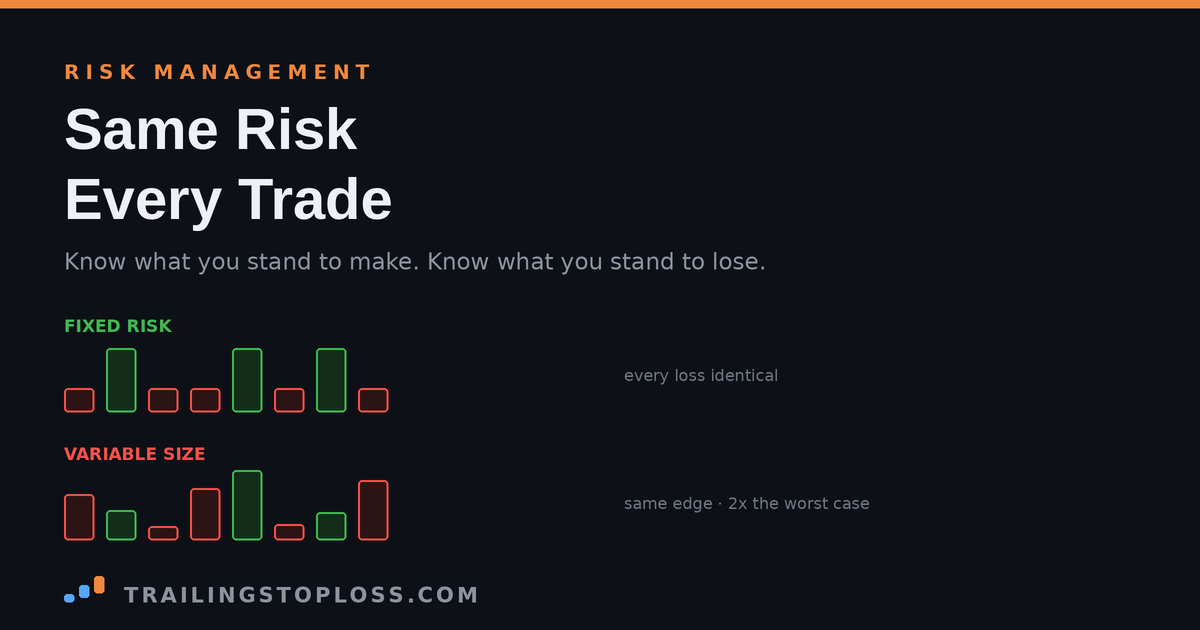
Win or lose, the risk is the same. Not because every setup is equally good — they aren’t — but because I can’t reliably tell in advance which ones are, and neither can you. What I can control is knowing, before I click, exactly what I stand to make and exactly what I stand to lose. A $1,000 loss one day and a $3,000 loss the next isn’t a strategy. It’s a mood.
Most traders arrive at fixed risk for emotional reasons and only later discover the math backs it up. Both halves are worth understanding, because the emotional case is what makes you do it and the mathematical case is what stops you abandoning it the first time a “sure thing” comes along.
The emotional case: a known loss is a survivable loss
Here’s what a variable loss actually does to you. A $1,000 loss on a day you expected to risk $1,000 is a cost of doing business — it lands, you note it, you move on. A $3,000 loss on a day you meant to risk $1,000 is something else entirely: it’s a shock, and shocks demand a response. That’s the moment traders start trading on tilt, widen the next stop, or double up to “get it back.” The oversized loss didn’t just cost three times as much — it manufactured the behavior that costs even more.
Fixed risk removes that entirely. If every loss is the same size, no single loss can surprise you. You’ve already agreed to it, in advance, in a calm state of mind. There’s nothing to react to, because nothing unexpected happened. That’s the whole point: you are pre-deciding your emotional response by pre-deciding the number.
It also makes the arithmetic of your own life legible. If you know your risk is fixed at 1R, you know a five-loss streak costs 5R. You can look at that number today, calmly, and decide whether you can live with it — rather than discovering the answer in the middle of the streak, when your judgement is at its worst.
The math case: variable sizing adds nothing
The usual argument for varying size is that you should “bet more on your best setups.” It sounds obviously correct. It rests on an assumption that almost never survives inspection: that you can identify your best setups in advance. Not in hindsight — in advance, at the moment of entry, reliably enough to be worth the extra risk.
Here’s what happens when you can’t. Twenty thousand simulated 100-trade runs at a 40% win rate and a 3:1 target. One trader risks a fixed amount every time. The other varies between 0.5x and 3x. Critically, both carry the same average risk, so this isn’t a comparison of more leverage against less — it’s the same total risk, distributed differently.
| Approach | Mean result | Spread (stdev) | Bad-run outcome (5th pct) | Worst run |
|---|---|---|---|---|
| Fixed risk | +90.4R | 29.4 | +42.0R | −18.0R |
| Variable size | +89.8R | 34.6 | +34.0R | −36.0R |
Read the first column carefully: the returns are the same. Varying your size didn’t make more money — it made the same money with a wider spread of outcomes. The worst run doubled, from −18R to −36R. The bad-but-not-disastrous case (the 5th percentile) got meaningfully worse. You took on more risk of ruin and received nothing for it.
That’s the honest version of the argument. Variable sizing isn’t evil, and it isn’t automatically less profitable. It’s simply uncompensated variance — extra pain with no extra payoff — unless your ability to pick winners in advance is genuinely better than chance. Most traders have never tested whether theirs is, and confidence is not evidence.
Without fixed risk, you can’t measure anything
This is the argument that convinces systematic traders, and it’s the one people miss. R only means something if R is constant. The moment your risk varies trade to trade, “I’m up 8R this month” stops being a fact about your strategy and becomes a fact about your sizing decisions — which are mood, not method.
Consider what you lose. You can’t compare this month to last month, because the units changed. You can’t tell whether a losing stretch is normal variance or a broken edge, because the losses aren’t comparable to each other. You can’t evaluate a rule change, because the noise from sizing swamps the signal from the change. Your journal becomes a record of outcomes with no attached meaning.
Fixed risk turns your trade history into a clean dataset. Fifty trades at 1R is fifty comparable observations — enough to say something real about your win rate, your expectancy, and which conditions your setup fails in. That’s the difference between trading a system and merely having opinions with money attached.
🧠 The compounding benefitFixed risk is what makes every other rule enforceable. A daily loss limit is meaningless if one trade can be three times another. “Never move your stop” only protects you if the stop distance was sized correctly to begin with. Consistent risk is the foundation the rest of the framework sits on — including one trade a day at 3:1, where the entire expectancy calculation assumes a fixed 1R.
How to find your number
The right risk per trade is the largest amount that doesn’t change how you behave. Practically, three tests:
As a starting point, most risk-management writing lands somewhere around 1–2% of account equity per trade, with more conservative traders going lower. But the percentage matters less than the consistency — a trader risking a steady 0.5% will outlast one who averages 1.5% by swinging between 0.5% and 3%.
Size from the stop, never the reverse
The order of operations is non-negotiable and gets it wrong constantly:
Doing it backwards — picking a contract count first and putting the stop wherever that makes the risk tolerable — is how traders end up with stops in meaningless places. If the resulting size is uncomfortably small, that’s the market telling you this setup requires a wide stop, not an invitation to move it closer.
When changing size is legitimate
Fixed risk doesn’t mean the same dollar amount forever. It means the amount doesn’t change because of how you feel about a particular trade. These adjustments are fine:
The test for every one of these: could you have written the rule down last week? If yes, it’s systematic. If you’re deciding at the moment of entry because this one looks especially good, it’s the thing this article is about.
⚠ The honest counterargumentSome professional traders do vary size, and it can be correct — if you have a tested classification showing that a specific, definable subset of your setups genuinely outperforms, with enough trades to prove it. That’s a real edge, and Kelly-style sizing formalizes it. But note what that requires: hundreds of categorized trades and honest record-keeping. Until you have that evidence, “this one looks better” is a feeling wearing a suit — and the simulation above shows what acting on it costs.
What it looks like in practice
- Write the number down. Dollars or percent, decided away from the screen, before the session. It’s a constant, not a variable.
- Calculate size from the stop every time. No exceptions, no rounding up because it’s “close enough.”
- Place the bracket immediately. Stop and target as resting orders, so the risk you sized for is the risk you actually take.
- Log the R, not just the dollars. R is comparable across months and account sizes; dollars aren’t.
- Review the number monthly, not mid-trade. Adjustments happen between sessions with a clear head, never while a position is open.
- Treat a size breach as a rule break. Log it like any other. If oversized trades cluster around your worst days, you’ll see it in a month — and that’s a far more persuasive argument than anything in this article.
The bottom line
Trading the same risk every time isn’t a lack of conviction. It’s the recognition that your conviction isn’t measurable in advance, while your risk is — so you control the part you can control. You get an emotional benefit (no loss can shock you, because you agreed to it beforehand), a mathematical one (the same expected return with a tighter distribution and a shallower worst case), and an analytical one (a trade history you can actually learn from).
Know what you stand to make. Know what you stand to lose. Decide both before you click, and let the outcome be whatever it’s going to be. That’s not a limitation on the strategy — it is the strategy.
Fixed risk only proves itself in the data. Log the R on every trade and a month of history will tell you whether your sizing is actually consistent.
Open the free P&L Calendar →Related: test your number with the free risk of ruin calculator, then read one trade a day at 3:1, which builds on fixed risk, and moving your stop, the habit that breaks it. The trading psychology guide ties the cluster together.
FAQ
Should I risk the same amount on every trade?
For most traders, yes. Simulations at equal average risk show variable sizing produces essentially the same expected return as fixed sizing while roughly doubling the worst-case outcome. Varying size only helps if you have tested evidence that a specific subset of your setups genuinely outperforms — and most traders have never measured that.
How much should I risk per trade?
The largest amount that doesn’t change your behavior. Common guidance is 1–2% of account equity, with conservative traders going lower, but the specific figure matters less than keeping it constant. Test it three ways: could you sleep after taking that loss, could you survive seven of them in a row, and does the position make you watch the screen more closely than usual? The risk of ruin calculator will show you what a given risk level does to your survival odds.
Why does variable position sizing hurt if the average risk is the same?
Because it adds variance without adding return. In a 20,000-run simulation at a 40% win rate and 3:1 target, fixed and variable sizing produced almost identical mean results, but the variable approach had a worst run of −36R against −18R for fixed. You take on more risk of a deep drawdown and get nothing in exchange.
Doesn’t fixed risk mean I miss out on my best setups?
Only if you can identify your best setups in advance, reliably, at the moment of entry. Hindsight always makes some trades look obvious. Unless you have a categorized sample of several hundred trades demonstrating that a defined subset outperforms, betting more on the ones that feel better is acting on confidence rather than evidence.
Is it ever okay to change my position size?
Yes, when the change is systematic rather than emotional. Risking a fixed percentage means the dollar amount naturally scales with your account. Scheduled step-ups at predefined milestones, reducing size during a drawdown, and trading smaller before a trailing drawdown locks are all defensible. The test is whether you could have written the rule down a week earlier.
How do I calculate position size from my stop?
Place the stop where market structure dictates, measure the distance from your entry to that stop, then divide your fixed risk amount by that distance. The result is your position size. Never work backwards by choosing a size first and placing the stop wherever makes the risk feel acceptable — that produces stops in meaningless locations.
This article is educational and not investment advice. Simulation figures are illustrative modelling of a 40% win rate at a 3:1 reward-to-risk ratio, not projections of real results. Trading carries substantial risk of loss.


