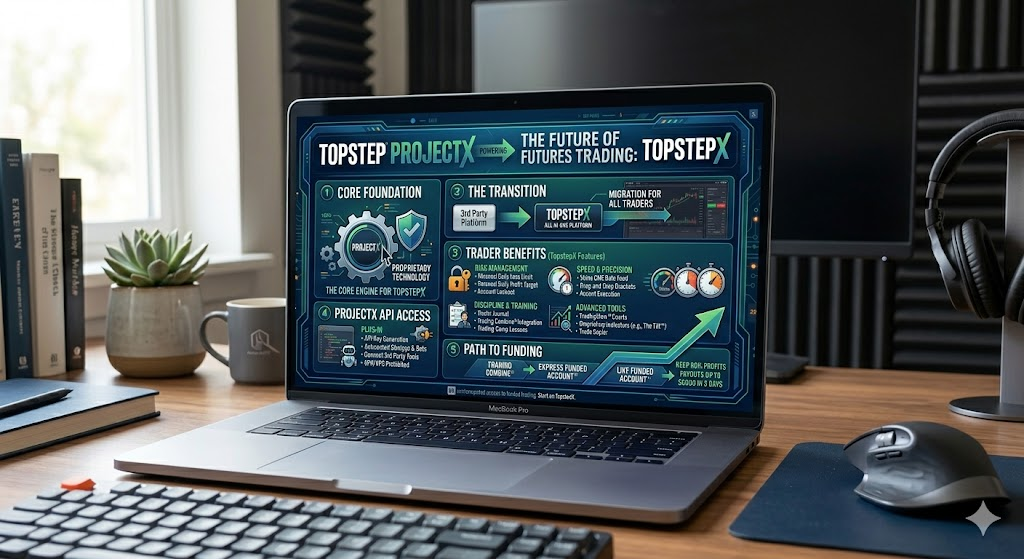
ProjectX was, briefly, the most important piece of software in the futures prop firm industry that almost nobody outside it had heard of. At its 2025 peak, the white-label platform powered the trading dashboards at nearly a dozen prop firms — Bulenox, Tradeify, Lucid Trading, Alpha Futures, Phidias, TradeDay, One Top Futures, Tick Tick Trader, Blue Guardian Futures, and others. By March 2026, it powered exactly one: TopStep. And the traders left on it were watching their accounts get blown up by outages the company itself admitted were not their fault. The story of how the platform went from infrastructure-of-the-future to single-firm liability in under two years is a useful one if you trade futures, run a prop firm account, or just enjoy watching the tech stack of an entire futures trading sector collapse in slow motion.
Origins: From Sims2Funded to "ProjectX"
ProjectX did not start its life as ProjectX. The underlying company, Sims2Funded Solutions LLC, spent its early years building backend technology for futures prop firms — risk engines, trader management dashboards, the unglamorous plumbing that lets a prop firm enforce daily loss limits and trailing drawdowns at scale. The rebrand to ProjectX hit in August 2024, and it came with an unusually specific announcement: six additional prop firms would be launching on the platform within forty-five days, and retail trading access was coming shortly after. This was not a quiet pivot. It was a public declaration that one company intended to become the infrastructure layer for the entire futures prop trading ecosystem, per Prop Firm App's ProjectX review.
The technical pitch was genuinely good. ProjectX combined TradingView-style charting (via an actual TradingView integration, not a hand-rolled imitation), low-latency market data, modern web and mobile interfaces, and a deep set of native risk controls — bracket orders, contract size caps, daily loss limits, trailing drawdown enforcement, and a "Manual Lockout" button traders could hit when they felt themselves tilting. For prop firms, this stack solved two problems at once: it protected firm capital with automated guardrails, and it let traders keep the charting environment they already knew. Historically, prop platforms had asked traders to give up their familiar setups; ProjectX didn't, which removed a major friction point per Damn Prop Firms' platform breakdown.
The Peak: 2025 and the Quiet Empire
By mid-2025, ProjectX was running quietly in the background of an industry. The list of partner firms had grown to include One Top Futures, Trading Lucid, Tradify, Blue Guardian Futures, Tick Tick Trader, Bulenox, Tradeify, Alpha Futures, Phidias, TradeDay, and TopStep itself, with TopStep's deployment branded as TopstepX. For a brief stretch, if you were evaluating a futures prop firm, there was a non-trivial chance you'd be trading on a ProjectX skin no matter which company you picked, according to Finance Magnates' coverage of the prop platform landscape.
The company also kept the lights on with a fairly normal-sounding corporate move: in October 2025, CFD broker Plus500 became TopStep's trading technology provider and, separately, ProjectX's exchange partner. Anyone paying close attention to the org chart could see the financial gravity quietly bending toward one node in the network. Nobody outside the boardrooms was paying that kind of close attention. They were about to start.
November 2025: The Notice Nobody Wanted
In mid-November 2025, ProjectX began scheduling meetings with its partner prop firms. The agenda, as it turned out, was the same in every meeting. Lucid Trading's CEO later posted on Discord that ProjectX had scheduled the call "to announce their intent to discontinue support for all third-party firms" and move exclusively to TopStep. The official notice, posted publicly by One Top Futures, read in part: "After careful consideration, we've made the decision to wind down our ProjectX third-party service offering… shifts in operational demands and upcoming compliance reporting, oversight, and audit requirements have made continuing third-party support no longer sustainable." The cutoff date was February 28, 2026, per Finance Magnates.
The "compliance reporting and audit requirements" framing was the kind of language that does a lot of work in a small space. Everyone in the industry understood what it actually meant: ProjectX and TopStep had a relationship that neither company would publicly confirm, and they had decided the relationship would now be exclusive. The remaining nine or so partner firms had roughly fourteen weeks to migrate every funded trader off their ProjectX skins onto a different platform — typically Tradovate Prop or a Rithmic-based stack — or watch those accounts go dark. Ben from Alpha Futures, who had been publicly critical of ProjectX before, summed up the mood across the affected firms in language that doesn't translate well to a family-friendly recap, per PropTraders' newsletter.
December 2025: The Platform Falls Apart
Having just consolidated their fate around a single platform, TopStep proceeded to live through the worst quarter of platform stability in the company's fourteen-year history. Between October and December 2025, TopstepX experienced eleven confirmed outages — confirmed not by hostile reviewers but by TopStep itself. Traders were locked out of funded accounts during active CME trading hours. Stop-loss and take-profit orders failed to execute. Market data feeds dropped. The dashboard desynchronized from the backend, showing one balance while the firm's risk engine saw another. Multiple funded accounts were liquidated because traders physically could not exit losing positions, according to Phidias's comparative breakdown.
The credibility damage was measurable. TopStep's Trustpilot rating dropped to 3.6, with 16 percent of all reviews coming in at one star, and the company replied to only 4 percent of negative reviews — averaging a two-week response time when it did. Better Business Bureau complaints tripled, with 75 of the firm's 101 lifetime complaints filed in the preceding twelve months. On December 23, 2025, TopStep posted on Discord: "Right now, we are not delivering the Ultimate Trading Experience we promised." CEO Michael Patak followed up on X promising that "in January we will be making things right." This is the part of the story where you should pause to consider that trading psychology exists for a reason and that watching your funded account die during an outage you had no control over is, statistically speaking, bad for it, per Finance Magnates' outage coverage.
TopStep's compensation policy for traders whose accounts were closed during confirmed outages was straightforward and not especially generous: evaluation resets only. No funded account reinstatements. No refund of the activation fee. No retroactive profit recovery. A "remediation window" was implemented around each acknowledged outage during which negative trades would be removed, but traders whose blow-ups fell outside the window — or who simply felt the window was drawn too narrowly — were left holding the bag, per PropTradingVibes' Trustpilot review analysis.

February 2026: The Exclusivity Hits
On February 28, 2026, the third-party licensing officially ended. Every prop firm except TopStep lost access to ProjectX overnight. Traders at Bulenox, Tradeify, Lucid Trading, Alpha Futures, Phidias, TradeDay, and the rest had spent the prior three months migrating to alternatives — mostly Tradovate Prop or Rithmic-based platforms like TradeSea. The transition was messy but, importantly, it gave most of those firms something TopStep had voluntarily given up: optionality. If Tradovate has an outage, a multi-firm trader can be on another firm's Rithmic stack the next morning. If TopstepX has an outage, TopStep traders can do exactly nothing, according to Damn Prop Firms' 2026 platform comparison.
Then on April 1, 2026 — and no, the date is not a joke, though traders made the obvious jokes anyway — TopStep acquired The Futures Desk, the last remaining ProjectX partner firm that had quietly held on. TFD's branded platform, TFD-X, was folded into TopstepX. The consolidation was complete. ProjectX as a third-party technology business no longer existed in any meaningful sense; it existed only as TopstepX, the in-house platform of a single prop firm, per Damn Prop Firms' ProjectX guide.
The Damage, in a Table
| Phase | Date | What Happened |
|---|---|---|
| Origin | Pre-Aug 2024 | Operated as Sims2Funded Solutions LLC, backend tech for prop firms |
| Rebrand | August 2024 | Relaunched as ProjectX; announced six new partner firms within 45 days |
| Peak | Mid-to-late 2025 | Powered ~10–12 prop firm platforms across the futures industry |
| Plus500 deal | October 2025 | Plus500 becomes TopStep's tech provider and ProjectX's exchange partner |
| Outages begin | Oct–Dec 2025 | 11 confirmed TopstepX outages; funded accounts blown during downtime |
| Exclusivity notice | Nov 15, 2025 | ProjectX notifies all third-party firms of February 28 cutoff |
| Trustpilot collapse | Dec 2025 | TopStep's rating drops to 3.6; BBB complaints triple year-over-year |
| Third-party cutoff | Feb 28, 2026 | All non-TopStep firms lose ProjectX access; mass migration to Tradovate |
| Final consolidation | April 1, 2026 | TopStep acquires The Futures Desk; TFD-X folded into TopstepX |
So What Actually Killed ProjectX?
There is a tempting clean narrative here — ProjectX got greedy, went exclusive, broke under the load, and dragged TopStep's reputation down with it. The actual story is messier and probably more interesting. ProjectX did not fail technically before the exclusivity move; the eleven-outage stretch happened after the third-party cutoff was announced and as Plus500 was being integrated as a new technology and exchange partner. There is a reasonable read of the timeline in which the outages were caused by exactly the kind of infrastructure consolidation the exclusivity deal made possible — fewer partners, more concentrated load on a re-platformed stack, a fresh deployment of new components, and a smaller pool of engineering attention spread across all of them.
The strategic question is whether the exclusivity itself was a mistake. ProjectX traded a diverse revenue base — licensing fees from a dozen prop firms — for a single relationship with TopStep. TopStep traded platform choice for vertical integration. Both bets only pay off if TopstepX runs cleanly enough that traders don't leave, and the December 2025 outage cluster suggests the platform may not have been ready to be anyone's only option, let alone the only option for an entire prop firm's customer base. The day trading community is, charitably, not known for patient forgiveness on platform reliability.
What This Means If You're Trading Futures Right Now
The post-shakeup landscape is simpler than the buildup, which is a kind of mercy. Three platform ecosystems now dominate futures prop trading. Tradovate Prop has become the default multi-firm platform, connecting Apex, Tradeify, TPT, Lucid, FundedNext, TradeDay, Alpha Futures, and others through a single cloud workspace. Rithmic-based stacks — including the newer web-based TradeSea — serve advanced scalpers, algo traders, and anyone who values low-latency execution above all else. And TopstepX exists for TopStep traders, full stop. You cannot trade TopstepX with any other firm in 2026. You cannot trade TopStep on any other platform. It is, in the most literal sense, a closed loop.
For new futures traders evaluating firms in 2026, the lesson worth taking away from the ProjectX story is not "avoid TopStep" — TopStep is a well-funded, fourteen-year-old company with the best coaching ecosystem in the industry and an actual brokerage product. The lesson is that platform risk is a real category of prop firm risk that nobody talked about until 2025, and the firms that survived the ProjectX transition without losing accounts to outages were the ones with platform optionality. Pick a firm whose platform you can leave if it breaks. Or pick TopStep with full awareness that you have no fallback, and size your futures positions accordingly.
Frequently Asked Questions
Is ProjectX still available outside of TopStep?
No. As of February 28, 2026, ProjectX terminated all third-party licensing. On April 1, 2026, TopStep acquired The Futures Desk, the last remaining third-party partner. ProjectX technology now exists exclusively as TopstepX, the in-house trading platform for TopStep evaluations, funded accounts, and the Topstep Brokerage live trading product.
What's the actual difference between ProjectX and TopstepX?
TopstepX is a rebranded deployment of ProjectX. The underlying platform technology — TradingView charting integration, risk controls, order routing, mobile access — is the same engine that previously ran under Bulenox ProjectX, AlphaTicks, TradeDayX, and other partner-firm skins. Neither TopStep nor ProjectX has publicly confirmed the corporate relationship between the two companies, but the platform identity is openly shared.
Did traders get compensated for the December 2025 TopstepX outages?
Partially. TopStep implemented a remediation policy that removed negative trades within a defined time window around each acknowledged outage. For traders inside the window, the response was generally considered adequate. For traders outside it, the official policy was evaluation resets only — no funded account reinstatements, no refund of activation fees, and no retroactive profit recovery. The narrowness of the remediation windows is a primary complaint in the Trustpilot and BBB filings from Q4 2025.
What prop firms moved off ProjectX, and where did they go?
Bulenox, Tradeify, Lucid Trading, Alpha Futures, Phidias, TradeDay, One Top Futures, Tick Tick Trader, Blue Guardian Futures, and others lost ProjectX access in February 2026. Most migrated to Tradovate Prop, the multi-firm cloud platform, or to Rithmic-based stacks including the newer web-based TradeSea. The Futures Desk held on as the last third-party partner until TopStep acquired the company on April 1, 2026.
Who actually owns ProjectX?
The legal entity behind ProjectX is Sims2Funded Solutions LLC, which rebranded as ProjectX in August 2024. A separate company also called "ProjectX" was launched in late 2025 by DayTraders.com using TradingView technology — this is a different product and created some confusion in the trading community. The ProjectX discussed throughout this article refers to the Sims2Funded entity that powered the futures prop firm industry and now operates exclusively with TopStep.
Is TopStep still safe to trade with after all this?
TopStep remains a fourteen-year-old, well-capitalized prop firm with strong coaching, a brokerage product, and the deepest funded trader community in the industry. The platform-stability and platform-choice issues raised by the ProjectX consolidation are real and worth weighing, particularly if your strategy depends on uninterrupted execution during volatile sessions. The honest framing: TopStep is still the safest choice in the prop firm industry, but it's no longer the best value or the most flexible.