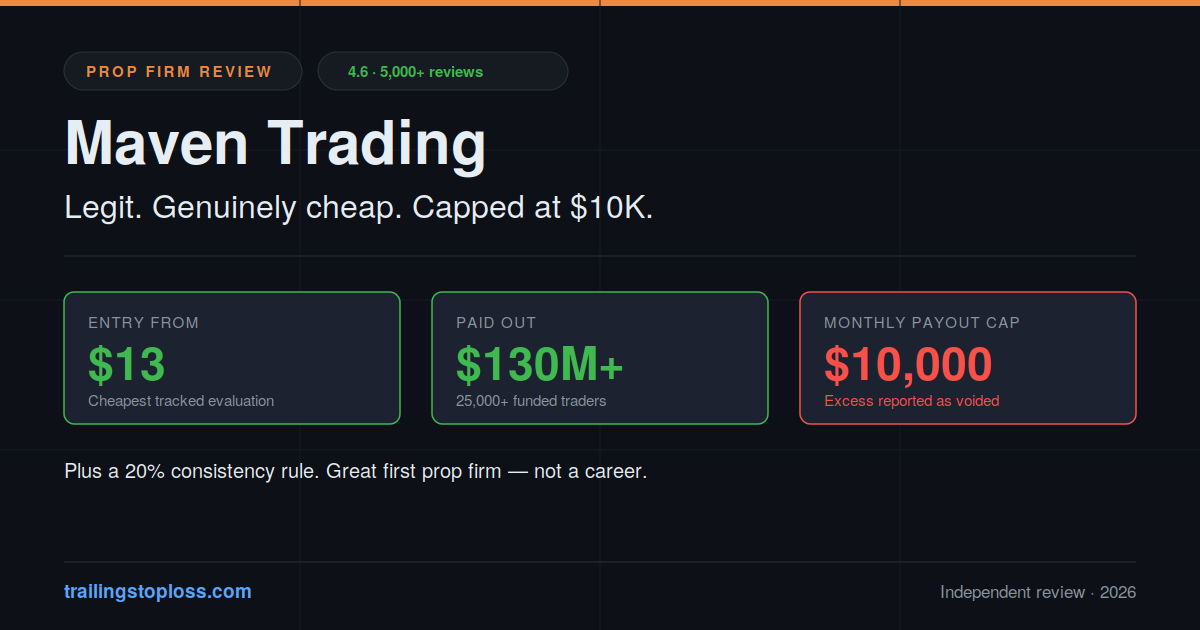
Maven Trading Review (2026): Legit, Genuinely Cheap, and Capped at $10K
Prop Firm ReviewLet’s start where most reviews bury the lede: Maven Trading is legit. It’s been operating since 2022, it’s registered in the UK with a published company number, it holds a Trustpilot rating in the 4.3–4.6 range across roughly 5,000 reviews, and it has published more than $130 million in distributed payouts to 25,000-plus funded traders. It is not a scam, and nothing in this review suggests otherwise. What it is — and what almost nobody puts in the headline — is a firm with a hard ceiling bolted onto your upside. You can start a challenge for about thirteen dollars. You just can’t withdraw more than $10,000 in a month, and the overflow doesn’t wait around for you. Prop Trading Vibes
What Maven actually is
Maven Trading is a budget-tier forex and CFD prop firm built around accessibility. It offers an unusually wide spread of evaluation models — 1-Step, 2-Step, 3-Step, Instant Funding, and Mini accounts — across MT5, Match Trader, cTrader, and TradeLocker. The pricing is the headline feature and it isn’t marketing fluff: a $2K 3-Step account runs around $13, which independent trackers rate as the cheapest published evaluation across 60-plus firms. The full matrix scales to roughly $440 for a $100K 2-Step, with cTrader pricing running noticeably higher line for line. For a trader who wants to test a funded workflow without lighting $500 on fire, that entry point is legitimately hard to beat. Prop Trading Vibes
Trust signals that most cheap firms can’t produce
Cheap prop firms are usually cheap because they’re new, anonymous, or planning a short career. Maven isn’t any of those. It has a four-year operating history in an industry where most firms don’t survive eighteen months, it discloses its company identity, registration, and jurisdiction rather than hiding behind a Discord handle, and its payout record is published rather than implied. Reviewers who trade their own money there report payouts processing reliably for traders who follow the rules, via crypto, bank transfer, or Rise. It also runs a coaching community and supports TradeLocker, which is a real point of difference at this price. Those are the boxes an honest review has to tick before it starts complaining. Responsible Trading
Now the caveats — and they matter more than the price
The $10,000 monthly payout cap, and what happens to the rest
Maven caps payouts at $10,000 per rolling 30-day cycle, per funded account. On its own that’s just a limit. The part that deserves your full attention is what reviewers report happens to profit above the line: it’s voided rather than carried forward. Read that again, because it inverts the entire logic of a funded account. Catch the move of the quarter, bank $28,000 in a month, and the $18,000 above the ceiling doesn’t queue up for next cycle — by these accounts, it evaporates. You are, in effect, being paid a salary with a really elaborate qualification process. If your plan involves ever having a genuinely great month, this single rule disqualifies Maven before any other consideration. Prop Trading Vibes
A 20% consistency rule punishes being right all at once
Maven enforces a 20% consistency rule: no single trade can account for more than 20% of your total profit. In practice that means your P&L has to arrive in tidy, evenly-distributed slices. Nail one clean fundamental move — the kind of trade most of us actually wait all month for — and you can find yourself penalized for the crime of being correct in a concentrated way. It’s a legitimate risk-management tool from the firm’s perspective, and it’s disclosed rather than hidden. But it fundamentally shapes what kind of trader can succeed here: you need consistent small-to-medium wins, not one great read. Combined with the payout cap, Maven is quietly describing the only trader it wants. Blueberry Funded
The withdrawal gate is operational, not just a dollar figure
There’s no flat minimum withdrawal amount, which sounds friendly until you read the actual conditions. To request a payout you need at least three trading days each closing 0.5% in profit, the funded account must be in profit, and you must have no active trades open at the time of the request. None of that is unreasonable on its own, but it means the payout path depends on your recent behavior and your position state, not simply on having earned money. Traders who scale into swing positions or run continuous exposure need to plan a flat window around every withdrawal request. Read the payout mechanics before you buy, not after you’re up. Directions Magazine
Wider spreads, and a mandatory interview once you start winning
Maven’s affordability shows up in execution quality: reviewers consistently note wider spreads than premium competitors, with recurring community complaints about spread widening around news events. On a tight daily drawdown, spread is not a rounding error — it’s a structural headwind eating your buffer on every entry. Separately, once a trader passes roughly $5,000 in lifetime payouts, Maven reportedly requires a mandatory risk interview with an analyst before releasing further funds. That’s a defensible compliance measure and plenty of firms do something similar. It’s also one more human checkpoint standing between you and money you’ve already earned, and you should know it’s coming. TheTrustedProp
Aggressive compliance automation — with a source-quality asterisk
You’ll find claims that Maven’s automated systems flag or terminate accounts for “copy trading” when traders simply connect from a different location or use a VPS, alongside complaints about internal policies shifting without advance notice. We’re flagging these because they’re worth asking Maven about directly — but we’re also going to be straight with you about where the loudest version comes from: a comparison page published by Blueberry Funded, a competing prop firm, which concludes that Blueberry conveniently has no consistency rule. That doesn’t make the claims false, and strict IP and VPS compliance is genuinely common industry-wide. It does mean you should treat competitor-sourced allegations as marketing until an independent trader corroborates them. Applying that standard to every review you read — including this one — is the actual skill. Blueberry Funded
Registered is not regulated
One last piece of context that applies to Maven and to almost every firm in this industry. Maven publishes a UK company registration and a company number, which is genuinely better than the anonymous outfits — but company registration is not financial regulation. A registered company is simply a company that filed paperwork; it carries no capital requirements, no client-money segregation, and no regulatory backstop if things go wrong. Your funded account is simulated, and your payout is a contractual promise from a private business, not a protected client balance. That’s the standard structure across retail prop trading, and it’s exactly why we built the Prop Firm True Cost hub and the forex prop firm cost breakdown. Directions Magazine
| Factor | Verdict | Detail |
|---|---|---|
| Legitimacy | Strong | Since 2022, UK-registered, $130M+ published payouts, 25,000+ funded traders |
| Trustpilot | Strong | 4.3–4.6 across roughly 5,000 reviews |
| Entry price | Best in class | From ~$13; cheapest published evaluation across 60+ tracked firms |
| Payout ceiling | Severe limit | $10,000 per rolling 30 days; excess reported as voided, not carried |
| Consistency rule | Restrictive | 20% — no single trade may exceed a fifth of total profit |
| Withdrawal conditions | Operational | 3 days at 0.5% closed profit, account in profit, no open trades |
| Execution quality | Budget-tier | Wider spreads; complaints of widening around news |
| Compliance friction | Notable | Risk interview after ~$5,000 lifetime payouts; strict IP/VPS checks |
| Regulation | Registered only | Company registration ≠ financial regulation; accounts are simulated |
The bottom line
Maven Trading is a legitimate firm that pays, and at thirteen dollars it’s the cheapest honest on-ramp to funded trading we’ve tracked. Buy it for what it is: a low-cost training environment where you can learn to operate inside a real rulebook without risking a meaningful fee. Do not buy it as a career. The $10,000 monthly ceiling with voided overflow, the 20% consistency rule, the wider spreads, and the compliance checkpoints together define a firm optimized for steady, modest, well-behaved performance — which is a real product with real value, just not the one the “up to $2 million in funding” corner of this industry advertises. If you’re a scalper, an EA user, or a trader whose edge produces occasional enormous months, you will fight this rulebook the entire way. Everyone else: start small, read the payout mechanics before you buy, withdraw early and often, and price your alternatives with our prop firm comparison tool.
Frequently asked questions
Is Maven Trading legit or a scam?
Maven Trading is legit. It has operated since 2022, is registered in the UK with a published company number, holds a Trustpilot rating around 4.3–4.6 from roughly 5,000 reviews, and has published over $130 million in distributed payouts to 25,000-plus funded traders. Independent reviewers report payouts processing reliably for traders who follow its rules.
What is Maven Trading’s payout cap?
Maven caps payouts at $10,000 per rolling 30-day cycle per funded account. Reviewers report that profit earned above that ceiling is voided rather than carried into the next cycle, which makes the cap the single most important rule to understand before buying — particularly for traders capable of large individual months.
What is Maven Trading’s consistency rule?
Maven enforces a 20% consistency rule, meaning no single trade may account for more than 20% of your total profit. It rewards evenly distributed small-to-medium wins and penalizes concentrated gains from a single large move, which shapes which trading styles can realistically succeed there.
How do you withdraw from Maven Trading?
Payout options include crypto, direct bank transfer, and Rise. Rather than a flat dollar minimum, the requirements are operational: at least three trading days with 0.5% closed profit each, the funded account in profit, and no active trades open when you submit the request.
Who should avoid Maven Trading?
Scalpers, EA and bot users, and any trader realistically targeting more than $10,000 per month in payouts. The payout cap, 20% consistency rule, wider spreads, and strict IP and VPS compliance checks make it a poor fit for those profiles. It suits beginners and disciplined, consistent traders on a tight budget.
Sources: Prop Trading Vibes, Responsible Trading, TheTrustedProp, and Directions Magazine independent reviews; Blueberry Funded comparison content (a competing prop firm — noted in text); Maven Trading’s published documentation and payout figures. Rules change frequently; verify current terms directly with the firm.


