▸ Trading Psychology
Trading on Tilt
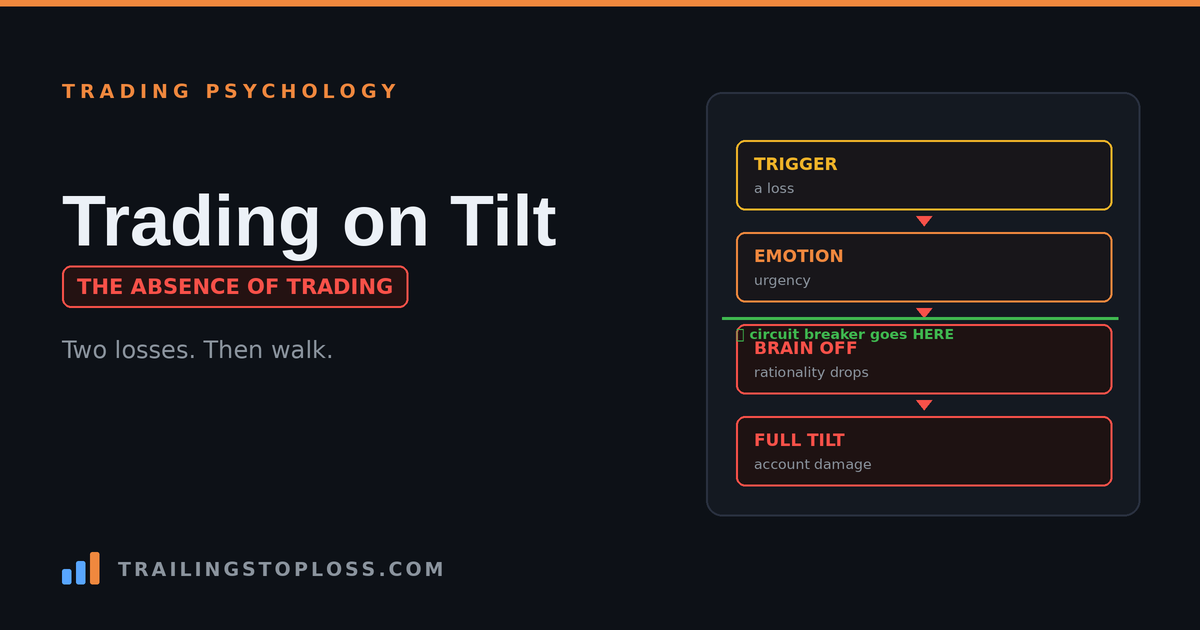
Poker gave us the word, and it’s the most useful one in trading. Tilt is the state where your emotions take the wheel and your rational brain checks out — and here’s the definition that should stick with you: tilt isn’t bad trading. It’s the absence of trading. You’re not executing a strategy anymore. You’re reacting to price based on how you feel. Every other article in this guide describes a specific leak; tilt is the state where all of them open at once, and it can erase weeks of gains in a single afternoon.
What’s actually happening in your head
This isn’t a metaphor or a character flaw — it’s neurology. When you tilt, your amygdala (the brain’s threat-detection center) effectively hijacks your prefrontal cortex (the part that handles rational analysis and impulse control). You shift into fight-or-flight: fantastic for escaping a predator, catastrophic for evaluating a risk-reward ratio. In that state your perception of probability distorts — losses feel inevitable, recovery feels urgent, and normal risk assessment simply stops functioning. (TradesViz: the amygdala hijack)
Which explains the thing that frustrates every experienced trader: knowing about tilt doesn’t prevent it. The mechanism operates below conscious thought, so intellectual awareness is useless in the moment. What actually works is having systems and rules that activate before tilt reaches its peak — because once you’re in it, the part of your brain you’d use to talk yourself down is the part that’s been suppressed. (TradesViz: why knowing isn’t enough)
Tilt isn’t one thing — it’s four
Most tilt advice is “calm down and take a break,” which is like treating a headache, a fever, and a broken leg with the same pill. Tilt has distinct types, each with its own trigger and its own defense. This framework traces to Jared Tendler, the therapist who wrote The Mental Game of Poker and then brought the methodology to trading — his core insight being that emotions aren’t enemies to suppress, they’re diagnostic signals pointing at specific flaws. (Upscale: Tendler’s tilt framework)
| Type | Trigger | How it shows up | The specific defense |
|---|---|---|---|
| Loss tilt | A loss, or a run of them | More trades after losses, bigger size, entries without a setup, abandoning stops. This is revenge trading. | Mandatory 15-minute break after 2 consecutive losses. Hard daily loss cap — when it hits, you’re done. No exceptions. |
| Win tilt | A hot streak | Size creep, looser criteria, “everything I touch works.” This is the confidence trap. | Position-size cap that never moves regardless of how well the day is going. Forced checklist before every post-win trade. |
| Injustice tilt | Getting wicked out at the exact low, right before the move | Re-entering to “prove” the analysis was right. Feels personal — even though it’s just statistics. | One entry per instrument per session. Stopped on NQ? You don’t re-enter NQ today. This kills the re-entry spiral outright. |
| Entitlement tilt | A flat or red day you feel you don’t “deserve” | Extending the session, forcing trades late, chasing a green close because you “put in the work.” | Hard stop time. When your planned trading hours end, the session ends — green, red, or flat. |
Notice that three of the four map directly onto articles you’ve already read here. That’s the point of this piece: tilt is the state, and revenge trading, the confidence trap, and the re-entry spiral are its symptoms. Fix the state and several leaks close at once. (TradeZella: the four tilt types and their defenses)
The 30-second check
The most reliable real-time test is a single question, and it takes half a minute. Can I articulate why I’m taking this trade, beyond an emotional reason? If the honest answer sounds like “I need to make it back,” “I’m on fire right now,” or “that should have worked” — that’s tilt. Not a hunch, not intuition. Tilt. (TradeZella: the 30-second check)
Your body will usually tell you before your mind admits it. The physical tells are consistent and worth learning: racing heartbeat, clenched jaw, leaning in toward the screen, clicking faster than usual, shallow breathing. Those are not incidental — they’re the physiological stage of the cascade, and they arrive before the worst decisions do. Learn to treat them as an alarm rather than as background noise. (TradeZella: the physical signals)
⚠ Even your winners are compromisedHere’s the counterintuitive part traders miss: a winning trade taken on tilt is still a bad trade, because the process that produced it was broken. You got paid for a decision you shouldn’t have made, which teaches your brain to make it again. Tilt sessions that end green are the most dangerous of all — they reward the exact behavior that will eventually take the account.
Why it’s disproportionately expensive
Tilt is not a slow leak; it’s a rupture. Unlike the biases that chip away at your performance gradually, tilt can wipe out weeks or months of gains in a single session — and for a lot of traders, the majority of their annual losses come from just a handful of tilt sessions. Which means fixing tilt can transform your results without changing a single thing about your strategy. (TradesViz: most annual losses come from a few sessions)
The prop data backs it up. In a PipFarm survey of 2,777 prop traders, 37.5% named emotional trading after losses as their primary problem, and 73% of failed accounts had violated their own stop-losses in more than 30% of cases. Those aren’t strategy failures. They’re tilt failures, at scale, in exactly the environment where a daily loss limit turns a bad hour into a dead account. (Upscale: PipFarm survey of 2,777 prop traders)
The things that make you tiltable before you even sit down
Tilt has a fuel tank, and most people arrive at the open with it half-empty. Poor sleep, hunger, excess caffeine, and life stress (relationships, money, health) all lower your emotional baseline and drastically raise your tilt risk. The research is blunt on sleep in particular: sleep deprivation impairs judgment in ways comparable to alcohol intoxication — a trader running on four hours is making decisions with the cognitive equivalent of being mildly drunk. (TradesViz: sleep deprivation and judgment)
The protocol: circuit breakers and recovery
You cannot out-think tilt in the moment — the thinking apparatus is the thing that’s compromised. So the whole game is pre-commitment: rules that fire automatically, before your judgment is needed. (JournalPlus: you can’t trade through tilt, only stop)
- Two losses, then walk — 15 minutes minimum. Not “if I feel bad.” Two consecutive losses, automatic break, no negotiation. This is your circuit breaker and it must sit upstream of the cascade, not at the end of it.
- Set a personal daily loss cap well inside the firm’s. If the firm’s limit is $1,000, yours is $500. When it hits, the session is over — win, lose, or draw. Your cap must be the thing that stops you, never theirs.
- One entry per instrument per session. The single most effective rule against injustice tilt. Stopped on NQ? NQ is closed for you today. It ends the re-entry spiral before it starts.
- When you catch it: close everything and physically leave. Not “trade smaller.” Close open positions, shut the platform, and move your body — a walk, stairs, anything physical. You’re trying to metabolize adrenaline, not reason with it. Thirty minutes minimum; often the day is done.
- Come back at minimum size, or not at all. If you do return, drop to the smallest size you trade — one micro. The goal is no longer profit; it’s clean execution. Take only A+ setups. Rebuild the process before you rebuild the P&L.
- Audit it after the session. Tag every trade for tilt type, total the dollar cost, and write down: what happened (facts only), what you felt, what you thought, what you should have done, and the one rule you’ll use next time. After 30 days you’ll have a map of your own triggers — the data that makes tilt predictable instead of mysterious.
🧠 The reframe that prevents itAnnie Duke’s insight from poker: tilt grows from the illusion that we control outcomes. When you genuinely accept that a good decision can lose and a bad decision can win, losses stop being personal — and the fuel for tilt disappears. Judge yourself on decision quality, not on P&L. A single trade is noise. Your identity is the process, not the result of the last thing that happened to you.
The bottom line
Tilt is the state where every other mistake in this guide becomes available at once: you widen the stop, size up, chase the re-entry, and abandon the plan — not because you forgot it, but because the part of your brain that holds the plan has temporarily gone offline. You can’t fix it with willpower or awareness in the moment; you fix it with circuit breakers you set when you were calm. Two losses and walk. A personal cap inside the firm’s. One entry per instrument. And when your jaw clenches and your hand moves faster than your reasoning — that’s the alarm. The session is over. Nothing you do in the next hour will be trading anyway. (TradesViz: tilt is the absence of trading)
Build the circuit breakers: pre-commit your caps with the Hard-Stop Plan Builder, track discipline streaks on the Hold Tracker, and log emotional state alongside every trade on the P&L Calendar. This is the capstone of our trading psychology guide — start at the pillar to find your specific leak.
FAQ
What does “trading on tilt” mean?
Borrowed from poker, tilt is a state of emotional destabilization where frustration, anger, or desperation takes over your decisions and you systematically violate your own rules. The sharpest definition: tilt isn’t bad trading, it’s the absence of trading — you’re no longer executing a strategy, you’re reacting to price based on how you feel.
What are the signs I’m on tilt?
The 30-second check: can you articulate why you’re taking this trade beyond an emotional reason? If the honest answer is “I need to make it back,” “I’m on fire,” or “that should have worked,” that’s tilt. Physical tells usually arrive first — racing heartbeat, clenched jaw, leaning toward the screen, clicking faster, shallow breathing.
Why can’t I just trade through tilt?
Because your amygdala has effectively hijacked your prefrontal cortex — the part responsible for rational analysis and impulse control. You’re in fight-or-flight, and your perception of probability is distorted. The apparatus you’d use to think your way out is the apparatus that’s compromised, which is why intellectual awareness doesn’t prevent tilt. Only pre-set rules that fire automatically do.
How long should I step away when I’m tilting?
Close all positions and walk away for at least 30 minutes — often the day is done. Do something physical to metabolize the adrenaline. Returning after 10 minutes is a common mistake. If you do come back, drop to minimum size (one micro) and take only A+ setups; the goal is clean execution, not recovering the loss.
Do experienced traders still tilt?
Yes. Experience reduces the frequency but doesn’t eliminate it — professional poker players who’ve played millions of hands still keep tilt protocols, and professional traders still keep daily loss limits and cooling-off rules. The difference is that experienced traders recognize tilt faster, have defenses already in place, and measure the cost with data. They don’t assume they’re immune.
TrailingStopLoss publishes independent, funded-trader analysis of prop firms, strategy, and trading psychology. Educational content only — not financial advice. Trading futures involves substantial risk of loss. Tilt is a normal reaction to loss; if trading is affecting your wellbeing beyond the screen, that’s worth taking seriously and talking to someone about.


