When to Take a Break From Trading — and What the Break Actually Has to Contain
Most traders step away for the wrong reason and push through the right one. The difference isn’t how bad it feels; it’s whether the losses are outside what your own system produces on an ordinary year. That’s a number, and you can check it.
A break that’s just time away changes nothing. If you come back to the same process with the same size, you’ve rested — you haven’t fixed anything.
First: is this actually a problem?
Take a genuinely profitable system — a 35% win rate on a 3:1 setup, which needs only 25% to break even and returns +0.40R per trade. Simulate twenty thousand years of it, 250 trades each, and look at what an ordinary year contains.
| What you experience | How often a working system does this |
|---|---|
| 3 losses in a row | 27.5% of runs |
| 5 losses in a row | 11.6% |
| 7 losses in a row | 4.9% |
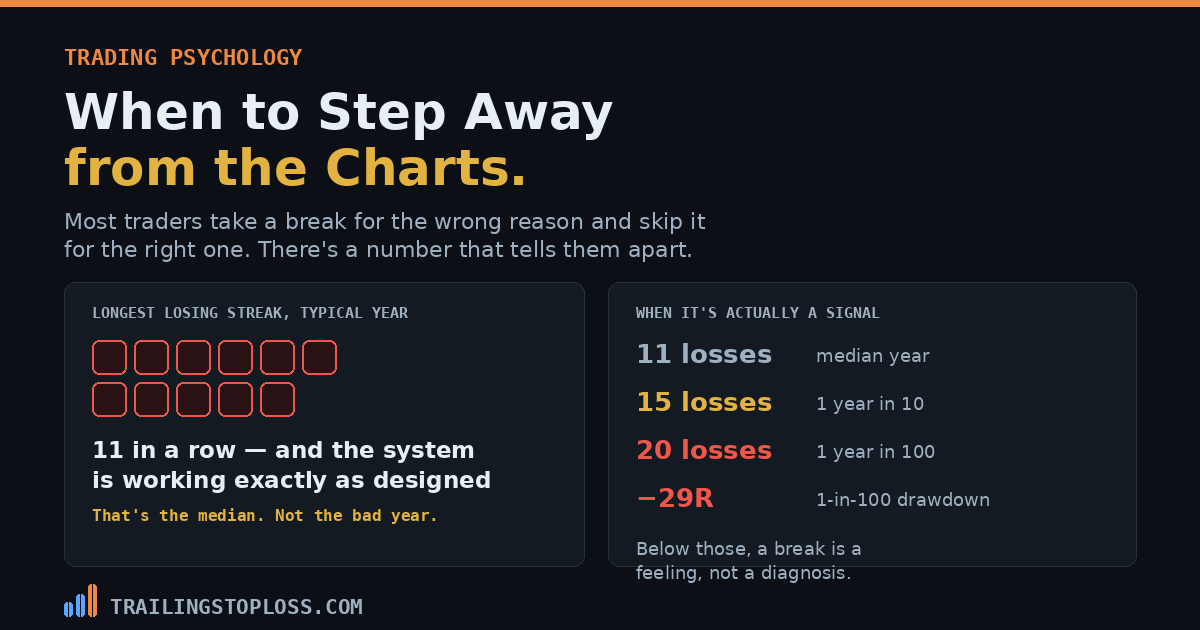
| 11-trade losing streak somewhere in the year | the median year |
| 15-trade streak | 1 year in 10 |
| 20-trade streak | 1 year in 100 |
| Worst drawdown of −13R | the median year |
| Worst drawdown of −20R | 1 year in 10 |
| Worst drawdown of −29R | 1 year in 100 |
An eleven-trade losing streak is what a median profitable year looks like. Not the disaster year — the typical one. Most traders have quit, switched strategy or “taken a break to reset” long before eleven, which means they’re reacting to the normal operation of a system that works.
Before deciding you need time away, check where your streak and drawdown sit against your own system’s numbers. Inside the median, there’s nothing to diagnose — you’re experiencing the cost of doing business. Past the 1-in-100 line, something plausibly changed and time away is warranted. Between them is judgment, and the honest answer is usually “I don’t know yet”.
Four different breaks, four different causes
“Taking a break” gets used for four situations that need completely different responses. Conflating them is why breaks so often fail to help.
The tilt break — hours
Short, immediate, and the only one with a physiological basis. When arousal is driving your decisions rather than your plan, the fix is to flatten, write down what happened, and leave the desk for at least fifteen minutes. That’s covered in full in how to get off tilt — the key point here is that it’s measured in hours, not weeks, and stopping for a month is an overreaction to a problem that resolves the same day.
The variance break — none needed
This is the one people take unnecessarily. If your streak is inside the median and you’re following your rules, stepping away doesn’t fix anything, because nothing is broken. What it does do is interrupt the sample you need — and demonstrating an edge takes around 600 trades, so every unnecessary pause pushes that further out.
If a losing run has made your size uncomfortable, the better move is reducing size rather than stopping. That keeps the sample accumulating while lowering the emotional load, which is exactly what the micro ladder is for.
The process break — weeks, with work in it
Warranted when the numbers are genuinely outside expectation, or — more commonly — when the problem isn’t the results at all but your execution. Repeatedly widening stops, sizing above your written number, taking setups that weren’t in the plan: those don’t need a statistical test. They’re a process failure and time away is appropriate, provided the time contains something.
The capital break — forced
A blown account takes the decision out of your hands. What’s left is what you do with the gap, and the honest answer is that most people do nothing but wait until they can afford another evaluation. That’s the worst possible use of it.
The thing nobody says about breaks
Time away, by itself, doesn’t improve anything. The evidence on this is unusually direct: the Brazilian study following nearly twenty thousand day traders through their regulator’s records found no evidence of learning by day trading — persistence alone did not produce improvement across the sample. If simply doing it more doesn’t teach you, then simply doing it less won’t either. (Chague, De-Losso & Giovannetti)
Which means a break is only worth taking if it contains a specific piece of work. Three that actually pay:
- Run the numbers on your existing trades. Not a review of individual losses — those are contaminated by knowing the outcome, as your journal is lying to you covers. Run distributions instead: what’s your actual win rate, average win against average loss, longest streak, worst drawdown? That tells you whether the last month was unusual or ordinary, which is the question the whole break rests on.
- Write the plan you clearly didn’t have. If you can’t state your setup precisely enough that someone else could apply it, that’s the work. A plan you can’t write down is a plan you can’t follow or test.
- Fix one thing, not everything. The failure mode after a bad stretch is rebuilding the whole approach, which resets your sample to zero and guarantees another year of not knowing whether anything works. One change, then enough trades to evaluate it.
Paper trading: useful for exactly one thing
Simulated trading is the standard advice during a break, and it’s genuinely good for mechanics — platform handling, order types, whether your setup even appears often enough to be tradeable. Use it for that without hesitation.
But be clear about its limit. A demo account doesn’t reproduce the cognitive state that causes most of the damage. The research on financial pressure shows that scarcity measurably degrades attention and cognitive control — the faculties you’d use to hold a stop — and a simulator generates none of that pressure. So a clean month on demo tells you your setup is executable. It tells you very little about whether you’ll execute it with money that matters. See why you trade worst when you most need the money.
The most expensive moment isn’t the break — it’s the first week back. Coming back at normal size after a drawdown means trading to recover, which is the break-even state where risk-seeking reliably increases. Come back smaller than you left. If you were trading three micros, return on one. The point of the first twenty trades back is to confirm you can follow the plan, not to make the money back.
The prop firm problem
Worth naming plainly, because it’s a real conflict rather than a psychological one. Breaks are expensive under most evaluation products. Monthly plans keep charging while you’re away. Evaluations with expiry windows — Apex’s currently run 30 days from purchase, with no resets on new accounts — mean stepping away can forfeit the fee entirely.
So the product actively penalizes the pause that would most likely help you. Two practical responses: take breaks between evaluations rather than during them, and prefer one-time-fee products without a time limit if you know you’re prone to needing space. That’s a purchasing decision made in advance, which is far easier than trying to make it while sitting in a drawdown.
How long, and how do you know you’re ready?
There’s no researched number here, and anyone giving you one is guessing. What’s defensible is a set of conditions rather than a duration.
| Break type | Rough length | You’re ready when… |
|---|---|---|
| Tilt | Rest of the session | Tomorrow’s plan is written and unchanged by today |
| Variance | None | n/a — reduce size instead of stopping |
| Process | Until the work is done | You’ve written the plan and made exactly one change |
| Capital | Until funded properly | You can lose the next evaluation fee without it mattering |
That last row is the one that gets ignored after a blown account. Buying the next evaluation with money you need reproduces the exact conditions that degrade decisions, which means you’re not returning refreshed — you’re returning under more pressure than you left.
Losing an account can hit harder than the money justifies, particularly if it was money you needed. If the low is severe, lasting more than a couple of weeks, or showing up in your sleep, appetite or relationships, that’s beyond what a trading article addresses — it’s worth talking to a doctor or therapist. That’s an ordinary thing to do and it’s treatable. The charts will still be there.
The short version
Check whether you have a problem before treating one. A profitable 35% system on a 3:1 setup produces an 11-trade losing streak and a −13R drawdown in a median year — so most “I need a break” moments are a reaction to a system working normally. Past a 20-trade streak or −29R you’re in 1-in-100 territory and something may genuinely have changed. Match the break to the cause: tilt is hours, variance needs no break at all (reduce size instead), a process failure needs weeks with actual work in it, and a blown account is a forced interval whose only value is what you put into it. Time away alone changes nothing — the research found no evidence of learning from day trading itself, so a break without work is just a pause. Paper trading fixes mechanics but can’t reproduce the pressure that causes the damage. And come back smaller than you left, because the first week back is where recovery trading does its worst. (Chague, De-Losso & Giovannetti)
Frequently asked questions
How many losses in a row means I should stop trading?
Fewer than you think is normal. On a 35% win rate at 3:1 — comfortably profitable — an 11-trade losing streak appears in the median year, 15 in roughly one year in ten, and 20 in about one year in a hundred. Below those thresholds you’re seeing ordinary variance, and stopping interrupts the sample you need. Past them, something may genuinely have changed and it’s worth investigating.
Should I take a break after blowing an account?
You don’t get a choice about the break; you get a choice about what’s in it. The worst use is waiting until you can afford another evaluation and starting again with the same process. The useful version is running the distributions on your existing trades, writing the setup precisely enough that someone else could apply it, and changing exactly one thing. And don’t buy the next evaluation with money you need — that recreates the pressure that degrades decisions in the first place.
Does paper trading actually help?
For mechanics, yes — platform handling, order types, and whether your setup appears often enough to be worth trading. For psychology, much less. A simulator doesn’t generate the financial pressure that measurably degrades attention and cognitive control, so a clean demo month proves your setup is executable, not that you’ll execute it with real money at stake. Treat it as a mechanics check rather than a readiness test.
How long should a trading break be?
Set conditions rather than a duration. Tilt: the rest of the session, and you’re ready when tomorrow’s plan is written and unchanged by today. Variance: no break, reduce size instead. Process failure: as long as the work takes, and you’re ready when you’ve written the plan and made exactly one change. Blown account: until you can lose the next evaluation fee without it mattering.
How should I come back after a break?
Smaller than you left. If you were trading three micros, come back on one. The first week back is the most dangerous part of the whole episode, because trading at normal size after a drawdown means trading to recover — the break-even state where risk-seeking increases. Make the goal of the first twenty trades “did I follow the plan”, not “did I make it back”.
Do prop firm rules make taking a break harder?
Yes, and it’s a genuine structural conflict rather than a psychological one. Monthly-fee plans keep charging while you’re away, and evaluations with expiry windows can forfeit the fee entirely — some currently run 30 days from purchase with no resets on new accounts. The practical responses are taking breaks between evaluations rather than during them, and preferring one-time-fee products without a time limit if you know you need space occasionally.
Related on this site: how to get off tilt · why you trade worst when you most need the money · why consistency reveals an edge · start with micros · free P&L calendar
Streak and drawdown figures come from 20,000 simulated 250-trade years at a 35% win rate and 3:1 payoff; run the same numbers on your own win rate and payoff, because the thresholds move with them. Nothing here is financial or medical advice. Futures trading carries substantial risk of loss.


