▸ Trading Psychology & Risk
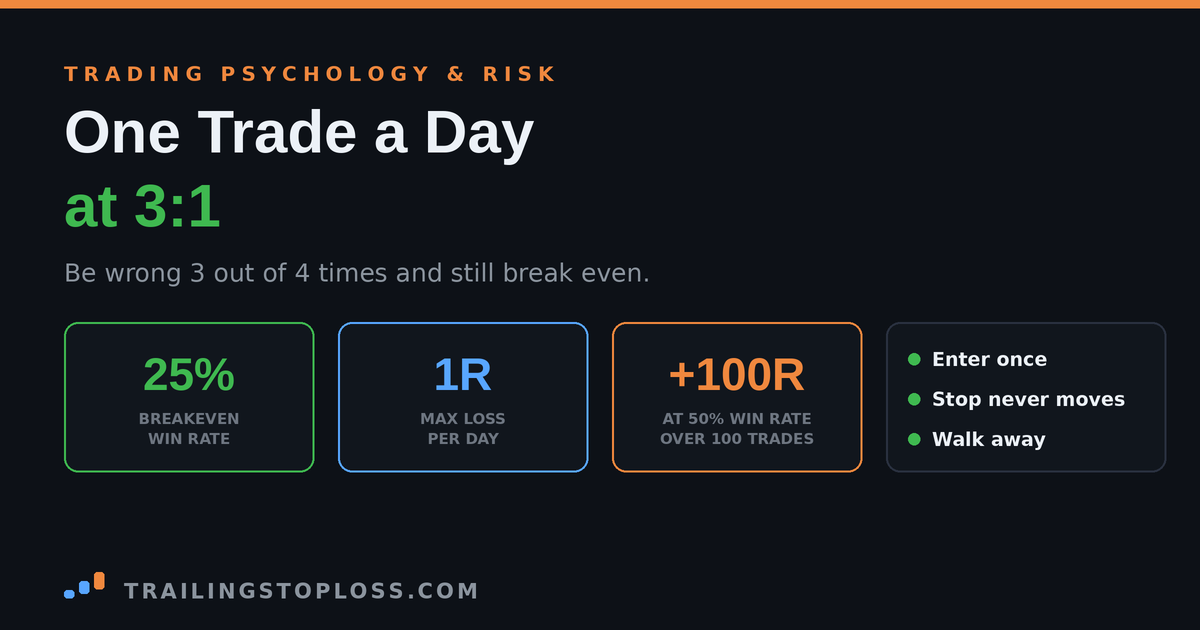
One Trade a Day at 3:1
One trade a day. Three-to-one or nothing. Stop goes where it goes and never moves again. Enter, walk away, accept the outcome. That’s the entire framework — and it survives not because it’s clever, but because it removes the two things that actually destroy accounts: the second trade, and the hand that keeps touching the stop.
It sounds austere. Most people’s instinct is that fewer trades and a harder target means less money. The arithmetic says the opposite, and the arithmetic isn’t a matter of opinion.
The math: why 3:1 only needs a 25% win rate
Your breakeven win rate is determined entirely by your reward-to-risk ratio. Risk one unit to make three, and you need to be right just 25% of the time to break even. Be right more than a quarter of the time and you’re profitable — while being wrong three times out of four.
| Reward : Risk | Breakeven win rate | What that demands of you |
|---|---|---|
| 1 : 1 | 50.0% | You must be right half the time just to stand still |
| 2 : 1 | 33.3% | Right one in three to break even |
| 3 : 1 | 25.0% | Right one in four to break even |
| 4 : 1 | 20.0% | Right one in five — but the target is far |
This is why 1:1 is a trap dressed as a safe choice. At 1:1 you’re carrying a 50% breakeven hurdle, which means commissions, slippage, and one bad week put you underwater — and you have to be right half the time forever just to tread water. At 3:1, three-quarters of your trades can be losers and you’re still even.
Run it over a hundred trades, risking a fixed amount each time. Using $1,000 of risk per trade to make the numbers concrete:
| Win rate | Winners | Losers | Net over 100 trades | Per-trade expectancy |
|---|---|---|---|---|
| 25% | 25 × $3,000 = $75,000 | 75 × $1,000 = −$75,000 | $0 | 0.00R |
| 30% | 30 × $3,000 = $90,000 | 70 × $1,000 = −$70,000 | +$20,000 | +0.20R |
| 40% | 40 × $3,000 = $120,000 | 60 × $1,000 = −$60,000 | +$60,000 | +0.60R |
| 50% | 50 × $3,000 = $150,000 | 50 × $1,000 = −$50,000 | +$100,000 | +1.00R |
A 50% win rate at 3:1 returns 100R over a hundred trades. At $1,000 of risk per trade that’s $100,000; at $100 of risk it’s $10,000. The dollar figure scales with your risk unit — the 100R is the part that’s actually the strategy. That distinction matters, because R is portable across account sizes and dollars aren’t.
The part nobody mentions: you will lose a lot in a row
Here’s where most people abandon 3:1, and it has nothing to do with the math being wrong. A low breakeven win rate means you spend most of your time losing. That’s not a flaw in the system; it’s the system working as designed. But it produces losing streaks that feel like the strategy is broken when it isn’t.
Over a hundred trades, assuming independent outcomes:
| Your win rate | Chance of a 5-loss streak | Chance of a 7-loss streak | Chance of a 10-loss streak |
|---|---|---|---|
| 30% | ~100% | ~100% | ~93% |
| 40% | ~100% | ~93% | ~42% |
| 50% | ~95% | ~52% | ~9% |
Read that again: even at a 50% win rate, you are almost certain to hit a five-trade losing streak inside a hundred trades, and it’s a coin flip whether you hit seven. At 40%, a seven-loss streak is close to guaranteed. None of that means anything is wrong. It means you signed up for a system where being wrong is the normal state and the winners do the heavy lifting.
This is precisely why one trade a day is not a side rule — it’s the load-bearing wall. Seven losses at one a day is seven bad days spread over a week and a half, and each one costs exactly 1R. Seven losses in a single afternoon, taken while trying to fix the previous one, is an account. Same seven losses. Completely different outcome, decided entirely by pacing.
The second trade is the one that kills you
The first trade of the day is the one you planned. You had the setup, the level, the reason. The second trade — the one taken right after a loss — is almost never that. It’s an attempt to undo something. And the moment a trade’s purpose is recovery rather than edge, everything that made the first trade valid is gone: you’ll take a worse entry because you need one now, size up because 1R won’t cover the hole, and hold longer because being wrong twice is intolerable.
Notice what the right-hand column really costs. It isn’t the −6R. It’s that you now need two winning trades at 3:1 just to get back to flat — and at a 40% win rate, two winners might take five sessions to arrive. One bad afternoon quietly mortgages your next week. That’s the real arithmetic of revenge trading, and it’s covered in more depth in trading on tilt.
Set it and leave: why the stop never moves
Everything above only holds if 1R is actually 1R. The instant you move a stop, your entire expectancy table becomes fiction — because every number in it assumed a fixed loss. A widened stop isn’t a small adjustment; it’s a different strategy with different math, chosen mid-trade by the least rational version of you. There’s a whole piece on why this specific habit is so destructive: moving your stop away from price.
The same logic covers not babysitting. Watching a live position doesn’t give you information — it gives you urges. Every tick against you argues for an exit; every tick toward target argues for taking profit early. Neither of those impulses is analysis. Both of them shrink your winners and stretch your losers, which is precisely the reverse of what 3:1 requires.
Yes, price will fly past your target
It will happen constantly. You’ll take your 3R and watch it run another twelve. This is the tax you pay for a mechanical system, and it’s worth paying — because the alternative is discretionary exits, and discretionary exits are where the “let me just move this a bit” reflex lives. A target you hit is worth more than a bigger target you talk yourself into and then give back.
The reframe that makes it painless: you didn’t miss that money, because that money was never part of your plan. Your plan was 3R. You got 3R. The extra move belonged to a different strategy you’re not trading. The same logic applies to setups you sit out entirely — see a missed trade is not a loss.
🧠 Why this framework fits prop accounts especially wellEvaluation and funded accounts punish exactly the behavior this framework forbids. Most failures come from loss-limit breaches, not bad strategies — and one trade a day makes breaching a daily loss limit nearly impossible, since your maximum daily damage is 1R by definition. It also plays well with consistency rules, because no single day can balloon into an outlier. See why most traders fail the evaluation.
The honest caveats
A framework you can’t poke holes in is a framework someone’s selling you. Here are the real ones.
How to run it
- Define the setup in advance. One setup, one timeframe, written down. If it doesn’t appear today, you don’t trade today — and that’s a successful day.
- Size from the stop, never the other way round. Stop goes where the structure says. Position size is whatever makes that distance equal 1R. This is the only order of operations that works.
- Require 3R to be realistic before entering. If the nearest logical target isn’t at least three times your stop distance, there’s no trade. This filter alone removes most bad entries.
- Place the bracket immediately. Stop and target as live orders. Then close the chart.
- One outcome, then stop. Win or lose, you’re done for the day. No exceptions, because the exception is always the expensive one.
- Log it, including the days you didn’t trade. A no-trade day is data. So is “I wanted to take a second trade and didn’t.”
- Judge in R over 100 trades, not in dollars over a week. Weekly P&L at a 35% win rate is noise. A hundred-trade sample is signal.
⚠ One rule that protects all the othersIf you break the one-trade rule, the fix isn’t to trade more carefully tomorrow — it’s to write down what the second trade cost you. Nearly always it’s your largest loss of the month. The rule doesn’t feel important until you can see, in your own numbers, that every account-threatening day started with a trade that wasn’t on the plan.
The bottom line
The framework is boring on purpose. One trade means one decision, and one decision can’t spiral. A 3:1 target means you can be wrong three-quarters of the time and still be fine, which takes the desperation out of every individual trade. A stop that never moves means 1R is always 1R, so the math you did before entering is still true when you exit. And walking away means the trade is decided by the plan rather than by whichever emotion is loudest at 10:47am.
None of it requires you to be right often. That’s the whole point. You’re not trying to win most of your trades — you’re trying to make sure that when you’re wrong, it costs exactly one unit, and when you’re right, it pays three. Do that consistently and the arithmetic takes care of the rest. Live to trade another day.
One trade a day is only a rule if you can see it. Log every trade — the free P&L calendar shows your daily count, so a second trade is visible the moment it happens.
Open the free P&L Calendar →Related: the win rate fallacy explains why chasing a high hit rate backfires, moving your stop covers the habit that breaks this math, and the trading psychology guide ties the full cluster together.
FAQ
What win rate do you need at a 3:1 reward-to-risk ratio?
You break even at a 25% win rate. Risking one unit to make three means 25 winners produce 75 units of profit while 75 losers produce 75 units of loss — exactly flat. Anything above 25% is profitable, so you can be wrong three times out of four and still make money. Commissions and slippage push the true breakeven very slightly higher, to roughly 25.5%.
Why trade only one trade a day?
Because it caps your worst possible day at 1R. Losing streaks are unavoidable with a high reward-to-risk ratio, and one trade a day spreads them out into single bad days instead of compounding them into a single catastrophic session. The second trade after a loss is almost always a recovery attempt rather than a valid setup, and that’s the trade that turns a normal loss into an account-threatening one.
Isn’t a 1:1 or 2:1 ratio easier to hit?
Easier to hit, harder to survive. At 1:1 you need a 50% win rate just to break even before costs, so a slightly-below-average stretch puts you underwater. At 3:1 three-quarters of your trades can lose and you’re still even. The higher target is hit less often, but the math gives you far more room to be wrong.
How many losses in a row should I expect at 3:1?
More than feels comfortable. Over a hundred trades at a 40% win rate, a five-loss streak is essentially certain and a seven-loss streak is around 93% likely. Even at 50%, a five-loss streak is about 95% likely. Those streaks are normal system behavior, not evidence the strategy is broken — which is exactly why the daily cap and a fixed 1R matter so much.
Why should I never move my stop?
Because every expectancy calculation assumes a fixed loss. Moving the stop makes 1R an unknown quantity, so your position size, your risk-to-reward ratio, and your breakeven win rate all become meaningless. You’re no longer trading the strategy you tested — you’re improvising with real money, mid-trade, under stress.
What if price runs far past my target after I exit?
That’s the cost of a mechanical system, and it’s worth paying. You planned for 3R and you got 3R — the additional move belonged to a different strategy you aren’t trading. Chasing it means discretionary exits, and discretionary exits are how traders end up holding losers and cutting winners.
This article is educational and not investment advice. All figures are illustrative arithmetic, not projections — the $100,000 example assumes a $1,000 risk unit and a 50% win rate, which is an exceptional result rather than a typical one. Trading carries substantial risk of loss, and no framework guarantees profitability.


