Why You Follow a Prop Firm’s Rules But Not Your Own
You’ll respect a $2,000 trailing drawdown you didn’t choose while blowing through the $500 limit you set yourself last night. The usual explanation for that just got retracted for fabricated data — and what’s left is a sharper answer.
The distinction isn’t external versus self-imposed. It’s enforced versus not.
The study that explained this no longer exists
For twenty-four years, the standard citation for “externally imposed rules beat self-imposed ones” was a 2002 paper in Psychological Science by Dan Ariely and Klaus Wertenbroch. Students faced either evenly spaced deadlines set by the instructor, a single end-of-term deadline, or deadlines they chose themselves. The reported finding was that the externally imposed, evenly spaced condition produced the best work. It accumulated somewhere north of 2,000 citations and became a fixture on psychology and economics reading lists.
On 2 September 2026, Psychological Science retracted it. The retraction followed a failed replication published in the same journal in July, and analyses from the Data Colada team finding the underlying datasets had been tampered with. The co-author requested the retraction; both authors agreed to it. (Retraction Watch)
The replication matters as much as the fraud finding. Hyndman and Bisin reported that changing the deadline structure had a negligible effect, and that evenly spaced external deadlines did not stand out as particularly effective. So it isn’t only that the original data was unreliable — when someone ran the experiment properly, the headline effect wasn’t there. (Ynet)
Trading psychology content is built almost entirely on borrowed behavioral science, usually cited third-hand and rarely checked. This one was load-bearing: it’s where “external structure beats willpower” came from, and it’s the implicit argument behind a lot of writing about why prop firm rules work. It is now retracted. Anything you’ve read that leans on it needs a different foundation — including, potentially, things on this site.
What survives
The retraction doesn’t demolish commitment devices generally. That literature has field evidence the deadline study never had.
The strongest example is a randomized trial in the Philippines, published in the American Economic Journal. Smokers were offered CARES — a savings account they funded themselves for six months, followed by a urine test for nicotine. Pass and the money came back; fail and it went to charity. Those offered the contract were about 3 percentage points more likely to pass at six months, and the effect held in surprise tests at twelve months, from a base quit rate near 9%. That’s roughly a 38% relative improvement, and it persisted after the commitment period ended. (Giné, Karlan & Zinman)
Note what’s different. The CARES contract wasn’t merely a rule someone else set — it was binding, with your own money forfeited automatically if you failed. No willpower involved at the moment of temptation. The mechanism isn’t where the rule came from; it’s that breaking it was made expensive without requiring you to enforce it.
Only about 11% of smokers offered the commitment contract took it. Nearly nine in ten looked at a device that would genuinely help them quit and declined to be bound by it. That’s not a footnote — it’s the whole psychology of this in one number. People understand they’d benefit from binding rules and mostly refuse them anyway, because the cost is immediate and the benefit is abstract.
What a soft rule actually costs
Here’s why self-enforcement fails specifically in trading, and it isn’t a character flaw.
Take a trader with a genuine edge and a $500 daily loss limit. Model two versions: one where the limit binds every time, and one where it’s honored 70% of the time — the other 30%, the session extends and size creeps up, which is what breaking a loss limit looks like in practice. Same edge, same trades, 250 days, 1,500 simulated years.
| Limit honored | Median year | Worst day | Chance of ≥1 account-ending day |
|---|---|---|---|
| 100% (a firm enforces it) | $33,376 | −$500 | 0% |
| 90% | $36,202 | −$7,919 | 60% |
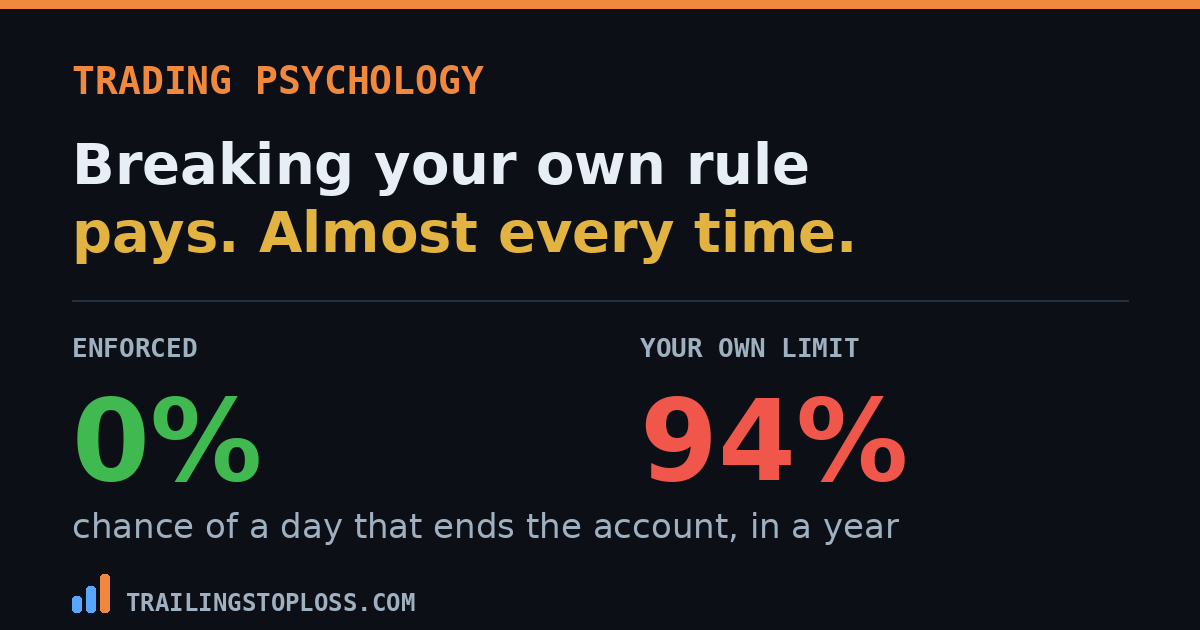
| 70% (you enforce it) | $40,468 | −$7,157 | 94% |
| 50% | $44,020 | −$8,364 | 99% |
Read the median column again. Breaking your own rule doesn’t cost you money — it makes you more. $40,468 against $33,376, about 21% better. With a real edge, continuing to trade after a bad start is positive expectancy, so most of the time the trader who ignores the limit is rewarded for it.
That’s the mechanism, and it’s why willpower is the wrong frame. You aren’t failing to resist temptation. You’re correctly learning from experience that the rule costs you money, because on the vast majority of days it does. The habit forms because it’s reinforced.
The entire bill arrives in the last column. A limit honored 70% of the time gives you a 94% chance of at least one day inside a year that would end a funded account, against 0% when the rule binds. Your worst day goes from −$500 to roughly −$7,000. The limit was never a profit tool. It’s the difference between an ordinary year and not having an account.
So what are you actually buying from a prop firm?
Enforcement. Not capital, not data, not a platform — those are cheap and available elsewhere. What a prop firm sells that you cannot easily produce yourself is a rule that binds without requiring you to enforce it in the moment you least want to.
Your broker will happily let you lose $7,000 in a session. A funded account won’t, because the position closes and the account is done whether you agree or not. That’s the same structural feature as the CARES deposit — the consequence is automatic and the decision was made in advance by someone who wasn’t in a drawdown at the time.
Which reframes the fee. Evaluation cost isn’t only buying access to capital; it’s buying a constraint you’ve demonstrated you won’t impose on yourself. Whether that’s worth $87 or $247 depends on how much your unenforced limit has cost you, and most traders have never calculated that.
It also explains why the rules people complain about most are the ones doing the work. A trailing drawdown that ends your account feels punitive precisely because it binds when you’d rather it didn’t. That’s the function, not a design flaw.
Making your own rules bind
If you’d rather not rent enforcement, the research points at what to build: consequences that are automatic, immediate, and don’t require your cooperation at the moment of temptation.
- Platform-level lockouts. Most futures platforms support a daily loss limit that flattens and locks. Set it once, when you’re calm. This is the closest thing to a personal prop firm rule, and it’s free.
- Separate the deciding from the doing. Choose your limit the night before, in writing, and treat the morning version of yourself as someone without authority to revise it. The CARES design works because the money is already committed before the craving arrives.
- Make the breach cost something outside trading. A forfeit to charity on any day you exceed the limit turns an abstract rule into an immediate loss. That’s the exact mechanism the smoking trial tested.
- Count breaches, not outcomes. Since breaking the rule usually pays, judging by P&L will teach you to break it. Track adherence as its own number, independent of whether the day worked out.
- Accept you probably won’t. Nine in ten smokers refused a device that would have helped them. If you know you won’t build this, that’s an argument for paying someone to enforce it — not a reason to keep promising yourself you’ll do better.
The honest limits
The headline study here is retracted, and I’m not replacing it with certainty. The claim that external rules beat self-set ones specifically is now poorly supported — the replication found the effect negligible. What survives is narrower: binding commitments with automatic consequences have real randomized evidence behind them.
The simulation is a model, not your account. It assumes a positive edge, normally distributed outcomes, and a particular shape of revenge trading. Real markets have fatter tails and real traders break rules in more varied ways. The direction is robust — soft limits shift damage into the tail while looking harmless in the middle — but treat the specific percentages as illustration.
Enforcement isn’t free. A rule that binds will sometimes stop you on a day you’d have recovered. The median column shows exactly that cost: about $7,000 a year in this model. The argument isn’t that enforcement is costless. It’s that the alternative carries a 94% chance of an ending.
The short version
The 2002 study that established “externally imposed rules beat self-imposed ones” was retracted on 2 September 2026 after a failed replication and findings of data tampering, and the replication found the effect was negligible to begin with. What still holds is narrower and more useful: binding commitment devices with automatic consequences work, demonstrated in a randomized trial where smokers who staked their own money were about 38% more likely to have quit a year later — though only 11% agreed to be bound in the first place. For traders the distinction isn’t external versus self-imposed, it’s enforced versus not. Modeling a $500 daily limit shows why self-enforcement fails: honoring it 70% of the time rather than 100% actually produces a higher median year, around $40,000 against $33,000, because continuing to trade with a real edge is usually rewarded. The cost is entirely in the tail — a 94% chance of at least one account-ending day within a year, against 0% when the rule binds. Which is what a prop firm actually sells you: not capital, but a rule you’ve proven you won’t enforce on yourself. (Giné, Karlan & Zinman)
Frequently asked questions
Why can I follow a prop firm’s rules but not my own?
Because theirs bind and yours don’t. A prop firm’s drawdown limit closes your position whether you agree or not, while your own limit requires you to enforce it at the exact moment you least want to. The difference isn’t discipline or willpower — it’s whether the consequence is automatic. Randomized evidence on commitment devices points the same way: what works is binding a decision in advance so that no cooperation is needed later.
Does breaking my daily loss limit actually cost me money?
Usually not, and that’s the problem. Modeling a trader with a genuine edge, honoring a $500 limit only 70% of the time produced a higher median year than honoring it every time — roughly $40,000 against $33,000 — because continuing to trade with positive expectancy tends to pay. The damage sits entirely in the tail: the worst day goes from −$500 to about −$7,000, and the chance of at least one account-ending day in a year rises from 0% to 94%.
Was the Ariely deadline study retracted?
Yes. Psychological Science retracted “Procrastination, Deadlines, and Performance: Self-Control by Precommitment” by Ariely and Wertenbroch on 2 September 2026. The retraction followed a failed replication published in the same journal in July 2026 and an investigation by Data Colada that found the underlying data had been tampered with. Wertenbroch requested the retraction and both authors agreed. It was the second retraction for Ariely.
Do commitment devices actually work?
The binding kind have real randomized evidence. In a trial in the Philippines, smokers offered a contract where they staked their own money against a nicotine test were about 3 percentage points more likely to pass at six months from a base near 9%, and the effect held at twelve months in surprise tests. The important qualifier is take-up: only about 11% accepted the contract when offered. People recognize they’d benefit and mostly decline anyway.
How do I make my own trading rules stick?
Build in consequences that don’t need your cooperation in the moment. Most futures platforms support a daily loss limit that flattens and locks your account — set it once while calm. Decide limits the night before in writing and treat the trading-day version of yourself as lacking authority to revise them. Track rule adherence as a separate number from P&L, since breaking the rule usually pays and judging by outcome will teach you to break it more.
Related on this site: daily loss limits and trailing drawdown · why watching your P&L costs you money · when a losing streak means stopping · true cost rankings
Simulation figures come from 1,500 modelled years of 250 sessions each, assuming a positive-expectancy strategy and a $500 daily limit; real markets have fatter tails, so treat them as illustrating the mechanism rather than forecasting your results. Nothing here is financial advice. Futures trading carries substantial risk of loss.


