▸ Trading Psychology · Risk Management
Moving Your Stop Away From Price
Price is grinding toward your stop. Your hand drifts to the mouse. “It just needs a little more room.” You drag the stop down a few ticks — and in that one motion, you stop trading your plan and start negotiating with a market that doesn’t negotiate. Most blown accounts don’t die from a thousand small cuts. They die from one moment exactly like this. If break-even stops are the small, frequent leak, moving your stop away from price is the single event that ends careers.
The most important rule in trading, in one sentence
Strip every strategy down and the same rule sits underneath all of them: risk can only move in one direction. You are always free to move a stop closer, take partial profits, or close early — anything that reduces your exposure. You are never free to increase the amount you’re willing to lose after the trade is live. The moment you widen a stop, the entire structure of your system collapses, because every other number in it — position size, R-multiple, expectancy — was built around the risk you just abandoned. (Coinmonks: never increase risk after entry)
Your stop loss isn’t an arbitrary line. It marks the exact price where your trade idea is proven wrong. Move it, and you’re no longer managing risk — you’re just hoping, holding a position whose entire thesis has already been invalidated. A trader who widens a stop has quietly switched from analysis to prayer, and the market has never once responded to prayer. (EdgeFlo: a moved stop means trading without a thesis)
Accounts die in a moment, not a thousand cuts
The comforting myth is that accounts erode slowly — a gentle decline as a strategy stops working. The reality is uglier and faster. Most accounts don’t die from a slow bleed; they die from one decision, one trade that spirals because the trader broke the one rule they’d promised themselves they’d never break. The setup was fine. The risk was defined. The stop was placed. Then price moved against it, the loss became real enough to hurt, and instead of clicking the trader gave it “just a little more room.” (Coinmonks: one moment, not a slow decline)
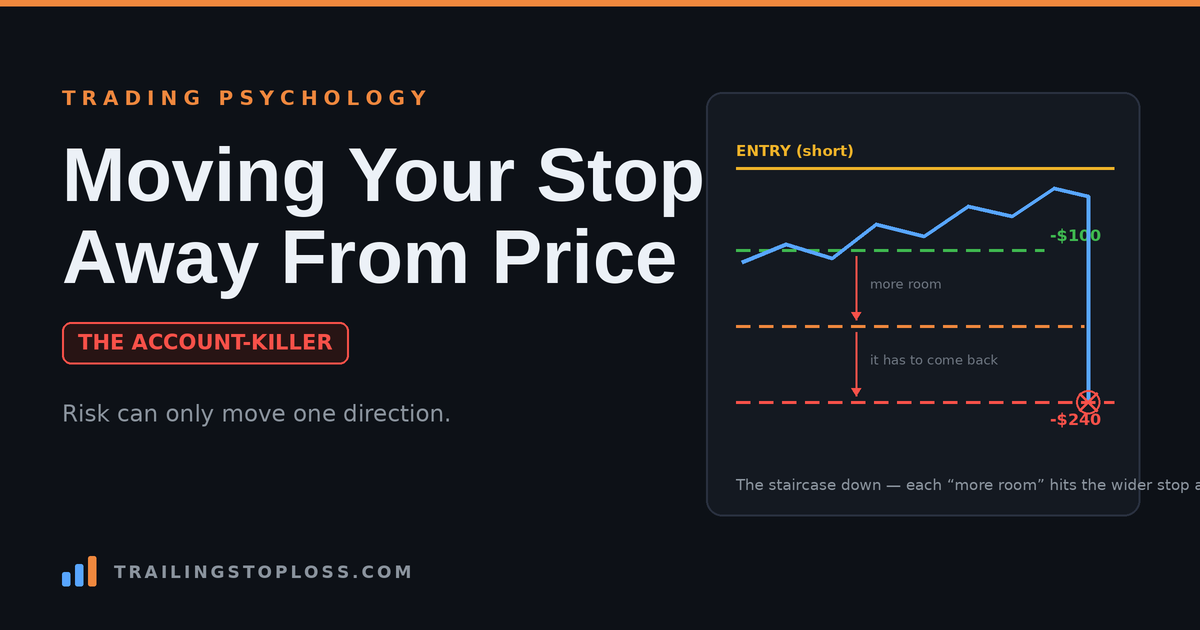
Watch how the spiral actually runs, because it’s never one move — it’s a staircase. A trader risks 1% on a EUR/USD short with a 25-pip stop. Price pushes toward it. “What if it breaks resistance?” He widens to 45 pips — dollar risk just doubled from $100 to $180, position size unchanged. Price stalls, then grinds up again. “It has to come back.” He widens to 60 pips, $240 at risk. It doesn’t come back. He’s stopped at his widened level for a $240 loss — nearly 2.5% of his account — on a trade the plan said should cost exactly 1%. Had he left the original stop alone, it fills for a normal $100 loss and life goes on. The extra $140 wasn’t bad analysis. It was self-inflicted. (EdgeFlo: $100 planned becomes a $240 self-inflicted wound)
Why your brain reaches for the mouse
This is loss aversion in its purest, most expensive form. The pain of a realized loss registers about twice as intensely as the pleasure of an equivalent gain, so closing a loser — making it real — feels almost physically wrong. Widening the stop makes that pain go away right now, in exchange for a much larger, uncertain pain later. Prospect theory nailed the mechanism decades ago: people turn risk-seeking when they’re losing, taking on more risk precisely when they should be cutting it. Moving your stop away is that instinct made literal. (Aron Groups: risk-seeking in losses, prospect theory)
Two accomplices make it worse. Confirmation bias: the moment the loss threatens, your mind starts hunting for reasons the market “has to” reverse, downplaying the broken support level right in front of you, so you can justify holding. And the entry-price anchor: because you’re judging the trade by whether you’re up or down relative to what you paid — a number the market has never heard of — rather than by whether the thesis still holds. Hide your entry price on the chart and the urge to widen loses most of its grip. (TradesViz: the entry price as reference point)
The math is even worse than it feels
Here’s the part that quietly destroys accounts even when no single trade blows up. Traders who widen stops almost always tighten their take-profit at the same time — nervous, they grab whatever green is available. So you get bigger losses paired with smaller wins: the exact inversion of what a profitable system needs. Run the numbers on a 2:1 setup at a 50% win rate over ten trades. Traded as planned: five wins at +2%, five losses at −1%, net +5%. With stop-widening and early exits: five wins at +1.5%, five losses at −2%, net −2.5%. Same setups, same win rate — a 7.5% swing from profitable to losing, created entirely by interference after entry. (EdgeFlo: a 7.5% swing from interference alone)
This is the win-rate fallacy and the disposition effect meeting in one trade: small wins, big losses, an inverted risk-reward that no entry edge can outrun. Your position size only works if you actually honor the stop it was calculated around. Widen the stop, and you’ve blown past your intended risk before the trade even resolves — the sizing math is now fiction. (EdgeFlo: position sizing only works if you honor the stop)
The honest caveat: tight isn’t holy either
To be fair, and because we don’t do dogma here: the answer isn’t “always use the tightest possible stop.” A CFA Institute analysis found that as stops widen, win rates actually rise — trades get room to absorb noise — while average losses grow relative to wins, producing a single optimal band with a sharp cliff on the too-tight side and a gentle slope on the too-wide side. Stops that are chronically too tight optimize for emotional relief, get you wicked out of good trades, and truncate the exposure that captures the big winners. There is a right distance, and it’s set by structure and volatility, not by your comfort. (CFA Institute: the optimal stop-width band)
But notice the crucial distinction. Choosing a wider stop before you enter — sized correctly, with position size reduced to keep dollar risk constant — is legitimate risk design. Dragging a stop wider after you’re in, with size unchanged, is the account-killer. The first is a plan. The second is a panic. Same direction on the chart, opposite universe in outcome. (Optimus Futures: pre-defined width vs in-trade interference)
How to make the line hold
You will not win this with willpower in the moment — by the time your hand is on the mouse, loss aversion is already driving. You win it by making the rule harder to break than to follow, before the trade ever goes live. (TradesViz: pre-commitment beats in-the-moment willpower)
- Use a hard, server-side stop — never a mental one. A resting stop order executes without hesitation. A “mental stop” is a decision you’ve promised to make during the exact moment of peak emotional stress, which is when you’re least able to make it. Set it and let the platform be the disciplined one.
- Size the trade around the stop, then lock it. Decide your stop distance first, set position size so the dollar risk is exactly your 1–2%, and treat both as fixed. If the stop is already correctly placed at invalidation, there is no honest reason left to move it wider.
- Place the stop at structure, then leave it. Below the swing low, outside a 1.5–2.5× ATR buffer — wherever your idea is genuinely wrong. Give it the right room once, at entry, so you’re never tempted to add room later.
- Hide your entry price. If your platform lets you, remove the entry line from the chart and watch structure instead. You can’t anchor to a number you can’t see, and most of the urge to widen dies with it.
- Let the stop move only toward you. The only legal direction is tighter — trailing behind new structure as the trade works. If price hasn’t printed a new level in your favor, the stop stays exactly where it is. It never, ever retreats.
- Audit it in your journal. Track how often you moved a stop and what it cost versus the planned loss. The habit hides in the heat of a single trade but is glaring in the aggregate — and seeing the total dollar figure is usually enough to end it.
🛑 The line, or the accountEvery time you widen a stop and get away with it, you’re not learning that widening works — you’re being trained to do it again, with more size, closer to the edge. The habit only has to win once. Somewhere out there is the trade that doesn’t come back, and a stop you refused to honor is how it finds your account. Hold the line while it’s small, because you will not be able to hold it once it’s large.
The bottom line
Moving your stop away from price is the purest expression of loss aversion there is: trading a small, certain, planned loss for a large, uncertain, unplanned one, purely to make the pain stop right now. It feels like giving a good trade room to breathe. It’s actually removing the one control that keeps a bad trade from becoming a career-ending one. Choose your stop distance deliberately before you enter, size the position around it, and then let the line hold — because risk moves in exactly one direction, and it isn’t the one your hand wants to drag it. (Coinmonks: survival is the whole game)
Build the habit on purpose: set and size your stop before entry with the Hard-Stop Plan Builder, visualize the right distance with the Stop-Loss & R:R Visualizer, and track your held-line streak on the Hold Tracker. This is part of our trading psychology guide — the exact opposite mistake, protecting too early, is covered in Should You Move Your Stop to Break-Even?
FAQ
Why is moving your stop loss away from price so dangerous?
Because it increases your risk after the trade is live, which breaks every other number in your system — position size, R-multiple, and expectancy were all built around the original stop. It also converts a defined, planned loss into an open-ended one. Most blown accounts trace to a single trade where the stop was widened repeatedly until a normal loss became an account-threatening one.
Why do traders widen their stops?
Loss aversion: the pain of realizing a loss feels roughly twice as intense as the pleasure of an equal gain, so closing a loser feels wrong and widening the stop makes that pain go away in the moment. Prospect theory shows people become risk-seeking when losing. Confirmation bias and anchoring to the entry price make it worse by helping you justify holding.
Is it ever okay to move a stop loss?
Only in the direction that reduces risk. Trailing a stop tighter as the trade moves in your favor, or closing early, is fine. Choosing a wider stop before you enter, with position size reduced to keep dollar risk constant, is legitimate risk design. Dragging a stop wider after entry with size unchanged is the account-killer. The rule: risk can only move one direction.
Are tight stops always better then?
No. Chronically too-tight stops get you wicked out of good trades on normal noise and cap the exposure that captures big winners — research shows an optimal stop-width band with a sharp penalty for being too tight. The point isn’t “tight,” it’s “correct”: set by structure and volatility (often a 1.5–2.5× ATR buffer) before entry, then left alone.
How do I stop myself from moving my stop?
Remove the decision from the moment. Use a hard server-side stop rather than a mental one, size the trade around the stop and lock both before entry, place the stop at structure, and hide your entry price so you can’t anchor to it. Allow the stop to move only tighter, never wider, and audit in your journal how often you break the rule and what it costs.
TrailingStopLoss publishes independent, funded-trader analysis of prop firms, strategy, and trading psychology. Educational content only — not financial advice. Trading futures involves substantial risk of loss.


