Tools
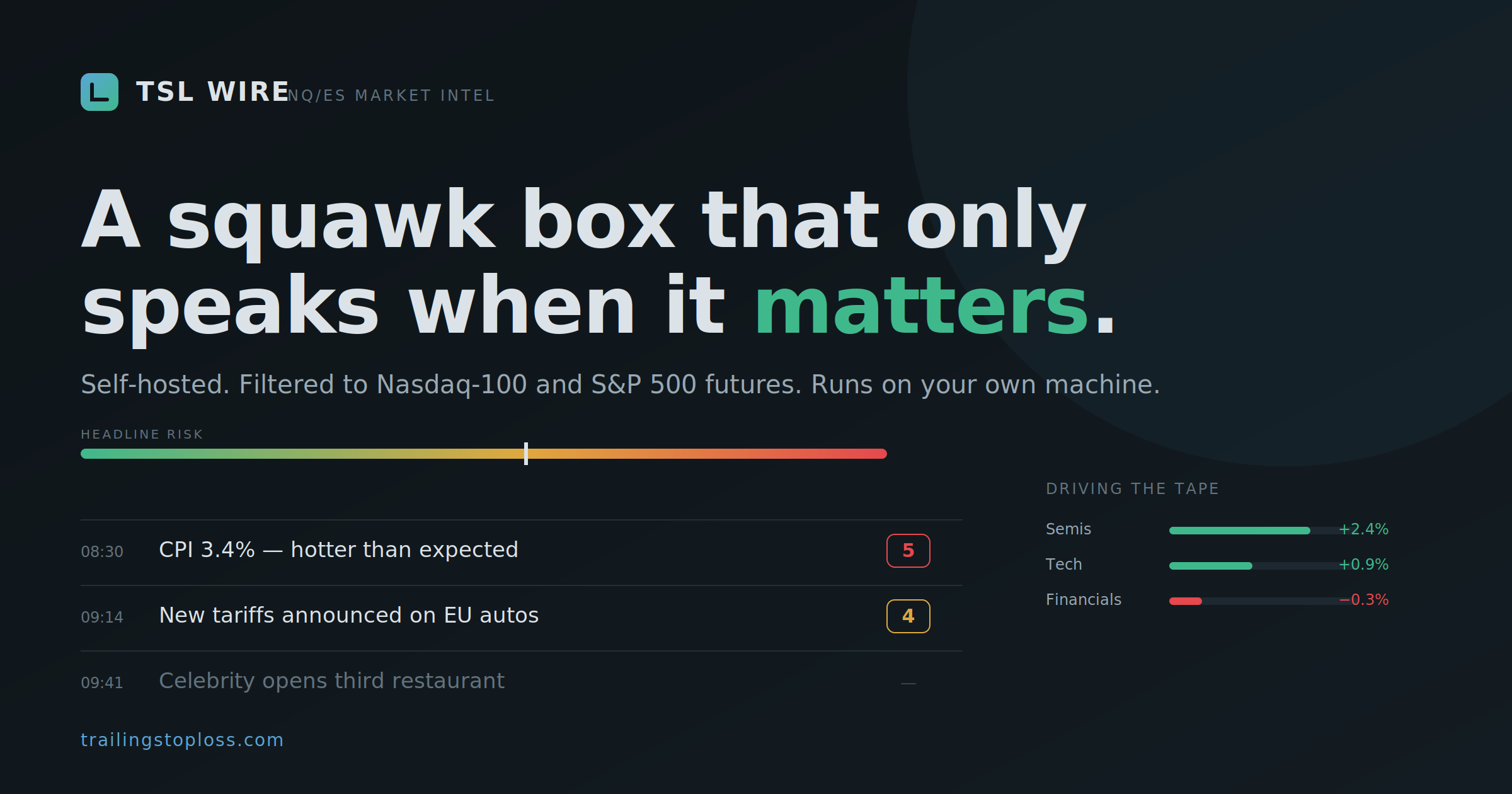
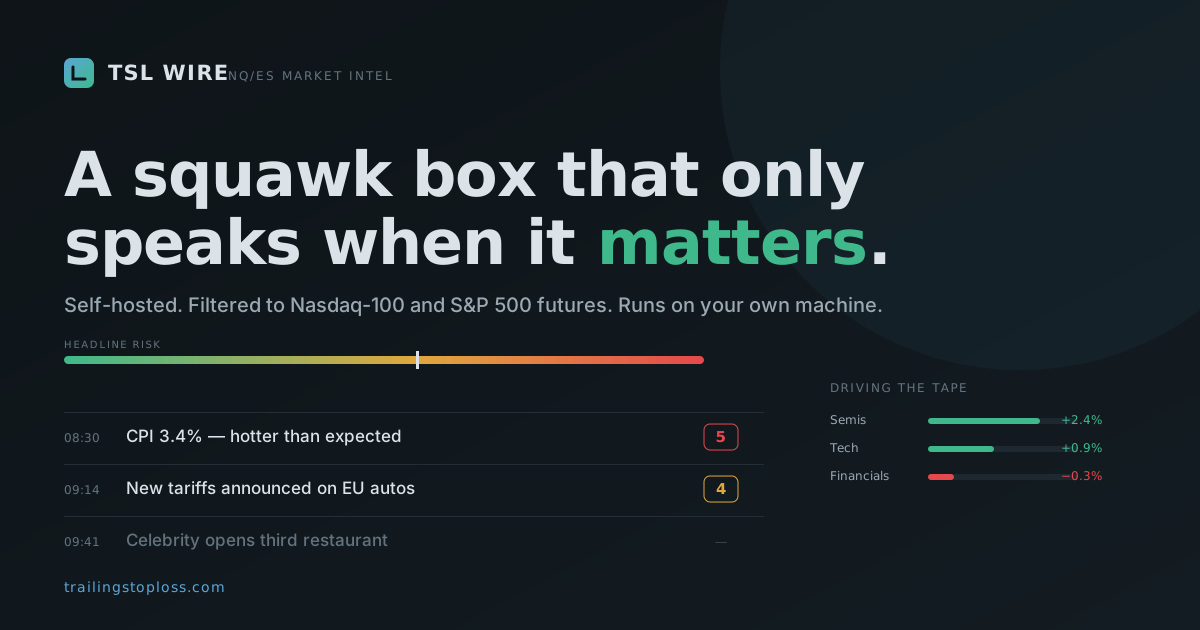
A squawk box that only speaks when it matters
TSL Wire watches the news for one narrow purpose: deciding whether a headline can move Nasdaq-100 or S&P 500 futures. Everything that can’t, it throws away. It runs on your own machine, and it costs roughly nothing.
The problem with reading everything
contextA professional squawk service puts a human on a low-latency wire and has them read it out loud all day. It works, and for a desk trading size it is worth every penny. For one person trading a couple of E-mini contracts, paying a monthly subscription to be told that the Fed exists is a harder sell. Compare: Newsquawk, FinancialJuice
The free alternatives have the opposite problem. They read everything. Somewhere between the celebrity divorce and the third story about a cryptocurrency you have never heard of is the tariff announcement that just moved your contract forty points, and you missed it because you had stopped listening two hours ago.
TSL Wire was built around a narrower question than “what happened today.” It asks, of each headline: could this move NQ or ES in this session or the next? A story that can’t, doesn’t appear. That is the entire premise, and everything below is machinery in service of it. Contract specs: CME Group, E-mini Nasdaq-100
What’s actually on the screen
panelsFive panels, each answering a question you would otherwise answer by opening five tabs.
Above all of it sits a headline-risk gauge: a single reading of how hostile the news environment is right now. Calm means continuation setups behave. High means levels break on news rather than structure, and the sensible move is to stand down until the reaction bar closes.
And it talks
Switch on the squawk and anything scoring four or five gets read aloud, with a chime in front of it and a queue behind it so two headlines never talk over each other. It picks the best neural voice installed on the machine, which on Windows means it sounds like a person rather than a 1998 GPS unit. Built on the browser’s Web Speech API
How it decides what matters
classifierHeadlines arrive from Truth Social, Finnhub’s news feed, CNBC’s finance and economy feeds, and the Federal Reserve’s own press releases. A cheap keyword gate throws out the obvious noise first, because there is no sense paying a model to think about a football result. Sources: Finnhub, CNBC RSS, Federal Reserve
What survives gets scored. There are two engines, and you choose which one runs.
The model
Claude Haiku reads the headline and returns a verdict: relevant or not, which contract, which direction, how hard, which theme, and a short reason. It understands that falling jobless claims are good news even though “plunge” is a bad-sounding word. It costs fractions of a cent per headline. Model: Anthropic Claude
The free one
Or you run the built-in keyword engine, which needs no API key, no account, and no credit. It scores headlines on weighted vocabulary — tariff, Fed, CPI, semiconductors, OPEC — plus index-heavyweight names, directional language, and a noise veto for sports and campaign chatter. On a benchmark of real headlines it agreed with the intended verdict every time.
It is also, being a keyword engine, gloriously literal. It once scored a story about Diet Coke can sizes in India as a geopolitical event, because the sentence happened to contain the words “Iran war.” It reads words, not meaning. Treat direction and magnitude from the free engine as a rough signal, not a judgement — and if that bothers you, the model is a config change away.
Economic releases, called as they print
the squawk momentThis is the part a squawk service exists for. At 08:30 the number lands and you want to hear “CPI three point four percent, expected three point two, higher than expected” before you have finished reading the first digit.
TSL Wire arms each scheduled high-impact release, polls hard in a three-minute window either side of it, and the instant an actual appears it speaks the print against the forecast and flags whether it beat or missed. The calendar comes from ForexFactory; the actual numbers are enriched from the St. Louis Fed’s own data, which is authoritative and free. Calendar: ForexFactory · Actuals: FRED, Federal Reserve Bank of St. Louis
Honest limit: FRED publishes minutes after the wire does. This makes the calendar correct, not first. The genuinely fast number still arrives through the news feeds — which is why both run side by side.
How a desktop tool feeds a public page
architectureThe service runs on your machine — that is where the API keys live and where the classifying happens. But a page on the open internet cannot reach your desktop, and nobody sane wants to run a public server off their trading PC.
So it publishes instead. Every thirty seconds the service pushes a sanitised snapshot — headlines, verdicts, calendar, earnings, sectors, and nothing else — to a Cloudflare Worker backed by a key-value store. The public page reads from the Worker. Your machine never accepts an inbound connection, and no key ever leaves it. Platform: Cloudflare Workers, Workers KV
If the desktop is switched off, the public page keeps showing the last snapshot and marks it paused rather than breaking. Cloudflare’s free tier absorbs whatever traffic arrives, which is a more reassuring arrangement than pointing the internet at a machine that is also running your charts.
What it doesn’t do
limitsEvery tool that claims no weaknesses is selling something. These are real, and worth knowing before you rely on it.
- It will not out-run a paid wire A human on a co-located feed reads a headline in under a second. Polling free sources every twenty seconds cannot match that, and pretending otherwise would be dishonest.
- It is not a price feed Quotes arrive from TradingView alert webhooks, which fire per bar rather than per tick. That’s fine for context and alerts. It is not a scalping tape, and no amount of configuration makes it one. Mechanism: TradingView webhooks
- The free classifier misreads things Keywords are not comprehension. Roughly one headline in twenty gets a theme it doesn’t deserve.
- It runs while your computer runs Self-hosted means self-hosted. Close the laptop and the wire pauses.
What it costs
$0Run the keyword classifier with the free news sources and the total is nothing — no subscription, no API key, no account. Every feed it relies on is either public RSS or a free tier, and it runs on hardware you already own. Runtime: Node.js
Switch the classifier to Claude and you’re into fractions of a cent per headline, which the keyword pre-filter keeps to pennies a day. Publish it to a public page and Cloudflare’s free tier covers the traffic. The only thing this tool competes for is your attention, which is the point: it is designed to want less of it than the alternatives.
See it running
The wire is live and public — real headlines, scored, updating through the session.
Open the live wire →TSL Wire is a market-intelligence tool. It reports and scores publicly available news; it does not provide trading signals, recommendations, or investment advice. Headlines link to their original publishers. Nothing here is a solicitation to trade futures, which carry substantial risk of loss.


