▸ Trading Psychology · The Pillar
Trading Psychology: The Real Edge
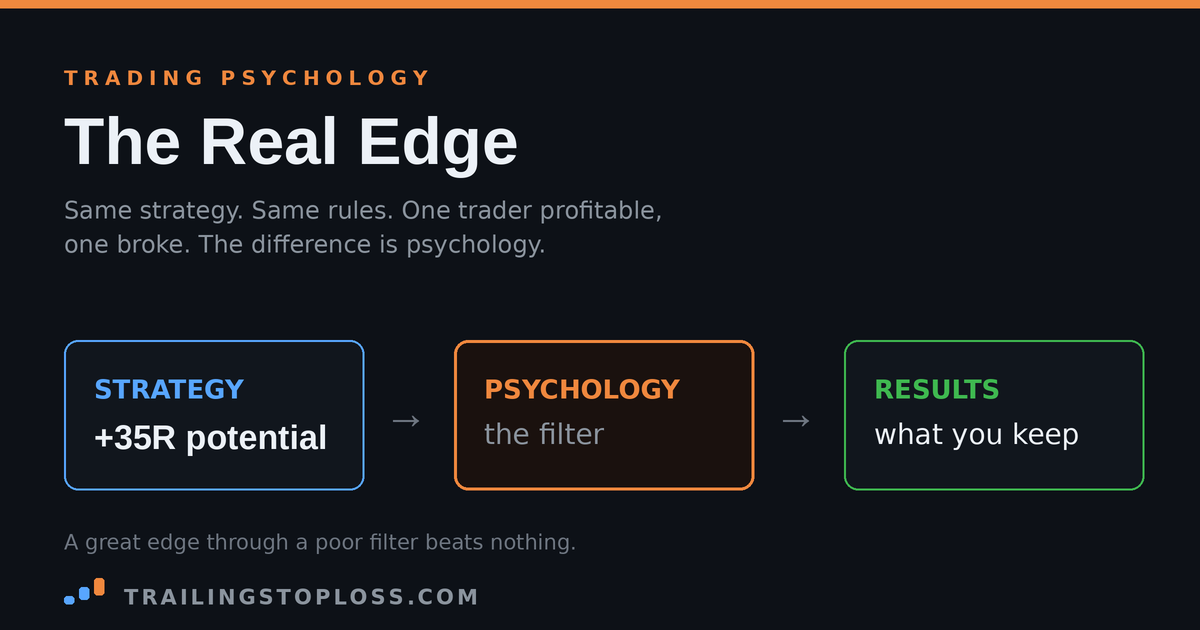
Give two traders the identical strategy — same entries, same exits, same rules, printed on the same sheet of paper. Six months later one is profitable and one has blown their account. Nothing about the strategy differed. Everything about the humans running it did. That gap is trading psychology, and it’s not a soft add-on to the “real” work of finding a system. It is the work. It’s the single largest determinant of whether a trader makes money, and it’s the one almost nobody actually trains.
This is the overview piece — the map of the whole territory. It makes the case for why psychology sits above strategy, walks through the specific mental failures that drain accounts, and points to the detailed breakdowns of each. If you read one thing on this site, read this, then follow the links into the parts that hit closest to home.
Why psychology beats strategy — in numbers
People treat “psychology matters” as a motivational cliché. It isn’t — it’s arithmetic. Take a perfectly decent edge: a strategy that wins 45% of the time at a 2:1 reward-to-risk ratio. Traded exactly as designed, that returns about +35R over 100 trades. Genuinely good. Now watch what ordinary, everyday psychological leaks do to that same strategy — not a worse strategy, the exact same one:
| How the trader runs the edge | Result / 100 trades | What changed |
|---|---|---|
| Trades the plan exactly | +35R | Nothing — the strategy as designed |
| Cuts winners early (2R → 1.4R avg) | +8R | Fear of giving back profit |
| Skips setups after two losses | +24R | Fear — only takes 70 of 100 valid trades |
| Widens stops on losers (−1R → −1.6R) | +2R | Can’t accept being wrong |
| One revenge trade per losing day | +17R | Tilt bleed after a loss |
Look at what a single leak does. The same profitable system, run by someone who widens stops because they can’t stand being wrong, drops from +35R to +2R — a rounding error away from breaking even. The strategy never changed. The human did. And most traders don’t have one of these leaks; they have several, compounding, on the same account.
This is why the endless search for a better strategy is usually the wrong search. The trader above doesn’t need a new system — they have a +35R system. They need to stop bleeding it away. A modest edge executed with discipline crushes a brilliant edge executed with fear, every single time, and it isn’t close.
The gap between knowing and doing
Here’s what makes trading psychology uniquely hard, and uniquely important: trading is one of the only skills where knowing the right thing to do and actually doing it are almost completely separate abilities. Every trader who moves a stop knows they shouldn’t. Every trader who revenge trades knew, before the session, that they wouldn’t. The knowledge was never missing. The execution was.
The reason is mechanical, not moral. Trading forces real decisions, with real money, under real-time uncertainty — the exact conditions under which the human brain hands control from its deliberate, planning system to its fast, emotional one. Fear, greed, and the sting of loss aren’t character flaws you can lecture away. They’re the default response of a nervous system that evolved to keep you alive, misfiring in an environment it was never built for. You will not out-willpower them in the moment. You beat them the way professionals do — with structure built before the moment, when you’re calm.
The failures that actually drain accounts
Trading psychology isn’t one thing — it’s a family of specific, recognisable failure modes, each with its own trigger and its own fix. Naming them precisely is the first step to catching them, because a vague “I need more discipline” never changed anyone’s behaviour. Here’s the map, with the deeper breakdown of each:
Notice the common thread running through all of them: each is a moment where an in-the-moment feeling overrides a pre-made decision. That’s the entire mechanism of trading psychology in one sentence. Fear, greed, the need to be right, the itch to act — they all do the same thing, which is talk you out of the plan you made when you were thinking clearly. Every fix in every one of those articles is, underneath, the same fix: move the decision earlier, when you’re calm, and remove your ability to override it later, when you’re not.
The disciplines that fix it
The good news is that the solutions are as concrete as the problems. You don’t fix trading psychology by “being more disciplined” through force of will — that’s the willpower trap, and willpower is precisely what fails under pressure. You fix it structurally.
🧠 The reframe underneath all of itGreat trading is not about being right. It’s about executing a repeatable process across a large number of trades and accepting that any single outcome is largely noise. The trader who internalises that stops needing each trade to work — and it’s the need for each trade to work that drives nearly every psychological failure on this page. Detach your ego from the individual result and most of the leaks close on their own.
Why TrailingStopLoss is the right place to learn this
Most trading-psychology content is written by one of two groups: academics who’ve never held a live position through a drawdown, or marketers selling a course, a signal group, or a mindset coaching package at the end. Both produce something hollow — the first is theory with no scar tissue, the second is a funnel with a psychology-shaped lid. Here’s what makes this different, and you can verify all of it.
That’s the honest version of “why us.” Not because we have credentials to wave, but because the writing is grounded in a real, working framework, every checkable claim is checked, and there’s nothing being sold at the end to bend the advice. In a space thick with course-sellers and signal-hawkers, “a real trader showing you the math for free” turns out to be genuinely rare.
⚠ What we won’t tell youWe won’t tell you psychology is a switch you flip, or that reading one article fixes years of habit. It doesn’t. This is slow, uncomfortable work that happens one logged trade at a time. Anyone promising a mindset transformation by Friday is selling something — and that, too, is why the honest version is worth more than the marketed one.
Where to start
If you recognised yourself in the numbers at the top — the trader with a real edge quietly bleeding it away — start with the failure that stung most to read. If you widen stops, that’s moving your stop. If you spiral after a loss, that’s rage trading and tilt. If you can’t hold a winner, that’s the break-even reflex. Then build the base underneath all of them: fixed risk and one trade a day.
None of it requires a better strategy. It requires becoming the kind of trader who can run the strategy you already have without getting in its way. That’s the entire game, and it’s winnable — not through willpower, but through structure, one honest trade at a time.
Psychology only changes when you can see the pattern. The free P&L calendar logs every trade, tags your worst habits, and turns invisible leaks into visible data.
Open the free P&L Calendar →FAQ
Why is trading psychology so important?
Because it decides how much of your strategy’s potential you actually capture. The same profitable system, run by a disciplined trader versus one acting on fear or tilt, can return wildly different results — a strategy worth +35R over 100 trades can drop to +2R from a single common leak like widening stops. The edge doesn’t change; the human running it does. Since most traders have several leaks compounding at once, psychology, not strategy, is usually the difference between profit and loss.
Is psychology really more important than strategy?
For the vast majority of traders, yes. A modest edge executed with discipline consistently beats a strong edge executed with fear. Most traders who keep losing don’t have a strategy problem — they have a perfectly workable edge they can’t stop sabotaging. The endless hunt for a better system is usually avoidance of the harder, more valuable work of fixing execution.
Why is trading psychology so hard to fix?
Because trading separates knowing the right thing from doing it. Real money and real-time uncertainty push the brain from its deliberate, planning mode into its fast, emotional one — so the trader who knows not to move a stop does it anyway under pressure. You can’t reliably out-willpower that in the moment. The fix is structural: make your decisions before the trade, when calm, and remove your ability to override them later.
How do I actually improve my trading psychology?
Structurally, not through willpower. Decide entry, stop, target, and size before you enter; risk the same amount every trade so no loss can shock you; cap your daily damage with a one-trade rule or hard loss limit; place resting orders and close the chart so you can’t tinker; and journal every trade so invisible patterns become visible data. The through-line is moving decisions earlier and removing your ability to react emotionally later.
What are the most common trading psychology mistakes?
Revenge or rage trading after a loss, moving a stop away from price to avoid taking the loss, moving a stop to break-even out of fear of giving back profit, cutting winners short, hesitating on valid setups, and overtrading during a winning streak. Each is the same underlying event: an in-the-moment feeling overriding a decision you made calmly in advance.
Can you learn trading psychology for free?
Yes. The core principles — decide in advance, fix your risk, cap your losses, journal honestly, detach from single outcomes — cost nothing and matter more than any paid course. Be cautious of anyone selling a psychology masterclass or coaching package as the answer; the fundamentals are freely available, and real change comes from applying them consistently over time, not from buying access to them.
This article is educational and not investment advice. The figures used are an illustrative model showing how execution affects an identical edge, not a prediction for any specific strategy. Trading carries substantial risk of loss. If trading is affecting your mental health or finances in ways that concern you, it’s worth speaking with a qualified professional.