The Gym Won’t Make You a Sharper Trader. It Does Something Better.
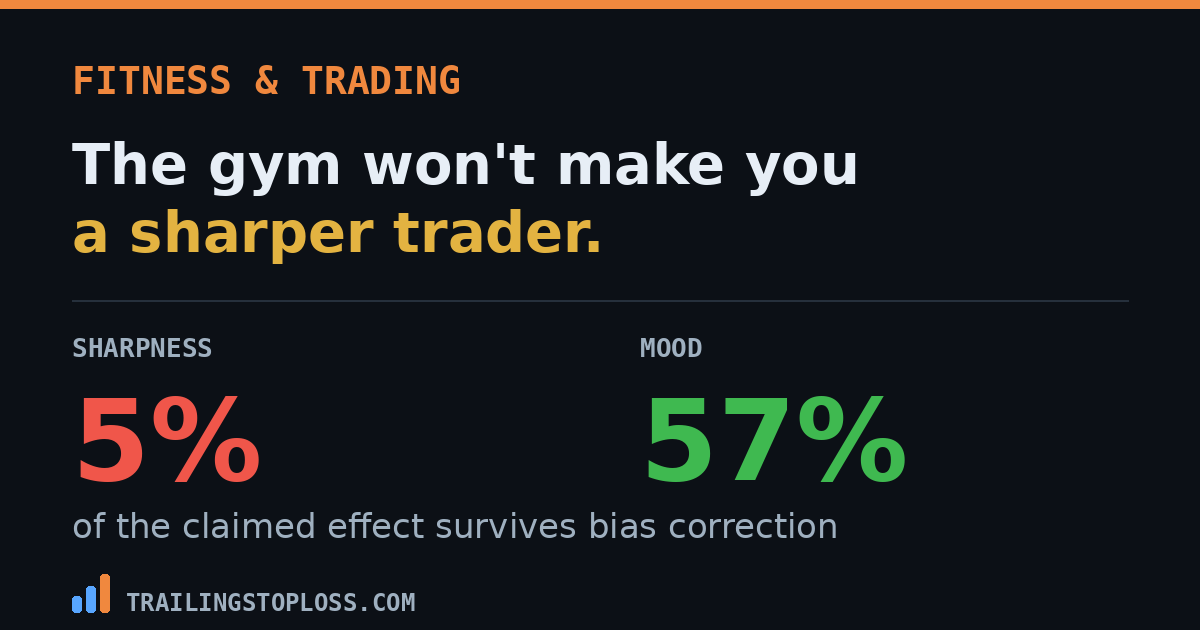
The claim you’ve heard is that exercise improves executive function, so you’ll have better impulse control at the screen. When researchers corrected that literature for publication bias, the executive function effect retained about 5% of its headline size. What survived correction is a different benefit — and for a trader it’s the more useful one.
Your problem at 10:15 on a red morning was never processing speed.
The claim, and what happened to it
The standard argument goes: exercise improves executive function — the cluster covering working memory, cognitive flexibility and inhibitory control — and inhibitory control is what stops you clicking the revenge trade. Train the body, sharpen the brain, trade better.
The evidence base looked strong. A 2025 umbrella review pooled 133 systematic reviews covering 2,724 randomized trials and more than 258,000 participants, reporting a substantial effect on general cognition and moderate effects on memory and executive function. That’s an enormous amount of data pointing one way.
Then a separate team reanalyzed the same literature while adjusting for publication bias — the tendency for studies finding an effect to get published while null results sit in a drawer. The adjusted numbers are much smaller than commonly reported, with prediction intervals spanning both positive and negative effects, and the authors concluded that broad claims of generalized cognitive enhancement from exercise appear premature. (Bartoš et al., 2025)
| Outcome | As published | Bias-adjusted | Retained |
|---|---|---|---|
| Executive function | 0.22 | 0.012 | 5% |
| Memory | 0.26 | 0.027 | 10% |
| General cognition | 0.42 | 0.227 | 54% |
Executive function — the exact mechanism the trading version of this claim depends on — comes out at 0.012, with a credible interval running from zero. For scale, 0.20 is conventionally the threshold for a small effect. This is two orders of magnitude below that. An earlier analysis of the same question found much the same thing: an effect of 0.13 that became negligible at 0.05 once publication bias was accounted for.
It doesn’t mean exercise is pointless, and it doesn’t mean the cardiovascular case has weakened. It means one specific claim — that a training session measurably improves the cognitive machinery you use to resist a bad trade — isn’t supported once you correct for which studies got published. If you took up the gym expecting sharper decision-making at the screen, the effect you were promised is roughly indistinguishable from zero.
What survived
The mood literature holds up considerably better under the same scrutiny.
An umbrella review of 27 reviews covering 190 experiments found exercise reduced depressive symptoms with a moderate effect size of −0.67 and a number needed to treat of 2.78. Crucially, the authors then restricted the analysis to studies at low risk of bias — the honest test. The effect shrank but held: −0.38, with a number needed to treat of 4.72. (Journal of Affective Disorders)
So roughly 57% of the headline effect survives, against 5% for executive function. And a number needed to treat of 4.72 means about one person in five gets a meaningful benefit — a better hit rate than almost anything else you might change about your routine.
Why the mood finding is the more useful one anyway
Here’s the thing the cognitive framing gets wrong about trading. You do not lose money because your working memory is a few percent below capacity. You lose it in identifiable emotional states — after a stopped-out trade, on the third red day, when you’re behind for the month and the drawdown threshold is close.
We’ve covered what that costs elsewhere: an eleven-trade losing streak is a median year, not a catastrophe, and the damage comes from how you respond to it rather than the streak itself. Similarly, breaking your own daily loss limit usually pays — right up to the day it ends the account. Neither of those is a cognition problem. Both are state problems.
Which is exactly the domain where the evidence survived correction. Not “you will think faster,” but “your baseline mood is likely to be better, and one in five people get a meaningful shift.” A trader in a better baseline state is a trader less likely to be in the state where the account-ending decision gets made.
Two more benefits need no meta-analysis because they aren’t psychological claims at all. Training takes you physically away from a screen you’d otherwise keep watching — the direct antidote to the problem of watching your P&L. And a session at a fixed time imposes a boundary on the trading day, which for anyone working from home is often the only thing separating “the session ended” from “I’m still at the desk at 4pm looking for something.”
What this means practically
- Stop treating the gym as performance enhancement. Expecting sharper decisions sets you up to quit when they don’t arrive. The realistic return is on mood and structure, and those show up over weeks rather than in the session afterwards.
- Schedule it against your worst window, not your best. If you tilt in the afternoon, training at 2pm removes you from the screen during the hours that cost you money. That’s a structural gain independent of any effect on the brain.
- Consistency beats intensity for this purpose. The mood evidence comes from sustained programs, not individual sessions. Three ordinary sessions a week you actually complete beat a punishing plan you abandon in a fortnight.
- Track it separately from your trading. Don’t look for a correlation between yesterday’s session and today’s P&L — with the sample size you have, you’ll find noise and draw a conclusion from it, which is the same error as reading causes into random losses.
- If you’re training already, don’t stop on this article’s account. Nothing here argues against exercise. It argues against one specific claimed mechanism, while a different one held up.
The honest limits
Bias-adjusted estimates are themselves estimates. The methods for correcting publication bias are contested, and different techniques give different answers. What isn’t contested is the direction: the published literature overstates the effect. How much is a live question.
None of this research studied traders. The depression findings come from clinical and general populations, largely people with diagnosed symptoms. Whether a modest mood improvement in that context translates into fewer revenge trades has, as far as we can find, never been tested on anyone.
Subgroups may do better than the average. The reanalysis noted that specific population and intervention combinations showed more consistent benefits, even where the overall picture was weak. An average near zero doesn’t rule out real effects for particular people doing particular things.
And if you have persistent low mood, this isn’t the article for that. Exercise having genuine antidepressant evidence behind it is not a reason to substitute it for talking to a doctor.
The short version
The usual argument for traders exercising is that it improves executive function and therefore impulse control at the screen. When researchers reanalyzed 133 reviews covering more than 2,700 trials while correcting for publication bias, the executive function effect fell from a published 0.22 to an adjusted 0.012 — about 5% of its headline size, with a credible interval running from zero, and far below the 0.20 conventionally needed to call an effect small at all. The mood evidence held up much better: restricted to low-risk-of-bias studies, exercise reduced depressive symptoms with an effect size of 0.38 and a number needed to treat of 4.72, meaning roughly one person in five benefits meaningfully. That’s the more useful finding anyway, because traders don’t lose money from slow cognition — they lose it in identifiable emotional states after a loss, a streak, or a bad month. Train for the state, not the sharpness, and take the two mechanisms that need no research at all: time physically away from the screen, and a fixed boundary on the trading day. (Journal of Affective Disorders)
Frequently asked questions
Does exercise actually improve trading performance?
No study has tested that directly. What can be said is that the mechanism usually cited — exercise improving executive function and therefore impulse control — largely disappears once the literature is corrected for publication bias, falling from a published effect of 0.22 to an adjusted 0.012. The mood benefits survive correction far better. Since most trading damage happens in emotional states rather than through slow thinking, that’s arguably the more relevant pathway, but it remains an inference rather than a demonstrated result.
Does exercise improve focus and decision-making?
Less than the popular claim suggests. A 2025 reanalysis of 133 systematic reviews covering 2,724 randomized trials found that after adjusting for publication bias, the effect on executive function was 0.012 and on memory 0.027, with prediction intervals spanning both positive and negative values. The authors concluded that broad claims of generalized cognitive enhancement from exercise are premature. General cognition retained more of its effect, at 0.227, but the specific decision-making claim did not.
How does exercise help with trading tilt?
Through mood and structure rather than cognition. Exercise has reasonable randomized evidence for reducing depressive symptoms — an effect of 0.38 in low-risk-of-bias studies, with about one in five people benefiting meaningfully. A better baseline emotional state means fewer sessions spent in the state where damaging decisions get made. Two non-psychological mechanisms matter too: training removes you physically from the screen, and a fixed session time imposes a boundary on the trading day.
When should a trader work out?
Against your worst window rather than your best. If you tend to tilt in the afternoon, training then removes you from the screen during the hours that cost you money, which is a structural benefit independent of any effect on your brain. Consistency matters more than intensity for this purpose, since the mood evidence comes from sustained programs rather than single sessions — three ordinary sessions a week you complete beat a demanding plan you abandon.
What is publication bias and why does it matter here?
Studies that find an effect are more likely to be published than those that don’t, so the visible literature overstates the true average. Statistical methods can estimate and correct for that. In exercise and cognition research the correction is dramatic: effects on executive function and memory largely vanish, while effects on general cognition and depressive symptoms shrink but persist. It’s the reason a claim can be supported by thousands of studies and still not be reliable.
Related on this site: why you break your own rules · watching your P&L costs you money · when a losing streak means stopping · free training calendar
Effect sizes are standardized mean differences drawn from published meta-analyses and reanalyses; bias-correction methods are contested and estimates vary between techniques. None of this research studied traders. Nothing here is medical or financial advice — if you’re dealing with persistent low mood, speak to a doctor rather than treating a training program as a substitute.


