▸ Trading Psychology
Fear of Pulling the Trigger
The setup is textbook. Every box on your checklist is ticked. Price is sitting right at your level — and your finger won’t move. You pull up a lower timeframe “just to confirm,” add one more indicator, wait for one more candle, and then watch the trade run to your target without you. This is the exact opposite problem from overtrading, and it’s just as expensive: the trader who knows everything and does nothing. If you’re often right about direction but never actually in the trade, this one’s for you.
Two different freezes
It helps to separate two things that feel identical from the inside. Analysis paralysis is an intellectual block before execution — you never finish analyzing, so you never reach the decision. Fear of pulling the trigger is an emotional block at execution — you complete the analysis, decide to trade, and then can’t click the button. They overlap and share fixes, but knowing which one you have tells you where to aim. Most traders who freeze have a bit of both. (Complete Trader’s Edge: paralysis vs execution fear)
Whichever it is, the honest diagnosis is uncomfortable: analysis paralysis is almost always fear of losing dressed up as caution. The logic feels responsible — “if I analyze enough, I can avoid bad trades” — but it’s a dead end, because losing trades are built into every profitable strategy. You cannot analyze your way out of a probabilistic game. The thoroughness is real; it’s just pointed at a problem (certainty) that doesn’t have a solution. (TradesViz: fear of losing dressed up as caution)
Why more analysis makes it worse
Here’s the cruel twist that keeps the loop spinning: past a useful threshold, more information makes decisions worse, not better. Each additional indicator, timeframe, or analyst opinion introduces noise that can contradict your existing signal, so you end up less confident rather than more. The trader who needs five confirmations isn’t being careful — they’re chasing a certainty that doesn’t exist in markets, and every new data point manufactures a fresh doubt faster than it resolves an old one. (TradesViz: more information, lower conviction)
There’s real science under this. Barry Schwartz’s work on the paradox of choice showed that more options reduce satisfaction and increase anxiety rather than improving outcomes. Stack RSI, MACD, two moving averages, Bollinger Bands, Stochastic, and volume profile on one chart and you haven’t raised your decision quality — you’ve raised the cognitive load until action becomes psychologically impossible. Clarity comes from reduction, not addition. (Complete Trader’s Edge: the paradox of choice on a chart)
What hesitation actually costs you
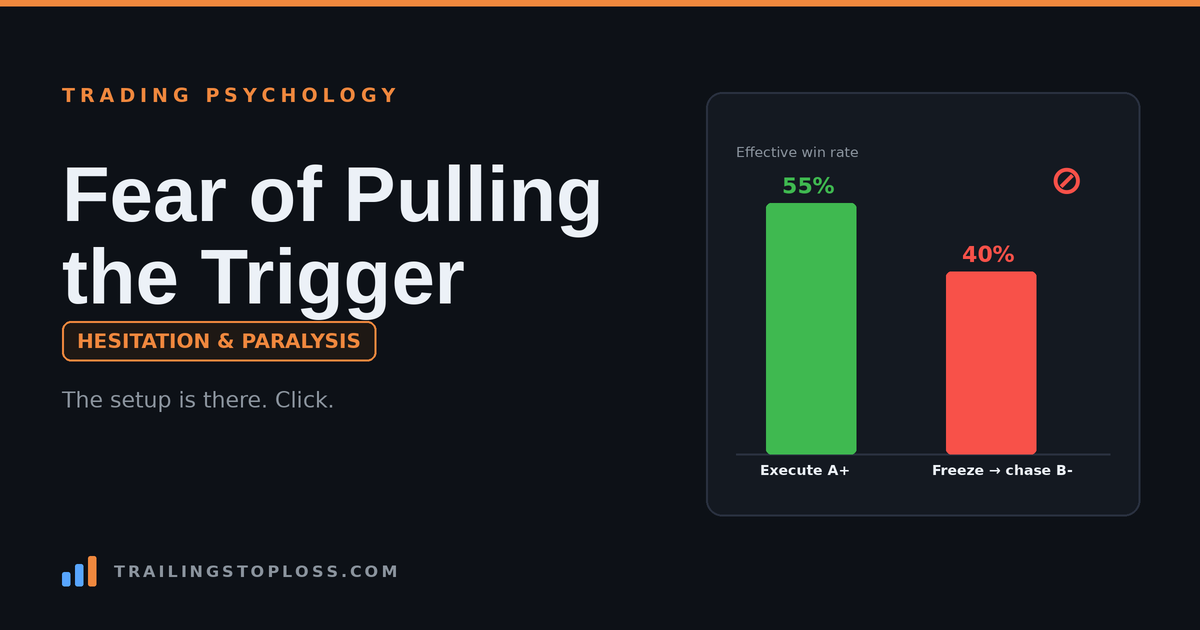
This isn’t a harmless quirk — it’s one of the main reasons a genuine edge never turns into profit. Watch what it does to the math. Say your system wins 55% at 2:1, a solidly profitable setup over 100 trades. Now let hesitation make you skip 30 of your cleanest A+ setups, and — because freezing breeds frustration — you jump into 30 impulsive B− setups instead to “make something happen.” You’ve swapped 30 high-probability entries for 30 low-probability ones, and your effective win rate can collapse from 55% toward 40%. A winning system becomes a losing one, not because the strategy failed, but because you couldn’t execute it. (Trinity Trading: skipping A+ setups tanks your effective win rate)
And there’s a second, sneakier cost the missed-trade pain itself. Many traders find the sting of missing a great move sharper than the sting of a loss, which spawns “reverse FOMO”: you got burned by missing something, so now you’re subconsciously terrified of entering at the wrong time, and you wait, and wait, for a “perfect” that never comes. Reverse FOMO masquerades as patience. It’s fear wearing a discipline costume. (Trinity Trading: reverse FOMO in a discipline costume)
Caution or paralysis? The one-question test
Crucially, not every hesitation is a problem — sometimes waiting is the correct, disciplined call. The difference isn’t the pause; it’s the reason for it. There’s one clean diagnostic. (Trader’s Second Brain: accurate hesitation vs paralysis)
A specific reason
“This doesn’t meet my criteria.” You checked your written plan, the setup falls short on a defined rule, and passing is the correct disciplined move. The hesitation points at something nameable on the chart.
A vague feeling
“I just can’t pull the trigger.” Your written criteria are objectively met and you still won’t act. The block is emotional, not analytical — and no amount of extra confirmation will clear it, because it isn’t an information problem.
So the test is a single question: do my written plan criteria say this is a valid trade? If yes, and you’re not taking it, you’ve crossed from caution into paralysis — full stop. The goal was never zero hesitation; it’s accurate hesitation: pausing on trades that genuinely fail your rules, and executing without delay on the ones that pass. (Complete Trader’s Edge: the written-criteria diagnostic)
The three real causes — and the fix for each
Hesitation feels like one problem but usually traces to one of three specific causes, and each needs a different tool. Aiming the wrong fix at it is why “just be more disciplined” never works. (Trader’s Second Brain: three causes, three fixes)
You don’t trust your edge. If you’ve never watched your setup work across 100+ examples, every live instance feels uncertain because you have no statistical basis for confidence. This hesitation is actually rational — and the fix isn’t more real-time analysis, it’s more backtesting and journaling. Pull your setup’s stats: how many trades, what win rate, what profit factor? If you can’t answer with numbers, you’ve found the problem. Print the stats, put them next to your screen, and let your brain override the fear with evidence. (Trader’s Second Brain: feed your brain better data)
Recent-loss trauma. After a painful loss, your brain files the market conditions away and slams the panic button the moment they reappear — a protective reflex that misfires on objectively valid trades. And “I should think more before trading” quietly mutates into “I should think forever before trading.” The cure is exposure at a size small enough that the trauma response doesn’t fire (see the protocol below), not another filter added to your rules. (TradesViz: overcorrecting after a burn)
Vague entry rules. If your criteria are fuzzy, every entry is a judgment call, and judgment calls under pressure are exactly what freezes. The bias loop — form a lean, then hunt confirmations until the entry’s gone — feels like discipline but is avoidance with extra steps. The fix is a binary checklist: three to five clear, objective conditions. Met, you take it, no exceptions. More than three or four conditions and it’s too complex to execute live. (MonkeyTrade: the bias loop is avoidance with extra steps)
The protocol that gets you executing
You don’t think your way out of this — you act your way out, in doses small enough that fear can’t veto the click. Here’s the graduated-exposure protocol. (TradesViz: shrink the stakes to unfreeze execution)
- Cut size until the click is easy. If the fear of being wrong is too intense at your normal size, trade smaller — much smaller. A 1-micro position you actually take is worth infinitely more to your development than a full-size trade you only imagine taking. Reducing the stakes reduces the emotional weight that triggers the freeze. Scale up only as execution becomes automatic.
- Separate analysis from execution. Do your analysis when the market’s closed or before the session — mark levels, define the setup, write the entry. Then in real time your only job is to execute a decision already made. Analysis is calm and deliberate; execution needs speed. Mixing them live is where paralysis is born.
- Build a binary 3-condition checklist. Reduce your entry to three objective yes/no criteria. If all three are true, you take the trade — no fourth confirmation, no lower-timeframe detour. This converts a judgment call into a rule you simply follow.
- Put a timer on your decision. Give yourself a fixed window — say 60–90 seconds — once price reaches your level. When it’s up, you either enter or you’ve passed. A deadline starves the “one more candle” loop that eats every entry.
- Strip your chart. Remove every indicator that isn’t part of your three criteria. Fewer inputs, less conflicting noise, lower cognitive load. Clarity is subtraction.
- Log every trade you didn’t take. Write down each valid setup you passed, why, and what price did next. Two weeks of that data usually ends the paralysis by itself, because seeing how many winners you skipped is more motivating than any pep talk. Track your “almost” trades — they’ll tell you exactly what hesitation is costing you.
🧠 The reframe that unlocks the clickMark Douglas put it best: traders who genuinely accept the risk before entering can execute without hesitation, because the fear has already been acknowledged and contained. You’re not looking for certainty — it doesn’t exist. You’re placing one bet in a long probability game, having already decided the exact amount you’re willing to lose. Accept that number in advance, and the trigger stops being a threat.
The bottom line
Fear of pulling the trigger is the overtrader’s mirror image, and it fails you for the same underlying reason: it’s an emotional response impersonating a rational process. Overtraders chase action to escape discomfort; you avoid action to escape the discomfort of being wrong — and both wreck the same edge. Confidence doesn’t come from knowing more; it comes from executing more, in small enough doses that your brain gathers the evidence it’s demanding. Shrink the size, simplify the rules, accept the risk in advance, and take the trade your plan already approved. The analysis is done. The setup is there. Click. (Enlightened Stock Trading: confidence comes from executing, not knowing)
Build the execution habit: define your binary entry and risk before the bell with the Hard-Stop Plan Builder, size micro-positions with the position size calculator, and log every “almost” trade on the P&L Calendar. This is part of our trading psychology guide — and the opposite failure, taking too many trades, is covered in You Don’t Have to Trade Every Day.
FAQ
Why can’t I pull the trigger on trades I know are good?
Usually because you don’t truly trust the edge yet, you’re carrying recent-loss trauma, or your entry rules are too vague to execute under pressure. The block is emotional, not informational — so more analysis makes it worse. The fixes are building statistical evidence in your journal, trading smaller to lower the stakes, and reducing your entry to a binary checklist.
What is analysis paralysis in trading?
It’s overanalyzing a potential trade to the point where you can’t act, so the opportunity passes. You have enough information to decide but keep hunting for one more confirmation. It’s typically fear of being wrong disguised as thoroughness — and because certainty doesn’t exist in markets, no amount of extra analysis resolves it.
How do I know if I’m being disciplined or just afraid?
Ask one question: do my written plan criteria say this is a valid trade? If the setup genuinely fails a defined rule, passing is healthy caution. If every criterion is met and you still won’t act, that’s paralysis, not patience. Healthy hesitation has a specific, nameable reason; fearful hesitation is a vague “I just can’t.”
Does hesitation actually cost that much?
Yes. Skipping your cleanest A+ setups and then jumping into impulsive B− ones to compensate can drop a 55% win-rate system toward 40% — turning a winner into a loser without changing the strategy at all. Missed profitable trades plus the lower-quality trades you take instead make hesitation one of the main reasons a real edge never becomes profit.
How do I stop hesitating and start executing?
Trade small enough that fear can’t veto the click, separate your analysis (done before the session) from execution (done in real time), reduce your entry to a binary 3-condition checklist, put a 60–90 second timer on the decision, strip your chart of extra indicators, and log every valid setup you skip. Accept your maximum loss before entering, as Mark Douglas advised, and the trigger stops feeling like a threat.
TrailingStopLoss publishes independent, funded-trader analysis of prop firms, strategy, and trading psychology. Educational content only — not financial advice. Trading futures involves substantial risk of loss.


