▸ Trading Psychology
The Break-Even Reflex
The moment a trade ticks into profit, a specific urge arrives: move the stop to break-even. It feels like the most responsible thing you can do — you’re taking risk off the table, making it a “free trade,” protecting yourself. Almost every trader does it, almost every trading educator recommends it, and almost nobody examines it. Which is a shame, because underneath the risk-management language it’s usually not risk management at all. It’s loss aversion wearing a hard hat, and it quietly clips your winners at the one spot where they can least afford it.
This is a narrow habit with an outsized cost, and it hides well — because moving to break-even feels like discipline. It has the texture of a rule. But a good rule survives inspection, and this one mostly doesn’t.
What the reflex actually is
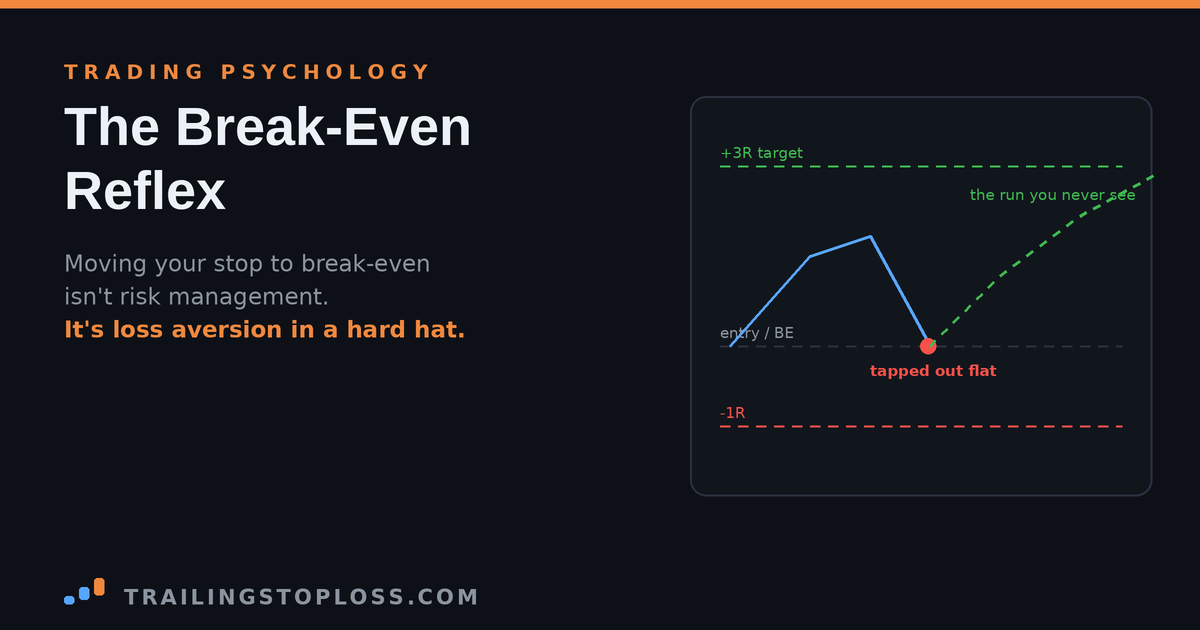
Strip away the justification and look at the mechanism. You enter a trade with a stop and a target, sized so the trade is worth taking. Price moves a little in your favour. You slide the stop up to your entry. Now one of three things happens: the trade continues to target (the stop change was irrelevant), the trade reverses and hits your original stop level (the change saved you a loss), or — and this is the case nobody counts — price pulls back through your entry on ordinary noise, stops you out flat, and then continues to your original target without you.
That third outcome is the whole story. The break-even stop doesn’t sit at a meaningful level. It sits at your entry price, which is meaningful to you and to nobody else. And your entry price is usually close enough to current price that normal, meaningless wiggle reaches it. You’ve placed your stop in the middle of the noise and called it safety.
Why it’s loss aversion, not risk management
Here’s the tell. Ask a trader why they moved to break-even and the honest answer, underneath the jargon, is: “I couldn’t stand the idea of this winner turning into a loser.” That’s not a statement about risk. It’s a statement about a feeling — specifically the disproportionate pain of giving back a gain you’d mentally already booked.
Real risk management is decided before the trade, when you’re calm and the outcome is unknown. You size the position, you place the stop where your plan says, and you accept the full risk as the cost of the opportunity. The break-even move is decided during the trade, in response to a price tick, by the part of you that’s now emotionally invested in not being wrong. Those are different activities. One is a plan; the other is a reaction to a feeling that happens to look like a plan. It’s the same root impulse behind moving a stop away from price — the direction is opposite, but the driver is identical: an in-trade emotional state overriding the pre-trade decision.
The math, directionally
Put rough numbers on it to see the shape of the problem. Imagine a genuine edge — a 3:1 target hit 40% of the time, which is comfortably profitable. Now compare leaving the bracket alone against religiously moving to break-even once price reaches the halfway point.
The break-even move does two things at once. It saves some losers — trades that would have gone to −1R exit flat instead. That’s real and it feels great. But it also clips some winners — trades that would have reached +3R get tapped out at zero by a pullback first. And here’s the asymmetry that sinks it: a saved loser is worth about 1R, but a clipped winner costs you 3R. You’re trading away 3R outcomes to rescue 1R ones, and it doesn’t take many clipped winners to swamp the saved losers.
| What the break-even move does | How it feels | What it’s worth |
|---|---|---|
| Saves a would-be loser (exit flat vs −1R) | Great — visible, immediate | +1R avoided |
| Irrelevant (trade reaches target anyway) | Neutral | 0 |
| Clips a would-be winner (flat vs +3R) | Invisible — you don’t see the run you missed | −3R given up |
The reason the habit persists is entirely in that middle column. The save is visible — you watched price reverse and felt the relief of exiting flat. The clip is invisible — you exited at break-even, closed the chart, and never saw the trade go on to hit its target without you. You feel every rescue and none of the amputations, so your gut scores the habit as a clear win while your equity curve quietly disagrees.
⚠ The hidden second costThe break-even reflex doesn’t just clip winners — it trains a belief. Every time a break-even stop “saves” you, it reinforces the idea that the market is out to take your profits and you must grab safety early. That belief then bleeds into taking profits early everywhere, cutting winners short across your whole approach — the exact opposite of what a 3:1 system needs. One small habit quietly rewires your relationship with every winning trade you take.
When moving to break-even is actually fine
This isn’t an absolute prohibition, and pretending it were would be dishonest. There are legitimate, pre-planned reasons to move a stop, and the test — as always — is whether you decided it before the trade or in reaction to a price tick.
The common thread: every legitimate version was decided in advance and would be written in your plan. The reflex version is decided at the moment price crosses some arbitrary profit threshold, by the part of you that wants the discomfort of an open risk to stop.
How to break the reflex
- Name it when it happens. The next time you feel the urge, say to yourself: “This is loss aversion, not management.” Naming the impulse robs it of the disguise it depends on. Half the battle is refusing to let it masquerade as discipline.
- Place the bracket and close the chart. The reflex needs you watching. If your stop and target are resting orders and you’ve walked away, there’s no tick-by-tick feed to react to. This is the same defense that beats most in-trade mistakes — see one trade a day at 3:1.
- Log the counterfactual. For one month, every time you’d normally move to break-even, don’t — and record what the trade would have done. Watching how many clipped winners you’d have surrendered is the single most convincing argument against the habit, because it makes the invisible cost visible.
- Separate the two decisions in writing. “Where’s my stop” is a pre-trade decision. “How do I feel about this open profit” is not a decision at all — it’s a feeling. Keep them apart on paper and the reflex has nowhere to hide.
- If you must manage, manage on structure, not on profit. A stop that trails behind genuine market structure is at least anchored to something the market respects. A stop parked at your entry is anchored to your emotions. If you’re going to move it, move it to a level, never to a feeling.
- Trust the sizing you already did. You accepted the full 1R risk when you entered, calmly, on purpose. The trade going slightly green doesn’t make that original risk decision wrong — it just makes the open position uncomfortable, which is a different thing entirely. See same risk every trade.
🧠 The reframe that fixes itStop thinking of an open profit as money you now own and could lose. It isn’t yours until the trade closes — it’s an unrealized number on a screen, and the trade is still just doing what you sized it to do. You didn’t “make and then give back” 1.5R when a winner pulls back to your entry. You took one trade, with one predetermined risk, and it resolved. The profit you “gave back” was never in your account and was never part of your plan. Nothing was lost except a feeling.
The bottom line
The break-even reflex is the most respectable-looking mistake in trading. It borrows the language of risk management, it feels like maturity, and it’s endorsed everywhere — which is exactly why it’s worth examining rather than inheriting. Underneath, for most traders most of the time, it’s loss aversion: an inability to tolerate a winner becoming a loser, dressed up as prudence, and paid for in clipped winners you never see run.
The fix isn’t complicated, just uncomfortable. Decide your risk before the trade, accept it as the price of the opportunity, and let the trade resolve on the terms you set when you were calm. Moving your stop to break-even because price ticked green isn’t protecting your trade. It’s protecting your feelings — and your feelings are not what the market pays you to manage.
See what the reflex actually costs you. Log a month of trades and mark every one where you moved to break-even — then check how many would have run. The invisible cost becomes very visible.
Open the free P&L Calendar →Related: moving your stop away from price is the same impulse in reverse, the win rate fallacy covers the obsession with being right, and the trading psychology guide ties the cluster together.
FAQ
Is moving your stop to break-even a good idea?
Usually not, if you’re doing it reflexively the moment a trade goes green. A break-even stop sits at your entry price, which is meaningful to you but not to the market, so it tends to sit right in the zone of normal price noise. That means it frequently taps you out flat on a routine pullback before the trade continues to its target — costing you a full winner to avoid a possible loser. It’s defensible only when it’s a tested, pre-planned part of your system.
Why does moving to break-even feel so responsible if it’s costly?
Because the benefit is visible and the cost is invisible. When a break-even stop saves you from a loss, you watch it happen and feel the relief. When it clips a winner, you exit flat, close the chart, and never see the trade go on to hit its target without you. You experience every rescue and none of the amputations, so it feels like a clear win even when your results say otherwise.
Isn’t a break-even stop just “risk-free” trade management?
That’s the framing, but it’s misleading. Real risk management happens before the trade, when you calmly size the position and place the stop your plan calls for. Sliding the stop to break-even mid-trade is a reaction to a price tick driven by the discomfort of an open profit — which is loss aversion, not management. Nothing is actually “free”; you’re paying for the reduced risk with a higher chance of being stopped out by noise.
When is it okay to move a stop to break-even?
When the decision was made before the trade rather than in reaction to it. Legitimate cases include a tested rule that measurably improves your expectancy over a real sample, a genuine invalidation of your trade thesis, a scheduled news event you’ve decided not to hold through, or a planned scale-out. The test is simple: could you have written the rule down before you entered? If yes, it’s a rule; if you’re improvising because the profit feels fragile, it’s the reflex.
How do I stop compulsively moving my stop to break-even?
Name the urge as loss aversion when it appears, place your bracket as resting orders and close the chart so there’s no tick-by-tick feed to react to, and for one month log what your trades would have done if you hadn’t moved the stop. Seeing how many winners you’d have clipped makes the hidden cost visible, which is far more persuasive than any argument. If you do manage a stop, anchor it to market structure, never to your entry price.
Does the break-even reflex have effects beyond the single trade?
Yes. Each time a break-even stop appears to save you, it reinforces a belief that the market is trying to take your profits and you should grab safety early. That belief tends to generalize into taking profits early across your whole approach, cutting winners short everywhere — which is the opposite of what a high reward-to-risk strategy needs to work. A small habit ends up reshaping how you treat every winning trade.
This article is educational and not investment advice. The figures used are an illustrative model to show the direction and shape of the effect, not measured results or a precise prediction for any strategy. Whether break-even stops help or hurt depends on your specific edge, instrument, and timeframe — test on your own data. Trading carries substantial risk of loss.


