▸ Prop Firm News & Analysis
The Alpha Futures Collapse: What NinjaTrader’s Exit Exposed
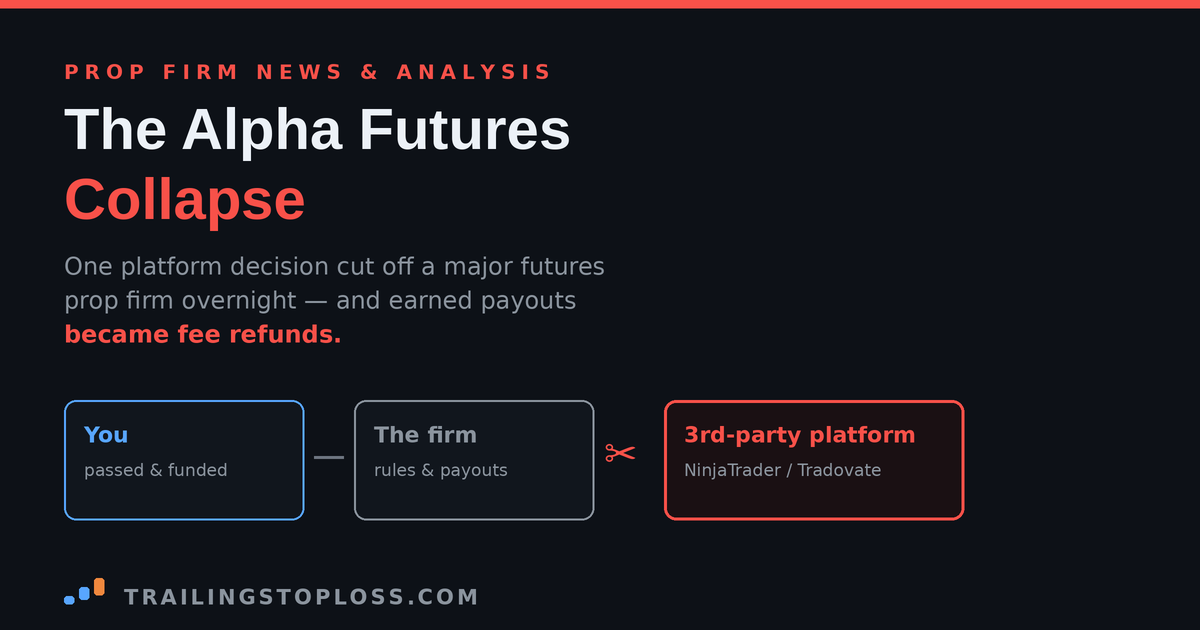
In roughly twenty-four hours, one of the larger futures prop firms went from a fixture in the rankings to delisted. A single decision by its platform provider cut off new accounts, killed a flagship plan, and — the part that matters most — turned some traders’ earned, pending payouts into refunds of their fee. It’s the cleanest illustration in recent memory of a risk almost no prop-firm ranking measures: what happens to your money when a firm doesn’t actually control the rails it runs on.
What happened, in order
The trigger was a platform split. On July 12, 2026, NinjaTrader terminated its contract with Alpha Futures, and because NinjaTrader also owns Tradovate, the cut severed Alpha from the two most widely used platforms in futures prop trading in a single stroke. [TradeInformer]
The two sides tell different stories about why. Alpha’s version is that after it launched its own platform, AlphaTrader, the relationship soured over NinjaTrader’s concern about hosting a competitor, and no agreement could be reached on integration or on promoting both platforms equally. NinjaTrader’s version, per widely circulated emails, is a contract dispute over an outstanding sum. No independent verification has settled it, which leaves the cause squarely in counterparty-dispute territory. [TopNews]
The part that actually matters: the payouts
A platform breakup is a business story. What turns it into a trader story is what happened to money people had already earned. Alpha closed all active Premium accounts and offered to refund account fees — but multiple reports describe earned, pending payouts being converted into refunds of the account fee instead of being paid out. [Prop Trader Edge]
Sit with the distinction, because it’s the whole point. A fee refund gives you your entry cost back. A payout is the profit you produced by passing the evaluation and trading the funded account. Converting the second into the first means a trader who did everything right — passed, traded, earned — walked away with their fee back and none of the profit they’d been told was theirs. Whatever the contractual justification, that is the single worst outcome a funded trader can experience, and it’s the exact scenario a review site exists to warn people away from. [Alpha Market Flow]
The risk nobody scores: platform dependency
Here’s the structural lesson, and it’s the one worth carrying to every other firm you’re considering. Alpha didn’t fail because its rules were bad or its evaluation was a scam. It failed because it didn’t control the infrastructure its business ran on — and when the third party that did control it walked away, the firm’s ability to operate and pay went with it, overnight, through no action of any trader. Industry coverage has framed the episode explicitly as a lesson in overreliance on third-party platforms. [Finance Magnates via TradingView]
Almost no prop-firm ranking captures this. Rankings score profit split, price, drawdown type, and payout speed — all real, all useful, and all irrelevant the moment the firm loses access to the platform that connects it to the exchange. Platform dependency is a firm-risk factor that sits underneath every other metric, and it only becomes visible when it detonates. It’s telling that in the wake of this, larger firms are moving the other way: Topstep, for instance, has been pursuing vertical integration — acquiring its own routing technology to keep complete control of the rails. [Finance Magnates]
✅ Why this was on our avoid list firstWe demoted Alpha Futures to the caution list in July, before the payout fallout was fully public — on the back of repeated plan retirements and the platform instability that preceded the split. This isn’t a victory lap; it’s the standard working as intended. A review site earns its keep by flagging firms on the warning signs before the collapse, not by writing the obituary afterward. See the prop firms to avoid list and our Alpha Futures review.
What to actually do with this
The point of a story like this isn’t schadenfreude — it’s a checklist for the firm you’re about to fund. Three questions the Alpha episode should make you ask of anyone.
None of this requires inside information. Plan retirements are announced, platform relationships are public, and payout complaints surface fast on trader forums and review sites. The signals were there to read before July 12 — which is precisely why the firms worth trusting are the ones still standing after a stress test like this, not the ones with the loudest promotion before it.
⚠ For traders currently affectedIf you hold an Alpha account or are owed a payout, rely on the firm’s own official statements for the current migration and refund process rather than secondhand summaries — this remains a developing situation and details have shifted day to day. Document everything: your passed evaluation, your account balance, any payout request and its status, and all correspondence. Whatever the eventual resolution, a clear paper trail is the one thing entirely within your control.
The bottom line
Alpha Futures didn’t collapse because of a bad evaluation or a rigged rule. It collapsed because it didn’t own the infrastructure it depended on, and when that infrastructure was pulled, the firm’s ability to pay went with it — and some traders’ earned profits were converted into fee refunds in the fallout. The lesson generalizes: the metrics that dominate prop-firm rankings all assume the firm can operate at all, and that assumption is exactly what platform dependency can erase overnight.
Judge firms on how they behave under stress, not on how they market during calm. Prefer the ones that control their own rails, that have paid cleanly through trouble, and that aren’t retiring a plan every few weeks. And when a firm shows the warning signs, believe them the first time — the traders who got their fees back instead of their payouts were funded on a firm whose cracks were already visible.
See which firms we currently flag — and why. The avoid list is updated as the warning signs appear, not after the collapse makes headlines.
See the Prop Firms to Avoid list →Related: prop firm drawdown types and futures prop firm true cost cover the metrics that do matter once a firm is stable, and the avoid list tracks the ones flashing warning signs now.
FAQ
What happened to Alpha Futures in July 2026?
On July 12, 2026, NinjaTrader terminated its contract with Alpha Futures. Because NinjaTrader also owns Tradovate, this cut Alpha off from both major futures platforms at once, halting new accounts. Alpha also discontinued its Premium plan, and the firm was delisted from major directories within about a day. The two companies gave conflicting reasons — Alpha pointed to its own competing platform, NinjaTrader to an alleged contract dispute — and the cause has not been independently settled.
Did Alpha Futures traders lose their payouts?
According to multiple industry reports, Alpha closed all active Premium accounts and offered to refund account fees, but earned pending payouts were in cases converted into refunds of the fee rather than paid out. That distinction is the heart of the story: a fee refund returns your entry cost, while a payout is the profit you earned trading the funded account. Affected traders should rely on Alpha’s official statements for the current process, as the situation has been developing.
Why did NinjaTrader drop Alpha Futures?
The two sides disagree. Alpha says that after it launched its own platform, AlphaTrader, NinjaTrader ended the relationship over concerns about hosting a competitor and about equal promotion of both platforms. NinjaTrader, per widely circulated emails, framed it as a contract dispute involving unpaid obligations. No independent verification has resolved which account is correct, so it sits in counterparty-dispute territory.
What is platform dependency risk in prop trading?
It’s the risk that a prop firm relying on a third-party platform inherits that platform’s decisions. If the platform provider withdraws — as NinjaTrader did with Alpha — the firm can lose its ability to onboard traders, operate, and pay, overnight, through no fault of any trader. Most prop-firm rankings score price, split, and drawdown but not this, even though it can erase all of those advantages instantly. Firms that own or build their own platform have removed this failure mode.
How can I tell if a prop firm is at risk before it collapses?
Watch three things: whether the firm controls its own platform or rents from a third party, how it has handled payouts during past stress rather than during calm, and how frequently it retires plans or changes rules. Repeated plan retirements in a short window signal a strained business model. These signals are public — announced plan changes, known platform relationships, and payout complaints on forums — and were readable in Alpha’s case before the termination.
Was Alpha Futures flagged before the collapse?
Yes. TrailingStopLoss demoted Alpha Futures to its caution list in July 2026, before the payout fallout was fully public, based on repeated plan retirements and the platform instability leading up to the split. The point of a review site is to flag firms on the warning signs ahead of a collapse rather than to document it afterward.
This article is news analysis and not investment advice. It summarizes reporting from third-party sources current as of late July 2026; the situation has been developing and specific details of account migration and refunds may have changed since publication — always confirm current details with the firm’s official statements. Accounts of the dispute differ between the parties and have not been independently verified. Trading with any prop firm carries substantial risk.