What Hedge Funds Have That You Don’t (And How Much of It Matters)
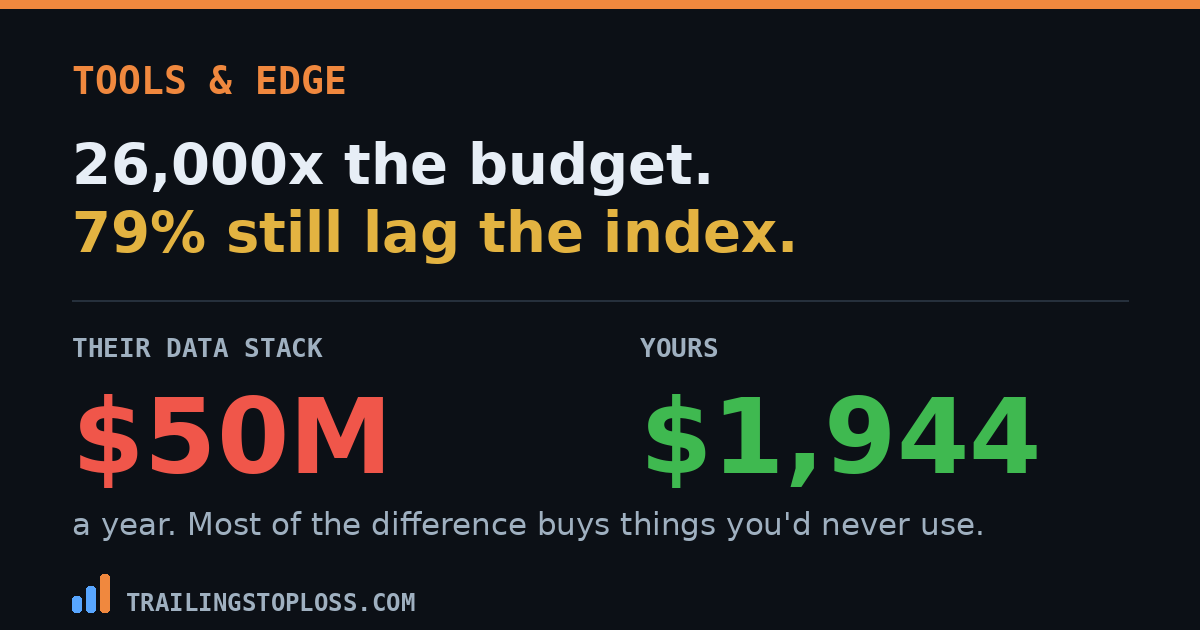
A single Bloomberg seat costs around $32,000 a year. The top twenty hedge funds each spend $40–60 million annually on alternative data. Set against that, a serious retail futures stack runs about $1,944 — roughly 26,000 times less. And 79% of active large-cap funds still lagged the index last year. Here’s an honest inventory of what the money buys, what’s collapsed in price, and what you genuinely can’t get.
The gap is real. Most of it is spent on strategies you’d never run.
The stack, priced
| Institutional | Per year |
|---|---|
| Bloomberg Terminal, single seat | ~$32,000 |
| B-PIPE real-time data API | ~$24,000–36,000 |
| Alternative data (top-20 fund average) | $40–60 million |
| Satellite imagery feed | $50,000–500,000 |
| Expert network access | ~$120,000 |
| Colocation and low-latency connectivity | six figures |
| Retail equivalent | Per year |
|---|---|
| TradingView Premium | $360 |
| CME real-time futures data add-on | $84 |
| Historical tick data, self-serve | ~$1,200 |
| Python, pandas, scikit-learn | $0 |
| Cloud compute for backtesting | ~$300 |
| SEC EDGAR filings | $0 |
| Broker API | $0 |
| Total | $1,944 |
Bloomberg’s price has barely moved in a decade and there is no individual tier — no stripped-down version, no discount for one person. Around 355,000 professionals pay it, generating an estimated $10–13 billion a year, and the reason isn’t really the data. (Godel)
Published 2026 figures for a single Bloomberg seat range from $24,240 to $31,980, because Bloomberg doesn’t publish rates and discounts depend on firm size and negotiating leverage. Anyone quoting one exact number is quoting one contract. The honest version is “roughly $25,000–32,000, and more for a small fund than for a large bank.”
What the money actually buys
1. The network, not the terminal
Bloomberg’s genuine moat is the IB chat network, which is where a large share of OTC bond trading is actually negotiated. You’re not paying for prices — you’re paying for the room everyone else is in. That’s a network effect, and it’s the one thing on this list money alone can’t replicate.
It also has nothing to do with trading NQ off a one-hour chart.
2. Alternative data
Satellite imagery of parking lots, aggregated credit card panels, geolocation footfall, web traffic. The famous case is Tiger Global counting cars in Walmart lots from satellites to estimate quarterly sales before earnings — which worked for years, until enough funds bought the same feed and the signal crowded out. (Vert Data)
Two things about that story get skipped. The signal decayed once it was widely bought, which is what happens to purchasable edges. And it’s an equity signal — it tells you something about a company’s quarter. There is no satellite feed that tells you what the NQ does after CPI.
The alternative-data figures here come from a vendor’s guide — a company that sells alternative data quoting how much hedge funds spend on alternative data. The direction is corroborated elsewhere and the numbers are widely cited, but treat them as indicative rather than audited. It’s the same reason we discount prop firm review sites that sell affiliate signups.
3. Execution infrastructure
Colocation, direct market access, smart order routing, sub-millisecond round trips. This is a genuine and unbridgeable gap — you cannot buy your way to a rack next to the matching engine on a retail budget.
It only matters if your strategy competes on speed. If you’re holding for minutes or hours, being 400 microseconds slower changes nothing. The correct response to this gap isn’t to try to close it; it’s to not play a game where it decides the outcome.
4. Financing and prime brokerage
Leverage at institutional rates, securities lending, cross-margining. Real, valuable, and mostly relevant to strategies requiring balance sheet — long/short equity, relative value, carry. A futures trader already gets exchange-set leverage that’s generous by any standard.
5. Research and expert networks
Sell-side analyst access and paid calls with industry specialists. Useful for fundamental equity work with a horizon of quarters. Irrelevant to intraday futures.
The moat is collapsing in some places
What used to separate institutions from everyone else was access to data. That’s largely over.
Real-time futures data costs $7 a month. Historical tick data is self-serve. Every filing is free on EDGAR. The statistical libraries a quant fund used in 2010 are now a free import, and the compute to run them costs less than lunch. One vendor’s summary of the shift — that what cost $500,000 a year in 2015 costs $5,000 in 2026 — is directionally right even allowing for the sales pitch.
The terminal market shows it plainly: alternatives now cover the core equity workflow at $79–118 a month against Bloomberg’s ~$2,665. For most users outside fixed income, the expensive product is depth they don’t use.
What hasn’t collapsed
- Order flow visibility. A market maker sees what customers are doing. It isn’t for sale.
- Colocation. Physics and rack space, not software.
- Genuinely exclusive datasets. The moment a dataset is broadly sold, its signal decays — so the valuable ones are the ones you can’t buy.
- An external risk function. Someone whose job is to cut your position regardless of your opinion. Structurally hard to buy for one person, which is the argument for renting enforcement from a prop firm.
The uncomfortable arithmetic
Set the whole inventory against the outcome. Institutions run a stack costing four to five orders of magnitude more than yours — and in 2025, 79% of active large-cap US equity funds underperformed the S&P 500, the fourth-worst showing in the scorecard’s 25-year history. Over 15 years, no category shows majority outperformance. (SPIVA U.S. Scorecard)
That’s not an argument that the tools are useless. It’s an argument that tools are not where the outcome is decided. If a $50 million data budget doesn’t reliably beat an index fund, a better charting package was never going to be your problem.
Which is worth remembering next time something is sold to you as the professional edge. The people with the actual professional edge mostly don’t beat the market with it.
What’s worth buying at your scale
- Accurate data for your instrument. Real-time CME data is $7 a month. Trading NQ off delayed or aggregated feeds to save that is a false economy.
- Historical tick data, if you actually test. Roughly $100 a month buys the ability to check whether an idea worked, which is the highest-value purchase on this list — and worthless if you don’t use it.
- Enforcement. A platform lockout is free. A prop firm’s drawdown limit costs an evaluation fee. Both substitute for the risk desk you don’t have, and that’s the gap that actually ends accounts.
- Nothing that promises signal. Purchasable edges decay on contact with buyers — that’s what happened to the parking lot data. Anything sold to retail as a signal has already been sold to everyone.
The honest limits
The cost figures are indicative. Bloomberg’s pricing isn’t published, alternative data spend comes from vendor estimates, and colocation costs vary enormously by venue. Treat the orders of magnitude as sound and the precise numbers as approximate.
“Hedge funds” covers wildly different businesses. A statistical arbitrage shop and a discretionary macro fund share almost no tooling. The stack above is a composite, not a description of any real firm.
Some funds do persistently win. The aggregate underperforms; specific firms have decades of results that aren’t luck. They’re also closed, and their edge is generally people and infrastructure rather than a purchasable product.
The short version
A Bloomberg seat runs roughly $25,000–32,000 a year with no individual tier, B-PIPE adds $2,000–3,000 a month for API access, and the top twenty hedge funds each spend $40–60 million annually on alternative data — against maybe $1,944 for a complete retail futures stack. But most of that gap buys things irrelevant to what a retail trader does: satellite imagery is an equity signal, expert networks serve quarter-horizon fundamental work, and colocation only matters if you compete on microseconds. The genuinely unbridgeable items are order flow visibility, colocation, exclusive datasets and an external risk function. Meanwhile the data moat has collapsed — real-time futures data is $7 a month, filings are free, and the statistical tooling is a free import. And with all of it, 79% of active large-cap funds lagged the S&P in 2025. Tools are not where the outcome is decided. (SPIVA)
Frequently asked questions
How much does a Bloomberg Terminal cost?
Published 2026 figures range from about $24,240 to $31,980 per seat per year, with multi-seat rates near $28,320. Bloomberg doesn’t publish pricing, contracts typically run two years, and large banks negotiate better terms than small funds — so the spread in reported numbers reflects real variation rather than bad sourcing. The B-PIPE real-time API for automated systems adds an estimated $2,000–3,000 a month on top.
What data do hedge funds have that retail traders can’t get?
The genuinely exclusive categories are satellite imagery, aggregated credit card transaction panels, geolocation footfall data and expert network calls — running from $50,000 to several hundred thousand a year each, with the top twenty funds spending $40–60 million annually in total. Order flow visibility isn’t purchasable at any price; it comes from being a market maker. Most of this is equity-focused and has no application to intraday futures trading.
Can retail traders compete with institutional tools?
On data, mostly yes now — real-time futures data costs $7 a month, filings are free, historical tick data is self-serve, and the statistical libraries are free. On execution speed, no, and you shouldn’t try: colocation is physical rack space next to the matching engine. The practical answer is to avoid strategies where the gap decides the outcome, which mainly means not competing on latency.
Does alternative data actually work?
It has, and it decays. The best-known case is Tiger Global using satellite images of Walmart parking lots to estimate quarterly sales ahead of earnings — profitable until enough funds bought the same feed and the signal crowded out. That pattern is the rule rather than the exception: a purchasable edge stops being an edge once it’s widely purchased, which is why the genuinely valuable datasets are the ones that aren’t for sale.
What should a retail trader actually spend money on?
Accurate real-time data for the instrument you trade, historical data if you genuinely test ideas, and some form of enforced risk control — a platform lockout or a prop firm’s drawdown limit standing in for the risk desk you don’t have. That’s a few hundred dollars a year. Be skeptical of anything sold as signal: if it can be bought by retail, it has already been bought by everyone.
Related on this site: why institutions win and you don’t · why most traders blow their accounts · why you follow a prop firm’s rules but not your own · true cost rankings
Cost figures were compiled from public pricing pages and industry estimates in September 2026; Bloomberg does not publish rates and alternative-data spend comes from vendor sources, so treat orders of magnitude as sound and precise figures as approximate. Nothing here is financial advice. Futures trading carries substantial risk of loss.