▸ Trading Psychology
A Missed Trade Is Not a Loss
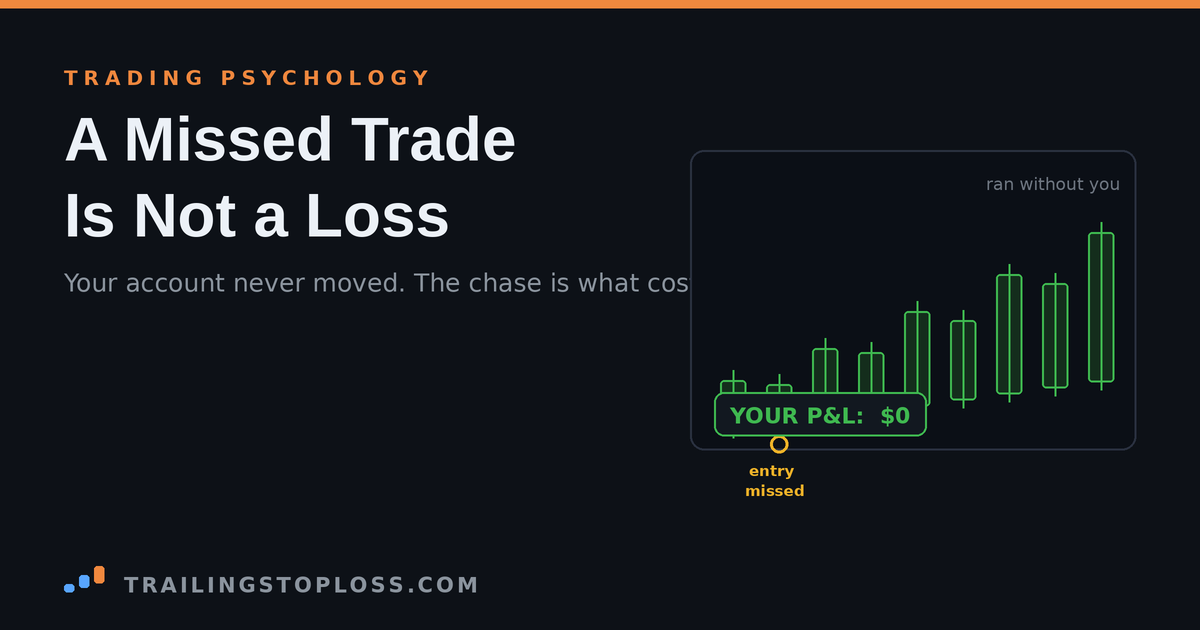
You watched the setup form. You hesitated, or you stepped away, or you waited for one more candle of confirmation — and then it went. Clean. Textbook. The exact move you were waiting for, running without you, printing green while you sat on your hands. And now there’s a specific, physical feeling in your chest, like someone reached into your account and took money out. Here’s the truth your nervous system refuses to accept in that moment: nothing was taken. Your balance is exactly what it was. You didn’t lose a trade. You watched one.
That distinction sounds like semantics until you understand what it does to your next decision — because the missed trade almost never damages your account. The reaction to it does.
Why a missed trade feels like a loss
The feeling isn’t irrational; it’s a well-documented feature of how humans process gains and losses. People feel the pain of a loss roughly twice as intensely as the pleasure of an equivalent gain — the core finding behind loss aversion and prospect theory. The catch is that your brain applies that same pain response to a counterfactual loss: the money you imagined you’d have. You mentally banked the profit the moment you spotted the setup, and now your mind is grieving a withdrawal that never happened. (Loss aversion, prospect theory)
This is the phantom P&L — the running tally of what you “should have” made. It’s completely fictional, and it’s the most expensive number in trading, because you’ll spend real money trying to chase it back. A green candle you’re not in is not your money. It never was. It’s a price doing what prices do, with or without your participation.
The miss isn’t the damage. The chase is.
Here’s the mechanism that actually blows up accounts. The missed trade costs you exactly zero dollars. But the emotional debt it creates — that itch to “make it back,” to not miss the next one — is what drives the genuinely destructive behavior: chasing an extended move late, jumping in without your criteria, doubling size to catch up, or forcing a marginal setup because you can’t stand to sit out twice. That’s how a missed winner, which cost nothing, becomes a real loss with a real number attached. You didn’t pay for the trade you missed. You paid for the one you took to soothe the feeling.
This is the same engine behind revenge trading and tilt: an emotional event (the miss) hijacks the decision-making that follows. If you’ve read our piece on trading on tilt, you’ll recognize the pattern — the trigger is different, but the downstream behavior is identical. And it’s the mirror image of the fear of pulling the trigger: hesitation makes you miss the trade, then FOMO makes you overcorrect into the next one. Two failures, one root cause — letting the emotional state, not the plan, size the position.
Opportunity cost is not a realized loss
Traders conflate two things that live in completely different accounts. A realized loss is dollars that left your balance — a stop got hit, the money is gone, it’s on your statement. Opportunity cost is a move you didn’t capture — it never touched your balance, and there’s no statement anywhere that records it. Your P&L calendar doesn’t turn red because you missed a winner. It stays exactly where it was: flat. A missed trade is a $0 day, not a losing day, and treating it like the latter is the whole error.
Missed trade
Opportunity cost. Your account is unchanged. There is no number. Nothing is on your statement. The only place it “cost” you anything is in your imagination.
Realized loss
Dollars that actually left. It’s on your statement, it moved your drawdown, it’s real. This is the only kind of loss that deserves the feeling you’re giving the missed one.
If you spent as much energy protecting against realized losses as you spend mourning opportunity costs, you’d be a better trader by Friday. The market hands out infinite missed trades and a strictly limited number of dollars. Guard the dollars.
There is always another trade
Underneath the pain of a missed trade is a scarcity belief: that was the one, and now it’s gone. But the market is not a train that leaves the station once a day. It is a firehose of setups — the same pattern that just ran without you will form again this session, tomorrow, next week, on another instrument, in another session. The trader who believes opportunity is scarce chases, forces, and oversizes. The trader who knows opportunity is effectively infinite can let a hundred trades go by and feel nothing, because number one-hundred-and-one is already on the way.
This is why the professionals who watch a clean move run without them can shrug it off in a way that looks almost inhuman to a newer trader. It’s not that they don’t see it. It’s that they’ve internalized a simple accounting fact: you cannot catch every move, and you were never supposed to. Your edge doesn’t come from catching them all. It comes from taking your specific setup, at your specific criteria, and doing that repeatedly. Everything outside that is somebody else’s trade.
🧠 The reframe that actually worksA missed trade often means your process worked. You had criteria; they weren’t fully met, or you weren’t at the desk, so you didn’t take it. That’s discipline, not failure. The alternative — taking every move that looks good in hindsight — is how you end up in trades you have no plan for. Not every good trade is your trade.
What to actually do when you miss one
Feeling the sting is fine — you’re human, and pretending you’re a robot just buries it until it leaks out as a chase. The goal isn’t to feel nothing. It’s to keep the feeling from touching the next decision.
- Name it out loud: “That was opportunity cost, not a loss.” Say it. The label breaks the phantom-P&L spell by moving the event from your gut to your prefrontal cortex.
- Do not touch the next candle to “make it back.” The single most expensive impulse in trading is the immediate re-entry after a miss. Sit on your hands for a beat. The urge to chase peaks fast and fades fast.
- Do not widen your criteria. If you missed it because your entry rules weren’t met, loosening them to catch the next one just guarantees a lower-quality trade. Your rules didn’t fail you; they protected you.
- Log it as a no-trade, not a red day. In your journal or P&L calendar, a missed setup is a flat day. Writing “missed — hesitated at entry” as a note is worth more than any phantom number.
- Wait for the next valid setup — and take that one. The cure for a missed trade isn’t the next trade. It’s the next qualified trade, taken exactly the way you’d have taken the one you missed.
⚠ The trap to watchThe most dangerous missed trade is a missed winner, because it “proves” you should have been looser — and that lesson is poison. You don’t know it would have won when you would have had to enter it. Survivorship bias makes every missed trade look like a missed fortune. Half of them would have stopped you out.
The bottom line
A missed trade is the cheapest event in trading: it costs nothing. It only becomes expensive when you let the feeling of it size your next position. Watch the move run, feel the pang, name it for what it is — a price doing its thing without you — and go back to waiting for the setup that’s actually yours. Your account will never know the difference between a trade you missed and a trade that never existed. Keep it that way.
Track your misses as flat days, not losses. A free P&L calendar makes the distinction visible — and note why you missed, so the pattern shows itself.
Open the free P&L Calendar →Keep going: the same emotional engine drives trading on tilt and the confidence trap, and the flip side of the missed trade is the fear of pulling the trigger. Start with the trading psychology guide for the full picture.
FAQ
Why does missing a trade feel worse than an actual loss?
Because your brain treats the profit you imagined as money you already had, and losing an imagined gain triggers the same loss-aversion pain response as a real loss — sometimes stronger, because there’s no closure. With a real loss the trade is over; with a missed trade the “what if” can run in your head all day. But your account only reflects real dollars, and a missed trade moved none of them.
Is a missed trade actually a loss?
No. A missed trade is opportunity cost — a move you didn’t capture — not a realized loss. Nothing left your account, nothing is on your statement, and your drawdown didn’t move. It only becomes a real loss if you chase the next trade to make up for it and that chase trade loses.
How do I stop chasing trades after I miss one?
Break the chain between the miss and the next entry. Name the miss as opportunity cost, refuse to touch the very next candle, don’t loosen your criteria, and wait for a fully qualified setup before acting. The urge to chase spikes and fades quickly — if you can sit through the first minute or two, it usually passes.
What is phantom P&L?
Phantom P&L is the running mental tally of money you “would have” made on trades you didn’t take. It’s entirely imaginary and appears on no statement, but it feels real enough that traders spend actual money chasing it back. Recognizing that the number is fictional is the first step to ignoring it.
Should I widen my entry rules so I stop missing setups?
Almost never. If you missed a trade because your criteria weren’t met, loosening them doesn’t help you catch good trades — it just lowers the quality of the trades you do take and increases your loss rate. Missing a setup that didn’t fully qualify is your rules working, not failing.
How should I record a missed trade in my journal?
Log it as a no-trade or a flat day, not a loss, with a short note on why you missed it — hesitated at entry, stepped away, criteria not met. That keeps your P&L honest and turns the miss into useful data about your own behavior, which is far more valuable than the imagined profit.
This article is educational and not investment advice. Trading involves substantial risk of loss. If missed trades or the urge to chase are consistently affecting your decisions or wellbeing, it’s worth stepping back and, if needed, speaking with a qualified professional.


