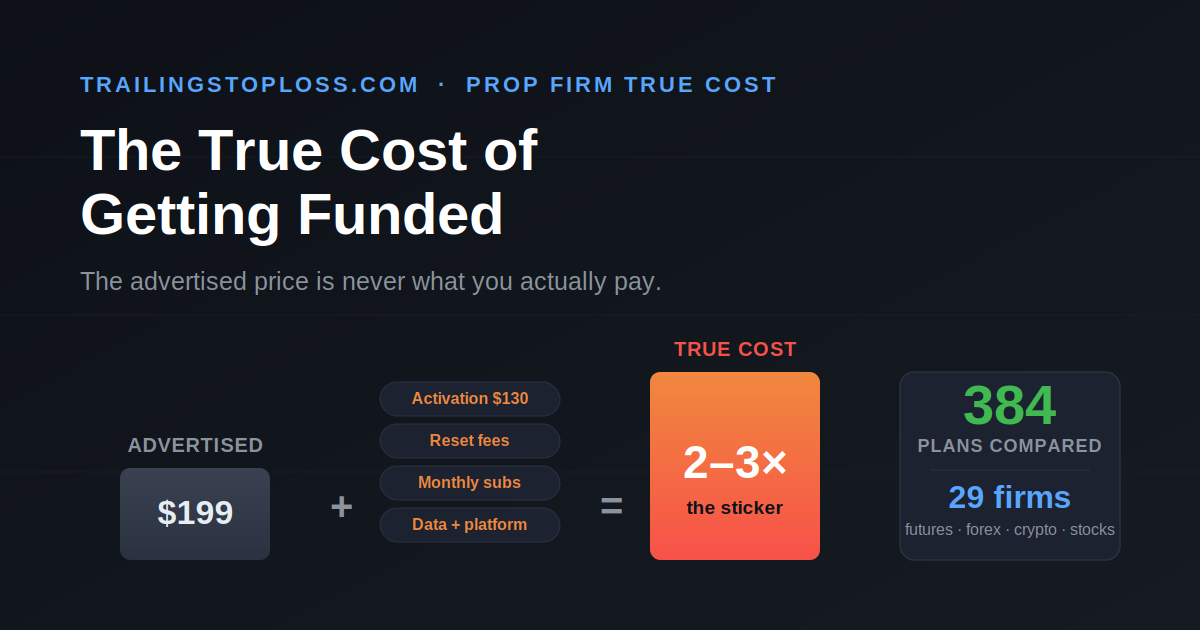
Four new reference pages went live on trailingstoploss.com: a complete itemized breakdown of what it actually costs to get funded at the top prop firms across futures, forex, crypto, and stocks. 384 plans across 29 firms, with sortable interactive comparison tools on every page. Spoiler: it's not what the firms advertise. Here's what's in the new section, why it exists, and which findings surprised me most while building it.
Every prop firm review article on the internet — and there are thousands at this point — does the same thing. It lists the headline challenge fee, mentions the profit split, name-checks the drawdown type, and moves on. The headline number is treated as the price. But anyone who's actually paid for a prop firm evaluation knows the headline number is the cheapest possible number, sitting in a vacuum that ignores activation fees, monthly subscriptions, reset costs, refund conditions, and the multi-attempt math that determines what most traders actually spend on the path to funded status. The gap between sticker and reality is wide enough to matter — sometimes 2-3x the advertised price — and it's not being clearly documented anywhere.
That gap is what the new true cost hub is built to close. Four pages, one per asset class, covering the top firms per category and every account size from entry-level through whatever ceiling each firm actually offers. The format is identical across pages so direct comparison is possible: itemized fee tables, sortable interactive comparison tools with profit split, platform support, and Trustpilot scores, multi-attempt cost calculations, hidden ongoing cost analysis, and a $100K side-by-side ranking that strips away marketing and shows the real first-pass total. The pages don't push any specific firm — there are no affiliate links, no "winner" rankings designed to drive sign-ups. The goal is making the math visible so traders can match firm structure to budget and strategy.
What's in each page
The four pages mirror each other structurally but cover materially different ground because pricing models differ by asset class. Futures runs heavy on monthly subscriptions and activation fees. Forex centers on one-time challenge fees with refund-on-first-payout mechanics. Crypto splits between crypto-native firms (real exchange execution) and crypto-as-CFD firms (synthetic spreads on forex infrastructure). Stocks splits even more sharply between Trade The Pool (the only firm offering real U.S. equity direct market access) and every other firm offering equity CFDs. Each page leads with how pricing actually works in that category before walking through individual firm breakdowns, which means you can read just the one most relevant to your trading without missing structural context.
| Page | Firms Covered | Account Size Range | Key Findings |
|---|---|---|---|
| Futures True Cost | Apex, Topstep, MFFU, TPT, Tradeify, Bulenox, ETF, TradeDay, E2T, FundedNext Futures, Blue Guardian, Phidias, Lucid, Alpha | $25K – $300K | Apex 4.0 rebuilt industry pricing in March 2026 |
| Forex True Cost | FTMO, FundedNext, The5ers, E8 Markets, FXIFY, FunderPro, Funded Trading Plus | $5K – $400K | "Refund on first payout" rarely actually happens |
| Crypto True Cost | HyroTrader, CFT, Breakout Prop, BrightFunded, Bitfunded, Tradeify Crypto, FundedNext, FTMO | $5K – $1.28M | Kraken's Breakout Prop acquisition created the cheapest crypto-native pricing in the industry |
| Stocks True Cost | Trade The Pool, Top Tier Trader, FundedNext, FXIFY, Funded Trading Plus, BrightFunded | $10K – $260K | Trade The Pool is the only major firm offering real U.S. equities — everyone else trades CFDs |
Each page is built to be a standalone reference — you don't need to read all four to use one of them. But the hub page at prop-firm-true-cost ties them together with cross-category comparisons and quick-reference cheapest-firm summaries for traders who want the answers without the methodology.
What surprised me most while building this
The activation fee gap is wider than I expected
Going in, I assumed activation fees would be relatively standardized — most firms in the $130-$200 range with some outliers. They aren't. Apex 4.0 charges $79 to $169 depending on size and drawdown type. Topstep is $149 flat. Take Profit Trader is $130 flat across all sizes. The5ers stacks $50 to $350 on top of an already-paid challenge. And MyFundedFutures, Tradeify, TradeDay, and most crypto firms charge zero. That means on a $100K account, depending on firm, you're paying anywhere from $0 to $260 in pure activation costs that don't appear on the firm's main pricing page. It's the single biggest pricing variable most comparison articles ignore.
One-time pricing is winning the futures category
Apex's March 2026 4.0 rebuild eliminated monthly subscriptions in favor of one-time pricing. MyFundedFutures offers one-time payment options across all plans. Elite Trader Funding's primary structure is one-time. This is a meaningful industry shift. Monthly subscriptions used to be the default — they still are at Topstep, TPT, Bulenox, TradeDay, and Earn2Trade — but the trajectory is toward one-time pricing because it removes the "how many months will I pay before passing" uncertainty that makes monthly models so expensive on multi-attempt scenarios. Within 12-18 months I'd expect at least two more major futures firms to follow Apex's lead. Phidias' Apex 4.0 breakdown documents the structural rationale.
"Refund on first payout" is technically true and practically misleading
Every major forex prop firm advertises some version of "your challenge fee is refunded with your first payout." This is technically true. It is also practically meaningless for the average buyer, because industry data suggests only 3-5% of evaluation buyers actually reach first-payout status. The funnel is: pay → 10-20% reach Phase 2 pass → 5-10% reach funded → 3-5% reach first profitable payout that triggers the refund. For the 95% of buyers who don't make it through that funnel, the challenge fee is a sunk cost regardless of what the firm's marketing says about refunds. Budget accordingly. Traders Second Brain's FTMO analysis made this point particularly clearly.
Kraken's Breakout Prop acquisition created the cheapest crypto-native pricing in the industry
This one was genuinely surprising. Pre-acquisition, Breakout Prop was priced in line with other crypto-native firms. Post-acquisition (October 2025), the firm rolled out aggressive pricing — the Turbo tier at $20 for a $5K account and $330 for a $100K account is meaningfully cheaper than CFT's equivalents. The strategic logic is that Kraken's growth capital lets Breakout subsidize entry pricing to capture market share. For traders who care about institutional backing and real exchange execution, Breakout at these price points is now objectively the value leader in the crypto prop space.
The stocks prop firm category is basically a one-firm race
This wasn't surprising so much as confirming. The stocks prop firm space has dozens of firms claiming to offer "stocks trading," but only one — Trade The Pool — actually provides direct market access to U.S. equities. Everyone else (Top Tier Trader, FundedNext, FXIFY, Funded Trading Plus, BrightFunded) trades equity CFDs against synthetic pricing. For most casual traders that distinction doesn't matter, but for anyone running real intraday equity strategies — gap plays, sector rotations, earnings reactions — only Trade The Pool delivers what the strategy actually requires. The Mini BP tier at $100 is also the cheapest entry to real-equity prop trading anywhere, and TTP bypasses the Pattern Day Trader rule entirely by trading firm capital instead of personal capital. The stocks page makes the real-equity vs CFD distinction the first thing readers see, because it's the most important variable in the category.
The "cheapest firm" answer differs by question framing
If you ask "what's the cheapest first-attempt total cost to a funded $100K account," the answer is Tradeify Growth at $199 (futures). If you ask "what's the cheapest entry point at any account size," the answer is Breakout Prop Turbo at $20 for a $5K crypto account, or Trade The Pool Mini BP at $100 for the cheapest real-equity entry. If you ask "which firm wins on multi-attempt expected cost assuming 2-3 failures before passing," the answer becomes FXIFY (forex, 50% reset discount) or E8 Markets (customizable, cheap entry). There is no universal "cheapest prop firm." The cheapest depends on which question you're actually asking, and the new pages make that explicit rather than collapsing it into a single ranking that doesn't survive contact with how traders actually use these accounts.
How the pages are intended to be used
The recommended workflow is to read the relevant asset-class page in full once, then use it as a lookup reference. The first read gives you the structural understanding of how pricing works in that category — what the dominant pricing model is, which firms charge activation fees, how reset mechanics differ. The reference use is for budgeting specific decisions: which size to buy, which firm to compare against, what to expect across multiple attempts.
The pages explicitly do not rank firms by overall quality. Cost is one variable among four (cost, drawdown type, profit split, rule fit with strategy), and the cheapest firm is rarely the best firm for any specific trader's situation. Topstep's $50 monthly is the cheapest first-month total in futures, but Topstep's news trading restrictions and trailing drawdown make it a poor fit for some strategies that Apex or MyFundedFutures would handle fine. The pages give you the cost math so you can filter firms by what fits your budget, then evaluate the survivors on rules and execution.
What's not on the pages (and why)
A few things were deliberately excluded. There are no affiliate links anywhere on the three true-cost pages or the hub. Firms were not ranked overall — only on specific cost dimensions like first-attempt total, multi-attempt total, and entry-level cost. Pass rates were referenced but not extensively quantified, because firm-published pass rates are unreliable and third-party data is patchy. Profit split details were summarized but not exhaustively detailed, since they vary by program within each firm and would substantially lengthen the tables.
The pages also exclude firms with less than 12 months of operating history or limited verified payout records. The crypto prop space in particular has dozens of newer firms launching aggressive pricing, but most of them lack the operational track record to assess reliability. Sticking to established firms per category — 14 in futures, 7 in forex, 8 in crypto, 6 in stocks — keeps the data quality high and the comparison apples-to-apples. The stocks category is smaller because the dedicated stocks prop firm space genuinely is smaller; most "stocks" prop firms are forex-first multi-asset firms with stocks bolted on as CFDs. For broader coverage of the prop firm landscape, including newer entrants and rule deep-dives, the category page has additional reading.
How the pricing data was verified
All pricing data was sourced from prop firm official websites, current third-party review documentation, and trader-reported pricing as of May 2026. Cross-referencing across multiple sources caught several discrepancies — firm marketing pages sometimes lag actual checkout prices, and review sites occasionally cite legacy pricing that's been superseded. Where multiple credible sources agreed, that number went in the table. Where sources disagreed, the firm's own pricing page took precedence, with checkout-page prices preferred over marketing-page summaries.
Pricing freshness is the persistent challenge with any prop firm cost reference. The industry moves fast. Apex restructured its entire model in March 2026. MyFundedFutures eliminated activation fees in July 2025. Kraken acquired Breakout Prop in late 2025. Bybit deepened its integration with Crypto Fund Trader through April 2025. Any of these events can shift the rankings substantially. The pages note verification dates and flag where promotions or recent structural changes materially shift the math. The expectation is that the pages will need periodic re-verification — likely quarterly — to stay current.
If you spot outdated pricing: Prop firm pricing changes constantly, and table data is verified as of May 2026. If you see a price that doesn't match what the firm currently shows at checkout, the firm's checkout page wins. The pages will be refreshed periodically to track major structural changes.
What's coming next
The true cost section is the foundation for several follow-up pieces already in the queue. A drawdown comparison series will walk through how trailing, EOD, and static drawdown structures differ across firms — the second-biggest variable after cost for matching firm to strategy. A payout reliability tracker will document actual processing times and any payout disputes across the firms covered in each category. A specific scalper-fit guide will identify which firms' rule structures actually work for high-frequency intraday strategies versus which look fine on paper but break on contact with active trading.
If you're already trading at one of the firms covered and have specific cost data or rule-experience worth adding to the pages, that's useful input. Real-world cost data — what you actually paid across multiple evaluation attempts, what reset discounts you got, what hidden fees surprised you — is exactly the kind of information that's hard to find on firm marketing pages but essential for accurate budgeting.
Start here: If you're shopping for a prop firm right now, go directly to the true cost hub for cross-category comparison, or jump straight to your asset class: futures, forex, crypto, or stocks.
Frequently asked questions
Why do prop firms hide so many of their fees?
Most firms aren't hiding fees in a strictly fraudulent sense — the fees are disclosed somewhere in the firm's documentation. They're just not on the main pricing page. Activation fees often live in support articles or post-evaluation flow pages. Reset costs are in account dashboards. Withdrawal fees are in payout terms. The structural problem is that the headline price gets weighted as the actual price in most trader comparison shopping, when it's actually only one component of the all-in cost.
Will the pricing on these pages stay current?
The May 2026 data is current at publication. Prop firm pricing changes frequently — sometimes weekly during promotional cycles, sometimes structurally when firms restructure their plans. The pages will be refreshed periodically (likely quarterly) to track major changes, and any restructure-level event (like Apex 4.0 or Kraken's Breakout acquisition) will trigger immediate re-verification across affected pages. Always confirm at checkout on the firm's official site before purchase.
Are there affiliate links on the true cost pages?
No. The four true cost pages and the hub page do not include affiliate links to any prop firm. Citations link to third-party review sources and firm documentation pages, but none are affiliate-tagged. The goal of the pages is accurate cost reference, not driving sign-ups to specific firms.
Which firms aren't on the list and why?
The pages cover the most-used firms per category: 14 in futures, 7 in forex, 8 in crypto, 6 in stocks. Selection prioritizes operating history, payout track record, and trader volume. Newer firms (less than 12 months operating, limited verified payouts) were excluded to keep the data quality high. This means some popular newer entrants — particularly in crypto, where the category is growing fast — aren't yet covered. As newer firms accumulate track records, they'll be added in subsequent updates.
Which page should I read first?
Read the page for the asset class you actually trade. If you trade multiple asset classes or you're shopping cross-category, start with the hub page for the cross-category comparison and cheapest-firm-per-category summaries, then drill into the relevant asset-class page for detail. The pages are designed to be standalone references, so you don't need to read all four to use one of them.


