Take the Win and Walk Away: The Case for Ending Your Day on One Good Trade
You caught the move. You’re up. And now the most dangerous part of your trading day begins — the part where you decide that one good trade was really just a warm-up.
The market does not owe you a second setup, and your account does not care how the profit was earned. What it cares about is whether the profit is still there at 4:00.
The trade after the trade
Here’s the sequence every day trader knows by heart. The setup forms, you take it, it works. You’re green before the first hour is out. You sit back, and somewhere in the next ten minutes a thought arrives, uninvited and wearing a convincing disguise: I’m reading this tape perfectly today. Twenty minutes later you’re in a second position that looked nothing like the first one, sized slightly larger, on a chart you don’t normally trade. That trade is not a strategy. It is a mood.
The uncomfortable part is that the second trade doesn’t feel reckless while you’re taking it. It feels earned. That distinction — between a decision your process produced and a decision your P&L produced — is the entire subject of this article, and it turns out behavioural finance has been chewing on it since well before any of us had a futures account. (Thaler & Johnson, SSRN)
Your brain quietly reclassifies the money
In 1990, Richard Thaler and Eric Johnson ran a set of real-money experiments on how prior outcomes change the risk people are willing to take next. They found that after a gain, subjects became measurably more willing to accept gambles they’d have refused from a cold start. The winnings hadn’t yet been mentally filed as theirs, so risking them didn’t register as risking their own money. Gamblers already had a name for it, which the researchers borrowed: playing with the house’s money. (Thaler & Johnson, SSRN)
This is not a casino curiosity that stops at the door of a brokerage. Researchers studying the Taiwan market found the house money effect discernible in actual investor behaviour, with prior gains leading to greater risk-taking in subsequent periods — and, interestingly, the effect fading as investors had more time to adapt to the gain and absorb it into their sense of net worth. Which is a polite academic way of saying the danger window is right now, in the twenty minutes after you close a winner, not next Tuesday. (Pacific-Basin Finance Journal)
An unrealised-to-realised gain creates a temporary pool of money your brain treats as not-quite-yours. Risk taken with that pool feels cheap. It is not cheap. It spends exactly like the money you woke up with, and it draws down exactly like it too. (Thaler & Johnson, SSRN)
The base rates are not on your side
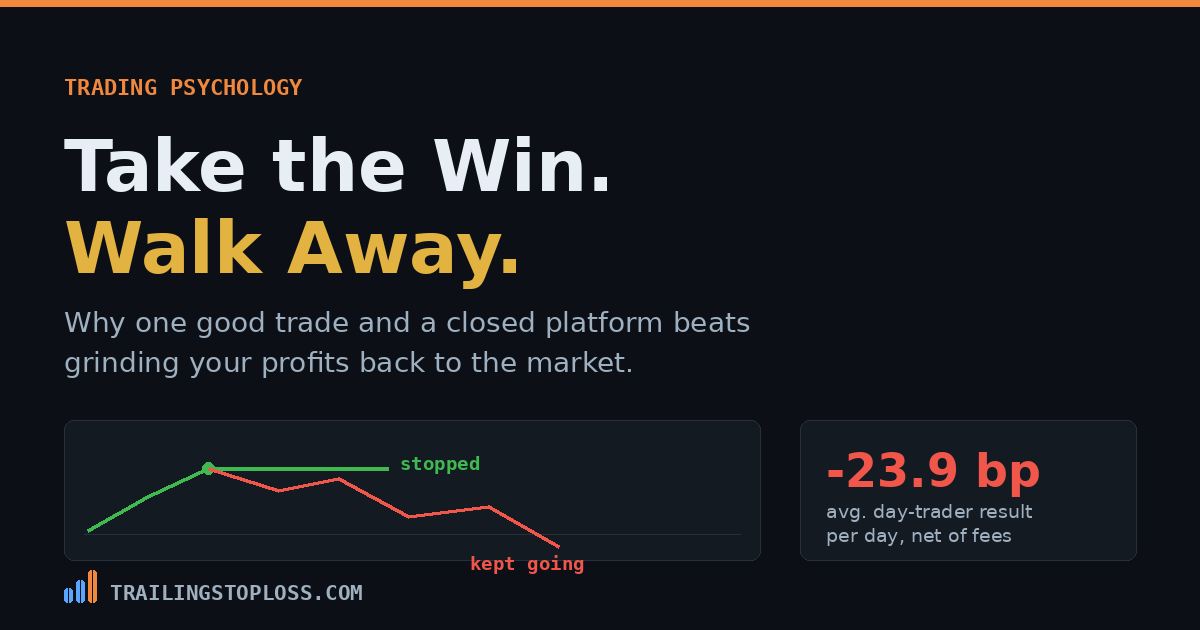
Zoom out from your morning and look at what happens to active traders in aggregate, and the picture gets bracing. Analysing 3.7 billion transactions on the Taiwan Stock Exchange between 1992 and 2006, Barber, Lee, Liu, Odean and Zhang found day traders lost an average of 23.9 basis points per day net of fees, with aggregate performance reliably negative in 14 of the 15 years studied. Costs did most of the damage — the gross loss was around 7 basis points, and transaction costs more than tripled it. (Review of Asset Pricing Studies, 2020)
The same body of research found that skill is real but rare: sorting day traders by prior performance and following them forward, less than 1% of the population predictably and reliably earned positive abnormal returns net of fees. The top-ranked cohort genuinely persisted. Everyone else funded them. (Journal of Financial Markets)
| What the Taiwan data shows | Figure |
|---|---|
| Average day-trader result, net of fees | −23.9 bp / day |
| Average result before costs | −7 bp / day |
| Still trading after one year | 44% |
| Still trading after three years | 15% |
| Reliably profitable, net of fees | <1% |
Read those two rows next to each other, because that’s where the argument for walking away lives. The gross number says the average trader’s edge is only slightly negative — nearly break-even, arguably fixable. The net number says the act of trading itself is what buries them. Every additional trade is a fresh subscription to that cost drag, and the second trade of your day pays it just as surely as the first. (Review of Asset Pricing Studies, 2020)
Does your judgment actually degrade? Honestly — it’s contested
The popular version of this argument leans hard on decision fatigue: the idea that making repeated effortful choices depletes some finite mental resource, after which your decisions get lazier and more impulsive. There is real work behind it in a financial context. An NBER working paper documented decision fatigue in equity analysts, showing forecast quality deteriorating and heuristic shortcuts increasing over the course of a workday. (NBER Working Paper 24293)
But the honest position is that this literature is under real pressure. A large-scale 2025 field study of healthcare professionals making thousands of sequential high-stakes judgments found no credible evidence for decision fatigue at all, with the statistical support running toward the null hypothesis. The authors were careful to say this doesn’t rule out weaker or context-specific versions of the effect — but it does undercut treating it as a universal law you can cite to explain your afternoon. (Communications Psychology, 2025)
So don’t build your rule on decision fatigue. Build it on the house money effect, which has held up considerably better, and on the cost arithmetic, which isn’t a psychological theory at all — it’s subtraction. If tired-brain science turns out to be soft, your commissions remain exactly as hard as they were. (Journal of Financial Markets)
What giving it back actually looks like
That figure is the part most traders get wrong when they picture the failure mode. Nobody gives back three good trades’ worth of profit by losing five in a row — that’s obvious enough to stop. It happens through a scatter of small wins, small losses and commissions that nets out slightly negative, over and over, while you tell yourself you’re still trading well because your win rate looks fine. Win rate is not the metric. Ending equity is. (Review of Asset Pricing Studies, 2020)
What “one and done” actually means
The rule is simple to state and irritating to follow, which is the case for most things that work. If you have a day trading plan with a defined edge, you take the setup when it appears, you manage it by the plan, and when it resolves at target you are finished for the session. Not “finished unless something great shows up.” Finished.
The word doing the heavy lifting there is defined. One-and-done is not a licence to take one impulsive trade and quit; it’s the opposite. It only works if the single trade you’re allowed is a specific, pre-written setup you could describe to someone else before the session starts. Otherwise you’ve just compressed a whole day of undisciplined trading into one oversized decision, which is worse, not better.
What counts as done
- Target hit. Obvious. Close the platform.
- Stopped out. Also done. The daily allotment was a trade, not a win — otherwise “one trade a day” quietly becomes “unlimited trades until one works,” which is the exact behaviour you were trying to prevent.
- Setup never appeared. A no-trade day is a completed day. Log it as one.
- Scratched at break-even. Done. You spent the decision.
“But some days the market hands you three clean setups and I’m leaving money on the table.” Sometimes, yes. You’re buying variance reduction with a slice of expectancy, and that’s a real trade-off, not a free lunch. The question is whether your marginal trades — the ones after the first — actually carry the same edge as the first. For most traders, the honest answer sits somewhere between “no” and “I’ve never checked.” Go check. Your journal already has the data.
Make it mechanical, because willpower isn’t the point
If the plan is “I’ll just stop when I’m up,” you don’t have a plan, you have an intention, and intentions are exactly what the house money effect goes to work on. The fix is to remove the decision from the moment it gets hard, which is the same logic behind every hard stop you already use. (Thaler & Johnson, SSRN)
- Flatten and close the platform. Not minimise. Close. A visible chart is an open invitation.
- Set a broker-level or platform-level daily trade limit if your software supports it, so the second entry is rejected rather than reconsidered.
- Write the stop condition down before the open, alongside your setup. “One trade, then flat and closed” belongs in the same note as your levels.
- Log the day immediately. Ten minutes of journaling right after you close is also ten minutes of not trading, which is the point.
- Schedule the next session. The market reopens. It genuinely does. Every single weekday.
Traders on funded accounts have a structural version of this handed to them whether they like it or not: daily loss limits and trailing drawdowns that end the session on your behalf. It’s worth understanding exactly how those thresholds work on your particular programme before you learn it the expensive way — the rules differ meaningfully between firms, which is the whole reason we keep prop firm rule data on this site. Treating your own daily stop with the same finality as a firm’s is, functionally, free practice for passing an evaluation.
The short version
You are not leaving money on the table by stopping. You’re declining to re-enter a game where the average participant loses 23.9 basis points a day after costs, at the exact moment your brain has decided the profits aren’t really yours yet. One good trade, logged and closed, is a complete trading day. The discomfort you feel at 10:15 with a green P&L and a closed platform is not a signal that you’re missing out. It’s just the feeling of not giving it back. (Review of Asset Pricing Studies, 2020)
Frequently asked questions
Does stopping after one winning trade mean I’ll miss big trending days?
Sometimes, yes — that’s a genuine cost, not a myth to be argued away. The trade-off is that you also miss every giveback day, and the research on aggregate day-trader performance suggests the giveback days are far more common than the runaway ones. If you want to keep some upside, a cleaner solution than “trade more” is to trail a portion of the original position rather than opening new ones.
Should I stop after a loss too, or only after a win?
Both. If the rule only ends the day on a win, it isn’t a one-trade rule — it’s permission to keep trading until something works, which is the revenge-trading pattern with better branding. One trade means one trade, resolved either way.
What is the house money effect?
It’s the tendency, documented by Thaler and Johnson in 1990, to take more risk after a gain than you would have from a standing start — because recent winnings haven’t yet been mentally absorbed as your own money. In trading it shows up as larger size, looser entries and unfamiliar instruments in the minutes after a profitable close.
Isn’t decision fatigue the real reason to stop early?
It’s a plausible contributing reason, but the evidence is genuinely mixed. Some financial studies find decision quality degrading across a workday; a large 2025 field study found no credible evidence for the effect at all. The cost arithmetic and the house money effect are the stronger foundations for this rule.
Does one-trade-a-day work for scalpers?
It changes what you’re doing, and you should be honest about that. A high-frequency scalping edge depends on sample size, so a hard one-trade cap is a different strategy rather than a discipline layer on top of the same one. The workable middle ground is a fixed daily trade count or a profit-based stop condition set before the open — the principle being that the number is decided in advance, not in the glow of a green P&L.
How do I stop myself from re-entering after I’ve closed for the day?
Make it mechanical rather than motivational. Flatten, close the platform entirely, and where possible use a broker or platform-level daily trade limit so a second entry is rejected outright. Writing the stop condition down before the open, next to your setup, makes it a rule you’re following rather than a decision you’re making under pressure.
Further reading on this site: trading psychology · day trading · education · trading tools
Nothing here is financial advice. Futures trading carries substantial risk of loss and is not suitable for every investor.