Micro vs Mini Futures: Why Moving Up Is a 900% Risk IncreaseStart With Micros: Why “Moving Up to Minis” Is a 900% Risk Increase You’d Never Choose Deliberately
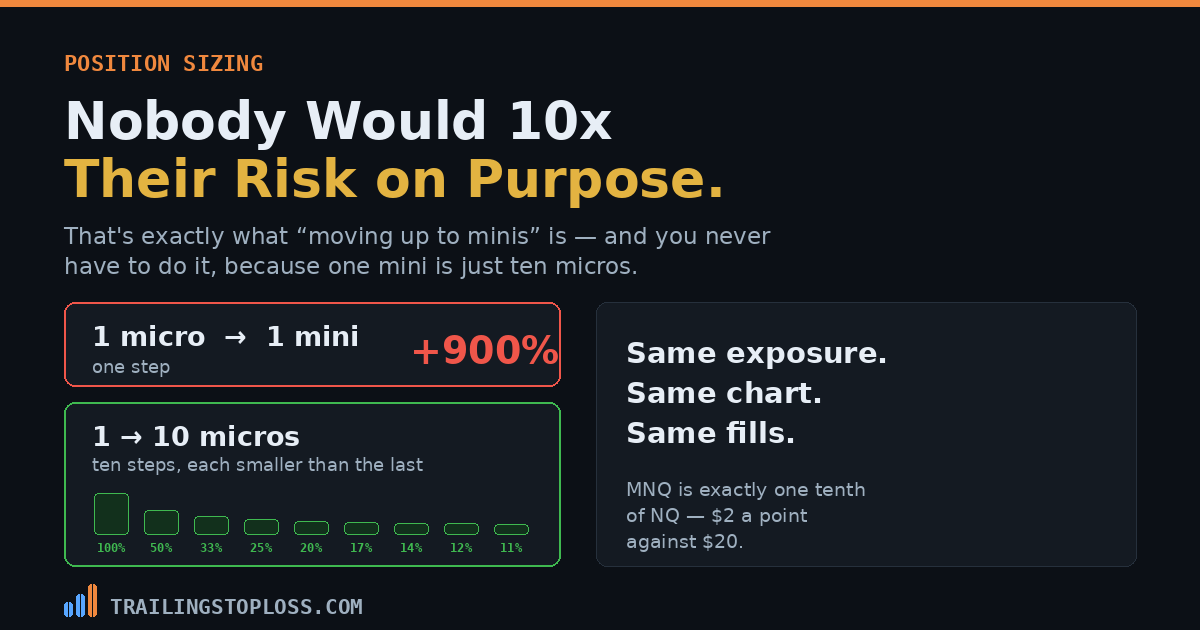
Nobody would decide to multiply their risk by ten in a single step. But that’s precisely what happens the day a trader graduates from one micro to one mini — and it’s completely unnecessary, because a mini is nothing more than ten micros.
You never have to “move up.” You can walk from one micro to ten and arrive at exactly one mini’s exposure, having never taken a step bigger than one micro.
The two contracts are the same instrument
This is the fact the whole article rests on. The E-mini Nasdaq-100 (NQ) carries a $20 multiplier with a $5 tick. The Micro E-mini Nasdaq-100 (MNQ) is exactly one tenth of it: $2 per index point, $0.50 per tick. Same index, same 0.25 tick size, same exchange, same hours, same liquidity during US equity hours. (NinjaTrader)
The S&P pair works identically. ES uses a $50 multiplier at $12.50 a tick; MES uses $5 at $1.25. In every case the micro is one tenth of the mini, so ten micros equal one mini in notional terms — identical dollar exposure, identical profit and loss. (Tradeify)
Margin follows the same ratio. As of late 2025 one MNQ required roughly $1,825 initial margin against $18,250 for NQ — a clean ten-to-one difference, with some brokers offering intraday margins far lower. (QuantVPS)
If ten micros are one mini, then “trading minis” isn’t a milestone, a graduation, or a different league. It’s a position size you can reach one contract at a time. The only thing the mini gives you that ten micros don’t is a lower commission bill — which we’ll get to, because it’s real.
The step you’re actually taking
Here’s the arithmetic that should end the debate. Going from one micro to one mini multiplies your exposure by ten. Walking the micro ladder instead produces steps that get smaller the higher you climb.
| Move | Exposure change | Risk on a 20-point NQ stop |
|---|---|---|
| 1 micro → 1 mini | +900% | $40 → $400 |
| 1 → 2 micros | +100% | $40 → $80 |
| 2 → 3 micros | +50% | $80 → $120 |
| 3 → 4 micros | +33% | $120 → $160 |
| 4 → 5 micros | +25% | $160 → $200 |
| 7 → 8 micros | +14% | $280 → $320 |
| 9 → 10 micros | +11% | $360 → $400 |
Both routes end in the same place — $400 of risk on a 20-point stop. One gets there in a single 900% jump. The other takes ten steps, and by the time you’re adding meaningful dollars, each increment is barely a tenth of what you’re already carrying.
Why the jump breaks people
The obvious answer is money, but that’s not quite it. The real problem is that size changes the trader, and a 900% change in size changes the trader a great deal.
Anxiety scales with position size far more reliably than it scales with probability. A stop that costs $40 is an accounting event; the same stop at $400 is something you feel in your chest at 8:15. That’s why the most useful diagnostic for pre-trade nerves is halving your size and seeing whether the feeling halves with it — and why a tenfold increase in one step reliably produces a trader who hesitates on setups they took comfortably last week. See the anxiety before the open.
There’s a second, quieter failure. The decision to size up almost never arrives after a bad week. It arrives after a good one — which is precisely when self-assessment is least reliable, because confidence updates on outcomes while ability doesn’t. A trader who has just had three green weeks is the trader most likely to make a 900% sizing decision and least equipped to evaluate it. See why traders get worse right after they start winning.
A size increase is correctly sized when your behavior doesn’t change. Same setups, same stops held, same willingness to sit through an adverse excursion. If the new size makes you cut early, skip entries or widen stops, it’s too big — and that’s true regardless of what your account balance says you can afford.
What micros let you do that minis can’t
Size to your actual risk instead of rounding
With minis your position size is an integer between one and whatever your limit is. If your risk budget says $280 and one contract risks $500, you have no legal move. With micros, $280 is 28 MES — and that granularity is the point. You can size to the risk you intended rather than the nearest contract. (Damn Prop Firms)
Scale out in thirds instead of all or nothing
Taking partial profit on three minis means exiting one contract, a third of the position, in one lump. On thirty micros you can exit ten, or seven, or whatever your plan specifies. The same applies to adding — if you pyramid into a winner, micros let the add be a fraction of the original rather than a doubling. (Damn Prop Firms)
Accumulate the sample you need without paying for it in drawdown
Demonstrating that a 55% win rate beats a coin flip takes on the order of 600 trades. At one trade a day that’s two and a half years, and you only get to run that experiment if you’re still solvent at the end of it. Micros are how you buy the trade count. The chart, the setups and the execution are identical — only the dollar consequence of the learning curve changes. See why consistency is what reveals an edge.
Survive the drawdown that a real edge guarantees
| Size | Risk per trade (20-pt stop) | Share of a $2,000 buffer | Losses to breach |
|---|---|---|---|
| 1 MNQ | $40 | 2% | 50 |
| 2 MNQ | $80 | 4% | 25 |
| 3 MNQ | $120 | 6% | 16 |
| 5 MNQ | $200 | 10% | 10 |
| 10 MNQ / 1 NQ | $400 | 20% | 5 |
At one micro you can be wrong fifty times before a $2,000 trailing drawdown is gone. At one mini you get five. Given that a genuinely profitable 35% system produces losing runs of eleven trades in a typical year, five is not a buffer — it’s a coin flip on whether the account survives ordinary variance.
The honest drawbacks
Commissions
Ten micros cost meaningfully more than one mini for identical exposure. At roughly $0.40 per side on micros and $1.50 on minis, ten MNQ round-trip costs about $8.00 against $3.00 for one NQ. Published comparisons put the penalty at two to three times, and one worked example has ten MES round-tripping at $30 against $3 for a single ES at a $1.50 rate. (Prop Trading Vibes)
Spread cost, notably, is not penalized — ten micros at a one-tick spread costs the same $12.50 as one mini at a one-tick spread. It’s purely the per-contract commission that stacks up. (Prop Trading Vibes)
Most firms count micros one-for-one against your contract limit. Apex’s $50K evaluation allows ten contracts “of any combination of mini and micro” — so ten micros consumes your entire limit while carrying the risk of a single mini. The ladder can hit a ceiling imposed by the rulebook rather than by your risk. Some firms handle it differently: Top One Futures caps in minis with a 10× micro equivalent, so a 50K account allows three minis or thirty micros. Check which model your firm uses before you build a plan that depends on high micro counts. (Prop Trading Vibes)
A scaling rule you can actually follow
- Start at one micro and stay there through your first 50 trades. Not until it’s profitable — until you have a sample. The point of the first fifty is finding out whether you execute your plan, which is measurable long before your edge is.
- Increase by one micro, never more. The step size is fixed at one contract regardless of how well things are going. This is the single rule that prevents a good month from producing a 900% decision.
- Raise size on execution, not P&L. The trigger is a run of trades taken as written — right setup, right size, stop held. A green month with three rule breaks in it is not a promotion.
- Hold each rung for a fixed number of trades. Twenty or thirty. Long enough that the new size stops feeling new before you consider the next one.
- Step back down after any rule break. Not as punishment — as recalibration. If you widened a stop at five micros, five micros is currently too big for you, whatever the arithmetic says.
- Switch to the mini when you’re consistently at ten micros. That’s the moment the commission saving becomes real and the granularity no longer matters, because you’re not adjusting in single micros at that size anyway.
When micros are the wrong answer
Two cases, both worth naming.
You’re a high-frequency scalper. A trader taking twenty to fifty trades a day at ten-micro size pays the commission penalty on every one of them, and at two to three times the mini rate it compounds into a genuine drag on expectancy. If your edge is a few ticks and your frequency is high, the mini’s cost structure matters more than the granularity. (Prop Trading Vibes)
Your firm caps contracts and you’ve hit it. If ten micros exhausts your position limit, the ladder stops there whether or not you’re ready to move on. That’s a rulebook constraint rather than a risk one, and the answer is usually a larger account rather than a larger contract. (Damn Prop Firms)
The short version
A micro is exactly one tenth of a mini — same index, same chart, same fills, one tenth the dollars — which means ten micros and one mini are the same position. So “moving up to minis” isn’t a graduation, it’s a 900% increase in risk taken in a single step, usually decided after a good week when self-assessment is least reliable. Walk the ladder instead: one micro at a time, raising on execution rather than P&L, holding each rung for twenty or thirty trades, stepping back down after any rule break. By the top, each increase is an 11% adjustment rather than a leap. The costs of doing it this way are real but small — roughly two to three times the commission of an equivalent mini position, and a prop firm contract limit that usually counts micros one-for-one. Both are cheap next to blowing an account learning position sizing at ten times the necessary scale. (Tradeify)
Frequently asked questions
Should I start with micro or mini futures?
Micros, in almost every case, and for longer than most traders think. A micro is one tenth the size of a mini — $2 per point on MNQ against $20 on NQ — so the learning curve costs one tenth as much while the chart, setups and execution are identical. Accounts under about $10,000 generally can’t size a mini position properly at all without stops that are either too tight or risk too much capital.
How many micros equal one mini?
Ten. MNQ is $2 per index point against NQ’s $20; MES is $5 per point against ES’s $50. Ten micros and one mini carry identical notional exposure and produce identical profit and loss. That’s why you never need to “move up” — you can reach one mini’s exposure one micro at a time.
When should I increase my position size?
On execution quality rather than profit. The trigger should be a run of twenty or thirty trades taken exactly as written — correct setup, correct size, stop held — not a green month, which can contain several rule breaks. Increase by one micro at a time, hold each rung until the size stops feeling new, and step back down after any rule break. The test of correct sizing is that your behavior doesn’t change.
Do micros cost more in commissions?
Yes, for equivalent exposure. At roughly $0.40 per side on micros against $1.50 on minis, a ten-micro round trip costs about $8.00 against $3.00 for one mini — commonly two to three times more. Spread cost is unaffected, since ten micros at a one-tick spread costs the same as one mini at a one-tick spread. Below full size the point is moot, because micros are the only way to size at all.
Do prop firms count micros differently from minis?
Usually one-for-one, which catches people out. Apex’s $50K evaluation permits ten contracts of any combination of mini and micro, so ten micros uses your whole limit while carrying one mini’s worth of risk. Other firms cap in mini equivalents — Top One Futures allows three minis or thirty micros on a 50K account. Verify which model your firm uses before building a strategy that depends on high micro counts.
When should I finally switch to minis?
When you’re consistently trading ten micros. At that point the commission saving becomes material and the granularity has stopped mattering, because you’re no longer adjusting your size in single micros. Switching then is a cost optimization on a position size you’ve already proven you can trade — which is a completely different decision from jumping to a mini as a promotion.
Related on this site: the anxiety before the open · why traders get worse after they start winning · adding to a winning position · daily loss limits and trailing drawdown · free P&L calendar
Contract specifications are CME standard and were verified in August 2026; margins and commissions vary by broker and change frequently — confirm current rates before sizing. Prop firm contract limits differ between firms and plans; confirm against your own account’s terms. Nothing here is financial advice. Futures trading carries substantial risk of loss.