▸ Trading Psychology
Rage Trading
Most of the industry calls it revenge trading. I call it rage trading, because that’s what it actually is: trying to make back a loss with your emotions in charge of your trading. Not your plan. Not your setup. Your emotions, holding the mouse, deciding the size. The word matters more than it looks, because “revenge” gives the behavior a dignity it hasn’t earned.
Revenge sounds deliberate — a cold-blooded settling of accounts, the kind of thing a competent operator does. It flatters the trader doing it. But nobody in that state is executing a plan. They’re furious, their heart rate is up, and they’re clicking. Calling it rage is simply more accurate, and accuracy is the first thing you lose when the money goes against you.
What separates it from a normal trade
A trade is an expression of an edge: this setup, at this level, sized this way, because your criteria were met. A rage trade is an expression of a feeling. The tell isn’t the entry — sometimes the chart genuinely does look fine. The tell is why you’re in it. You’re not there because the setup appeared. You’re there because the loss is still sitting on your P&L and you can’t tolerate it being there.
A trade
The target is a level. Size comes from the stop. You’d be equally willing to skip it if criteria weren’t met. Outcome is acceptable either way, because it was decided in advance.
A rage trade
The target is a number — the hole. Size comes from how big the hole is. Skipping it feels unbearable. Only one outcome is acceptable, which is why the stop becomes negotiable.
That second column contains the fatal detail: the position size is set by the loss, not by the setup. Once you’re sizing to cover a hole, you’ve inverted the entire logic of risk management — the market’s structure no longer determines anything. Your P&L does. And a position sized by your emotional state has no relationship to your edge, which is why it behaves like a coin flip you’ve bet the account on.
The math of digging
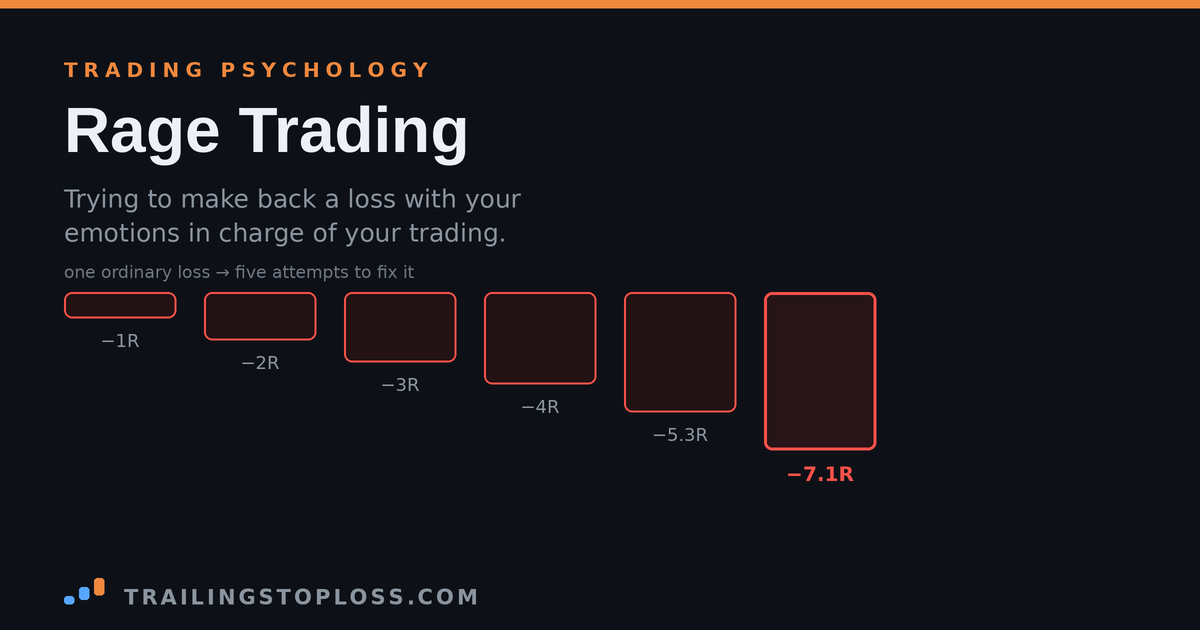
Here’s what makes rage trading uniquely destructive, and it isn’t obvious in the moment. Each failed attempt makes the next one larger, because the hole you’re covering has grown. Start with a single ordinary 1R loss and try to recover it in one trade, five times running:
| Attempt | Sized to recover | If it loses | Hole after |
|---|---|---|---|
| — | the original loss | −1.0R | |
| 1 | 1.0R | loses | −2.0R |
| 2 | 1.0R | loses | −3.0R |
| 3 | 1.0R | loses | −4.0R |
| 4 | 1.33R | loses | −5.3R |
| 5 | 1.78R | loses | −7.1R |
One ordinary loss became a 7.1R hole — and not one of those five trades was caused by the market. They were caused by the first loss being emotionally unacceptable. At a 3:1 target, digging out of 7.1R now requires 2.4 winning trades, which at a realistic win rate might take a week or more. An afternoon of rage has mortgaged your next several sessions.
Why you can’t think your way out of it
The reason “just be disciplined” fails as advice is that rage trading isn’t a knowledge problem. Every trader doing it already knows it’s a bad idea. They knew it before the session started. What’s happened is that the emotional system has taken priority over the deliberative one — a well-documented state where strong emotional arousal degrades exactly the executive functions you’d need to override it. The part of you that would talk you out of it is the part that’s offline.
That has one enormous practical implication: every defense against rage trading has to be built before the loss, not during it. Anything that requires in-the-moment judgement will fail, because in-the-moment judgement is the thing that’s compromised. This is the same mechanism covered in trading on tilt — rage trading is tilt with a specific target.
The tells
You usually get 30–60 seconds of warning if you know what to look for. The physical signs arrive before the conscious decision does.
⚠ The most dangerous versionRage trading after a winning trade that closed too early. You took 1R, price ran 6R without you, and now you’re furious at yourself rather than the market. It feels different — more like ambition than anger — but the mechanism is identical: an emotional state deciding your next position. See a missed trade is not a loss.
Circuit breakers that actually work
All of these share one property: they don’t require you to be calm in order to work.
- Hard stop after one loss. The cleanest rule available — the day ends with your first loss, full stop. It removes the decision entirely, which is the point. See one trade a day at 3:1.
- Physically leave. Not “step back mentally” — stand up and walk out of the room. Rage has a physiological half-life; movement and a few minutes away shortens it dramatically. You cannot click what you aren’t sitting in front of.
- Flatten and close the platform. Fully close it, not minimize. The friction of logging back in is often enough for the wave to pass.
- A fixed size you never change. If your size is constant by rule, the primary mechanism of rage trading — sizing to fit the hole — is unavailable. See same risk every trade.
- Pre-commit in writing. A note taped to the monitor: “After a loss, I am done for the day.” Written when calm, obeyed when not. Sounds trivial; it isn’t.
- Log the rage trade separately. Tag it in your journal. After a month, total up what those specific trades cost you. That number ends the argument better than any article can.
🧠 The reframe that helps mostThe loss was already paid. It’s gone, it’s sunk, and no future trade can retrieve that specific money — the next trade has its own independent outcome. There is no such thing as “making it back,” only “making money on the next trade,” and those are different sentences with different psychology. The market has no memory of your loss and offers no discount for having taken one.
If you’re in it right now
Some readers are looking this up mid-session, one loss deep, hand hovering. So, briefly: you are not going to make a good decision in the next ten minutes. That isn’t an insult — it’s what happens to everyone in this state. The trade you’re considering feels compelling because you’re activated, not despite it.
Flatten. Close the platform. Leave the room for fifteen minutes. If the setup is still valid when you come back and you can explain it without referencing your P&L, take it. If you can’t explain it without mentioning the loss, it was never a trade.
The bottom line
Rage trading is trying to make back a loss with your emotions in charge, and the reason it deserves the harsher name is that “revenge” makes it sound like a strategy someone chose. Nobody chooses this. It happens to you, fast, and by the time you notice you’re already three trades deep in a hole that started at 1R.
The defense isn’t willpower, because willpower is exactly what’s compromised. It’s structure built in advance: one trade a day, fixed size, a hard stop after a loss, and a physical exit from the room. Boring rules that don’t ask anything of you at the precise moment you have nothing left to give.
Tag your rage trades and total them up. One month of honest logging usually shows they’re your largest losses — and that’s the argument that finally lands.
Open the free P&L Calendar →Related: trading on tilt covers the wider emotional state, same risk every trade removes the sizing mechanism, and the trading psychology guide ties the cluster together.
FAQ
What is rage trading?
Rage trading is trying to make back a loss with your emotions in charge of your decisions rather than your plan. The entry isn’t taken because a setup appeared — it’s taken because the loss is intolerable. The defining feature is that position size is determined by the size of the loss rather than by the trade’s stop distance.
How is rage trading different from revenge trading?
They describe the same behavior, but “revenge” implies a deliberate, calculated act, which flatters what’s really happening. Nobody in that state is executing a plan — they’re angry and clicking. “Rage” is the more honest label, and naming it accurately makes it easier to catch in yourself.
Why does one loss turn into a much bigger one?
Because each failed recovery attempt makes the next one larger — you’re sizing to cover a hole that keeps growing. Starting from a single 1R loss and attempting to recover it in one trade five times running produces a 7.1R hole. At a 3:1 target, that then requires about 2.4 winning trades just to get back to flat.
How do I stop rage trading?
Build the defenses before the loss, not during it. Effective options: end the day after your first loss, keep position size fixed by rule so you can’t size up to fit the hole, physically leave the room rather than just stepping back mentally, and fully close the trading platform. Anything requiring in-the-moment judgement will fail, because that judgement is exactly what’s compromised.
What are the warning signs of rage trading?
Physical tension in the jaw and shoulders, leaning toward the screen, a raised heart rate. Talking or swearing at the chart. A sudden sense that you must act immediately — real setups create decisions, not urgency. Explaining to yourself why the loss was unfair. And hunting through charts or timeframes you don’t normally trade.
Can you rage trade after a winning trade?
Yes, and it’s easily missed. Closing a winner early and watching price run without you produces anger directed at yourself rather than the market. It feels more like ambition than rage, but the mechanism is identical — an emotional state, rather than a setup, is choosing your next position and its size.
This article is educational and not investment advice. Figures are illustrative arithmetic. Trading carries substantial risk of loss. If anger or loss of control around trading is affecting your wellbeing or relationships, it’s worth talking to a qualified professional.


