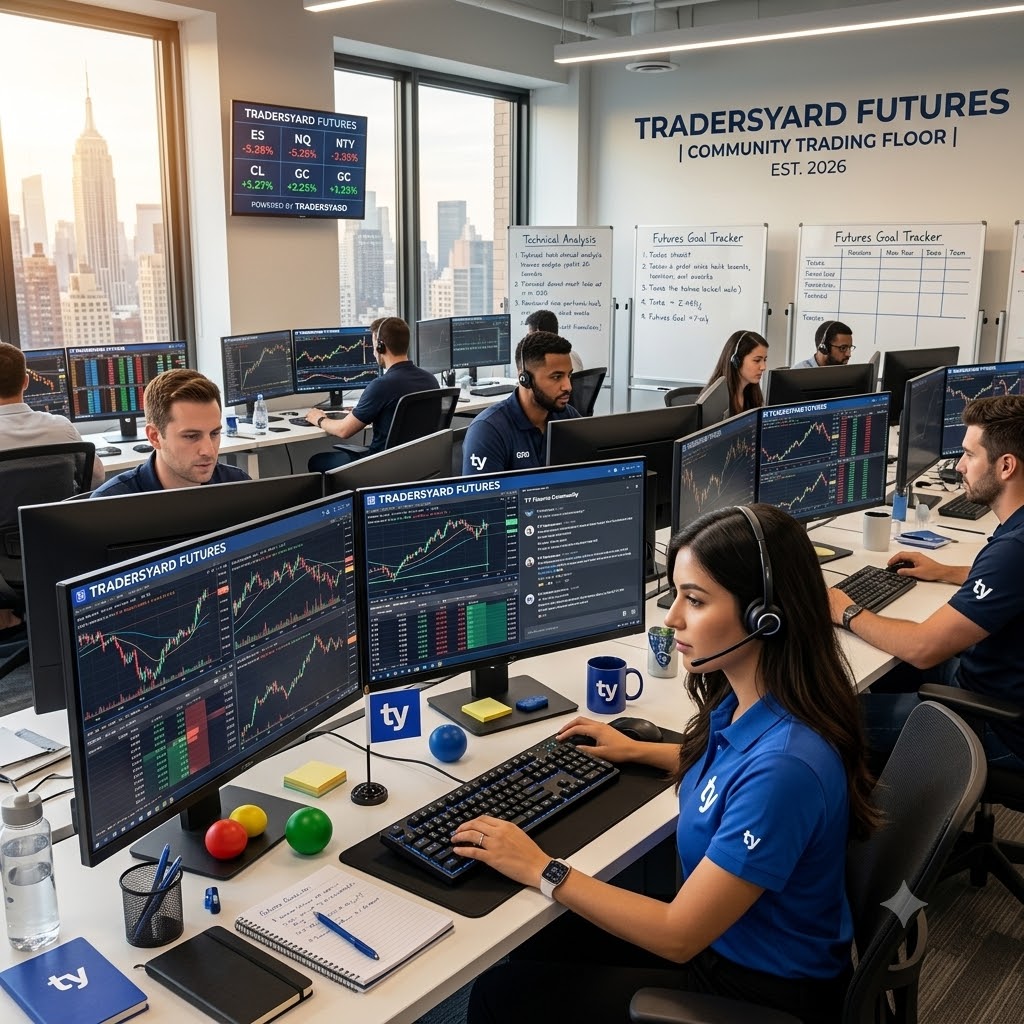
TradersYard Futures Review: A Swiss-Backed CFD Shop Crashes the Prop Futures Party
A firm that built its name on FX and CFDs now says everyone else does futures wrong. Bold words from the new kid. Here’s what an NQ scalper actually needs to know before handing over the entry fee.
The retail futures prop space has a tidy little hierarchy — Topstep, Apex, MyFundedFutures and a handful of others built on the rails US day traders recognize. So it was worth raising an eyebrow when TradersYard, a Swiss-backed, Vienna-operated firm best known for FX and CFD challenges, rolled out its TradersYard futures product and announced, more or less, that the incumbents have been doing it wrong this whole time. The pitch is confident. The question is whether the product behind it is built for the people it’s courting, or whether it’s an FX rulebook wearing a futures hat. Finance Magnates
What the TradersYard futures launch actually includes
TradersYard’s futures offering is a one-phase evaluation — pass a single profit target, no two-step gauntlet — with account sizes running from $10,000 to $150,000 and entry fees between $99 and $399 depending on size. There are two flavors: a static-drawdown variant with an 8% profit target, and an end-of-day drawdown variant with a softer 6% target. No consistency rule, no minimum trading days, and a 14-day money-back guarantee that evaporates the moment you place your first order. TradeInformer
- Structure: 1-phase evaluation
- Account sizes: $10K – $150K
- Entry fee: $99 – $399
- Targets: 8% (static DD) / 6% (end-of-day DD)
- Consistency rule: None
- Min trading days: Zero
- Platform: AgenaTrader (Windows desktop) + AgenaFeed data
- Payouts: Rise or crypto
The end-of-day drawdown option is the part that should catch the eye of anyone who trades the way our readers tend to — measuring drawdown off the session close rather than letting a trailing number chase your stop around in real time is a structurally friendlier model for a disciplined intraday trader. If you want the full breakdown of why drawdown style matters more than the headline account size, that lives in our True Cost hub.
The CEO’s pitch (and the obvious irony)
Co-founder and CEO Manuel Sonnleithner’s argument is that most firms treat futures like an afterthought, slapping recycled FX and CFD rules onto instruments with completely different contract sizes, tick values and margining — “unnecessary complex restrictions just to confuse users into failing their accs,” as he put it. He says futures need different risk management, different scaling logic, “different everything.” It’s a genuinely fair critique of the industry. It’s also a slightly awkward thing to hear from a firm whose entire prior catalog is, you guessed it, FX and CFDs. Finance Magnates
To their credit, the marketing claims line up with the actual ruleset — one phase, no consistency rule, no minimum days, an EOD drawdown option. That’s a cleaner sheet than plenty of established names. The skepticism isn’t about the rules on paper. It’s about what sits underneath them.
The platform reality nobody markets to you
Here’s the detail that matters most and gets the least airtime: TradersYard runs on AgenaTrader, a Windows-only desktop platform from its parent company, fed by AgenaFeed. AgenaTrader is a real, decade-old, Bloomberg-certified piece of software — this isn’t a fly-by-night skin on MetaTrader. But it is emphatically not NinjaTrader, Tradovate, or anything wired into Rithmic that a US futures scalper has muscle memory for. And AgenaFeed pulls from secondary exchanges, which the firm itself acknowledges can produce minor price variations versus primary exchange data. Prop Trading Vibes
How it stacks up against the incumbents
The honest framing isn’t “TradersYard good” or “TradersYard bad.” It’s “TradersYard is a small-ceiling, EU-platform newcomer to a category dominated by firms with years of futures-specific payout history.” Here’s the side-by-side that matters:
| Factor | TradersYard | US incumbents (Topstep / Apex / MFFU) |
|---|---|---|
| Max account size | $150K | $300K+ |
| Platform | AgenaTrader (Windows only) | NinjaTrader / Tradovate / Rithmic |
| Data source | AgenaFeed (secondary exchanges) | Primary CME routing |
| Futures track record | Since Jan 2026 | Multiple years |
| Consistency rule | None | Varies (often present) |
| EOD drawdown option | Yes | Some |
| US trader access | Verify before buying | Generally yes |
Who it’s for — and who should keep walking
One genuinely open question we can’t resolve for you: US trader eligibility and how the data routes for a US client. The firm’s center of gravity is European, and plenty of EU-domiciled CFD props geofence US traders entirely. Confirm it directly before you spend a dollar — and while you’re at it, run the rules through our comparison tool against whatever you’re currently trading.
The honest-broker verdict
TradersYard is not on our affiliate roster, we don’t earn a cent if you sign up, and that’s exactly why this read is what it is: a firm with a real platform pedigree, a cleaner-than-average ruleset, and a confident pitch — paired with a small account ceiling, an unfamiliar Windows-only platform, secondary-exchange data that should make any scalper nervous, and a futures track record measured in months, not years. It’s not a firm to avoid. It’s a firm to watch, demo skeptically, and verify before trusting with a payout. We’ll revisit once there’s a real body of futures-side withdrawal history to point at. Until then, the only number that matters is the one that comes out of a funded account — and that one’s still a blank.
This is a profile of a firm we do not have an affiliate relationship with. No referral links appear in this article. Figures reflect the firm’s published terms at the time of writing and are subject to change — the official site always wins. TradersYard Docs
Frequently asked questions
Does TradersYard offer futures accounts?
Yes. As of January 2026, TradersYard offers one-phase futures challenges with account sizes from $10,000 to $150,000, priced between $99 and $399, in static-drawdown (8% target) and end-of-day-drawdown (6% target) variants.
What platform does TradersYard use for futures?
AgenaTrader, a Windows-only desktop platform from its parent company, with data supplied by AgenaFeed. It is not NinjaTrader, Tradovate, or Rithmic, and AgenaFeed draws from secondary exchanges, so minor price differences versus primary CME data are possible.
Is there a consistency rule or minimum trading day requirement?
No. TradersYard’s futures challenges carry no consistency rule and no minimum number of trading days, which is a cleaner ruleset than many competing firms impose.
Can US traders use TradersYard futures accounts?
This needs to be verified directly with the firm before purchase. TradersYard is European-based, and many EU-domiciled prop firms restrict US traders. Do not assume access — confirm it on the official site first.
How does TradersYard pay out?
Payouts are processed via Rise or cryptocurrency. As the futures product is new as of 2026, there is not yet a long, independently verifiable futures-side payout history to evaluate.
Is TradersYard a good fit for an NQ scalper?
For a precision tick-scalper, the secondary-exchange data feed and unfamiliar Windows-only platform are meaningful drawbacks. Demo it hard against a live CME feed before trusting entries. Traders who want a primary CME feed and a familiar platform may prefer established US futures firms.