How to Get Off Tilt: Recognising It, Stopping It, and Trading Again Tomorrow
Tilt isn’t a bad mood you can talk yourself out of. It’s a physiological state that changes what “reasonable risk” feels like — which is why every plan you wrote at 8am stops applying by the time you need it most.
You will not notice tilt while you’re on it. That’s not a personal failing; it’s the defining feature. Which means the only interventions that work are the ones you set up beforehand.
What tilt actually is
The word comes from poker, and it’s usually described as anger after a bad beat. That framing is too narrow and it’s why most advice about it fails. Tilt is better understood as a shift in your risk preferences caused by a physiological stress response — which explains why it doesn’t feel like anger from the inside. It feels like clarity.
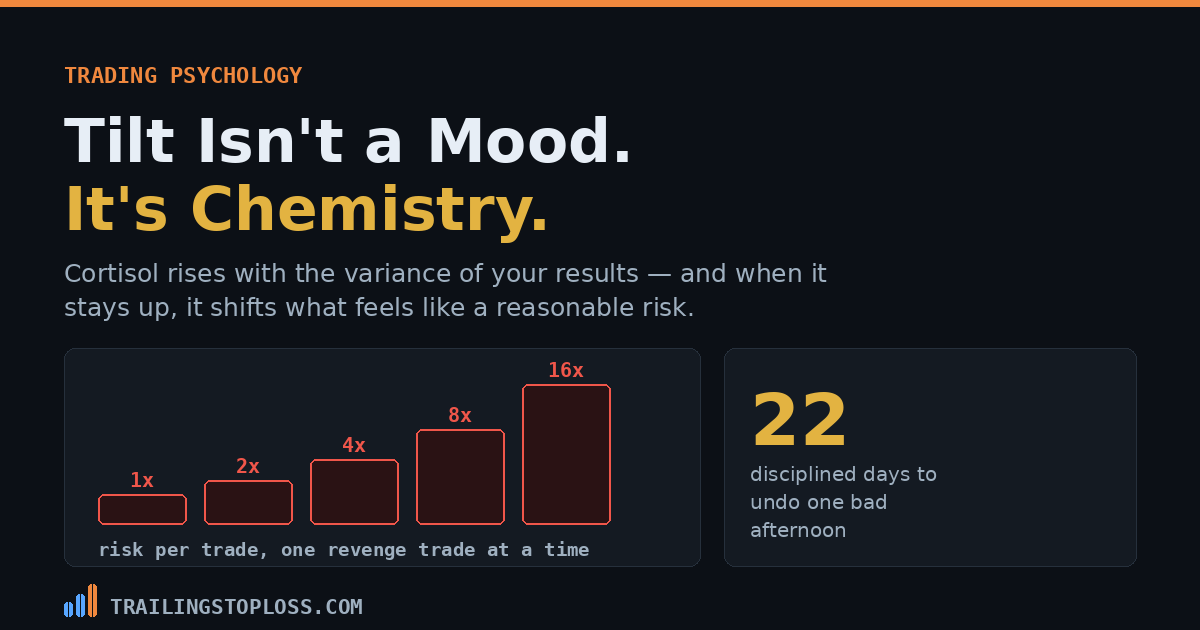
Coates and Herbert sampled hormone levels from traders on a London trading floor under real working conditions and found that a trader’s cortisol rises with both the variance of his own trading results and the volatility of the market. Not with losses specifically — with variance. Uncertainty and swing, in either direction. (Coates & Herbert, PNAS)
The follow-up work contains the sentence that matters most for tilt. Acutely elevated steroids may optimise performance on a range of tasks — but chronically elevated steroids may promote irrational risk-reward choices. The spike that makes you sharp at the open is the same chemistry that, sustained across a bad morning, quietly rewrites what you’re willing to risk. (Coates et al., Philosophical Transactions of the Royal Society B)
Discipline is a judgment you apply to a decision. Tilt changes the inputs to the judgment — the size that feels aggressive, the setup that looks acceptable, the stop that seems too tight. You aren’t overriding good analysis with bad behaviour. You’re doing careful analysis on corrupted inputs, which is far harder to catch.
What it costs
The reason tilt deserves its own protocol rather than a paragraph in a discipline article is the asymmetry of the damage. A normal losing day costs you one unit of risk. A tilt session costs weeks.
| The session | Cost | Disciplined days to recover |
|---|---|---|
| Normal losing day, one trade | −1R | 2.5 |
| Two revenge trades, same size | −3R | 7.5 |
| Three revenge trades, doubling | −7R | 17.5 |
| Four revenge trades, doubling | −9R | 22.5 |
| Five revenge trades, tripling | −16R | 40 |
At a healthy +0.40R per trade, one bad afternoon undoes three to four weeks of doing everything right. That’s the actual maths of it. Not a moral failure — a compounding problem, because size escalation is geometric while your recovery is linear.
The tells you can actually check
Since the internal signal is unreliable, use external ones. These are observable facts about your behaviour rather than judgments about your state — which is the whole point, because your judgment is the thing that’s compromised.
| Observable | What it means |
|---|---|
| Size is larger than your written number | The single most reliable tell. Nothing else needs checking. |
| Trade wasn’t in your plan this morning | You’re sourcing setups from the screen, not the plan. |
| Time between trades is shrinking | Deliberation window collapsing. |
| You moved a stop wider mid-trade | Protecting the story rather than the account. |
| You’re on a chart you don’t normally trade | Looking for action, not signal. |
| You’ve stopped writing entries down | Avoiding the record because you know how it reads. |
| Physical: jaw, shoulders, holding breath | The stress response you can’t feel emotionally. |
Notice that six of the seven are things a spreadsheet could flag. That’s deliberate. If your only tilt detector is asking yourself whether you feel tilted, you don’t have a detector. (Coates & Herbert, PNAS)
The intervention: name it in writing
There’s a specific, well-evidenced technique here, and it’s more useful than “take a breath”. Lieberman’s fMRI work on affect labelling found that putting feelings into words diminished the response of the amygdala and other limbic regions to negative stimuli, while increasing activity in the right ventrolateral prefrontal cortex — a region associated with top-down inhibitory processes. The two were inversely correlated. (Lieberman et al., Psychological Science)
In plain terms: naming the emotion turns down the alarm and turns up the part of the brain that inhibits behaviour. It’s not catharsis and it isn’t positive thinking. It’s a mechanical intervention, and it takes about ten seconds. (UCLA Health)
So the first move when a tell fires isn’t a breathing exercise. It’s a sentence, typed or written: “10:42 — angry about the stop-out, want to get it back.” Specific emotion, specific trigger, specific urge. Vague labels do less work than precise ones. (Lieberman et al., Psychological Science)
A protocol that works because it doesn’t need you
Every item here is set up in advance, when your inputs are clean. That’s the design principle: you’re not building willpower for the moment, you’re removing the moment’s authority. (Coates et al., Phil. Trans. R. Soc. B)
Before the session
- Write the size number down. One figure, in dollars or contracts. It becomes the tripwire — any deviation is tilt by definition, no self-assessment required.
- Set a daily loss limit inside the firm’s. The firm’s number is a liquidation threshold, not a risk plan. Yours should sit well before the point where your decisions degrade.
- Use a platform lockout if you have one. A rejected order is worth more than a resolution.
- Decide the stop-condition in advance. “Two losses, or one deviation from the plan, and I’m done” — written before the open, not negotiated at 11am.
The moment a tell fires
- Flatten. An open losing position keeps you in the state that produces the next bad decision. Realising it measurably reduces subsequent risk-taking; holding it doesn’t.
- Label it in writing. Time, emotion, trigger, urge. Ten seconds.
- Leave the desk for at least fifteen minutes. Not to calm down in the abstract — to break the loop between the screen and the arousal. Walk, stairs, outside. Physical movement, not scrolling.
- Don’t decide anything while you’re away. The decision is already made: the session is over. You’re not weighing it up.
After
- Log the tilt event as its own entry, separate from the trades. Date, trigger, what fired, what it cost, whether you stopped. After ten of them you’ll have a pattern, and it’s almost always narrower than you expect — a specific time, a specific setup failing, a specific type of loss.
- Score the stop, not the P&L. A day where you caught it at −2R instead of −9R is a success. If only green days count as wins, you’ve built a scoring system that punishes the exact behaviour you’re trying to install.
- Come back at reduced size for a defined period. Not as penance — as a way to make the next session survivable while your baseline resets.
Do not “make it back tomorrow.” Tomorrow’s plan should be identical to any other day’s plan. Carrying the deficit forward is how a one-session event becomes a losing week: you start Tuesday needing something from the market, which is the same state you were in on Monday afternoon.
The counterweight
Two honest caveats, because a protocol applied indiscriminately does its own damage.
Not every loss sequence is tilt. At a 35% win rate, three losses in a row happens about 27% of the time and five in a row about 12% — entirely normal variance in a profitable system. If your size is unchanged, your setups came from the plan, and you’re logging as usual, that’s not tilt. It’s Tuesday. Stopping every time the market takes three from you would leave you cutting the sessions your edge was built to survive.
And frequent tilt is information about the system, not just the trader. If it’s happening weekly, the useful question isn’t how to white-knuckle through it — it’s whether your size is too large for your tolerance, whether your win rate expectation is unrealistic for the strategy, or whether you’re trading a timeframe that doesn’t suit your temperament. Persistent tilt is often a correctly functioning alarm attached to a badly configured system. (Coates & Herbert, PNAS)
One more thing worth saying plainly. If the anger or the low after a bad session is severe, if it lasts days, or if it’s affecting your sleep, your relationships or your life outside trading hours — that’s beyond what a trading protocol addresses, and it’s worth talking to a doctor or therapist about. That’s a normal thing to do and it’s treatable.
The short version
Tilt is a physiological shift, not a mood: cortisol rises with the variance of your results, and sustained elevation nudges risk-reward choices in a direction that feels perfectly reasonable from the inside. That’s why you can’t detect it by introspection and why “be more disciplined” doesn’t work — the inputs to your judgment are what changed. Use external tells instead, with size against your written number as the primary one. When a tell fires: flatten, label the feeling in writing, leave the desk for fifteen minutes, and treat the session as over. One bad afternoon costs three to four weeks of disciplined trading, so catching it at −2R rather than −9R is the single highest-value skill in the whole discipline stack. (Coates et al., Phil. Trans. R. Soc. B)
Frequently asked questions
What is trading tilt?
A shift in your risk preferences driven by a physiological stress response, rather than simply being angry. Research on a London trading floor found cortisol rises with the variance of a trader’s results and with market volatility, and that chronically elevated stress hormones can promote irrational risk-reward choices. That’s why tilt doesn’t feel like anger from the inside — it feels like clarity, and the size that would have seemed reckless in the morning now seems justified.
How do I know if I’m on tilt right now?
Don’t ask yourself — check observable facts. Is your size larger than the number you wrote down? Was this trade in your plan this morning? Is the gap between trades shrinking? Have you widened a stop mid-trade, or moved to a chart you don’t normally trade? Have you stopped logging entries? Size against your written number is the most reliable single tell, and it needs no self-assessment.
How much does one tilt session actually cost?
Far more than the trades themselves suggest, because size escalation is geometric while recovery is linear. At an expectancy of +0.40R per trade, three revenge trades at doubling size costs about −7R, or roughly 17 disciplined days to recover. Four costs −9R, about 22 days. One bad afternoon can undo three to four weeks of doing everything right.
What should I do the moment I notice I’m tilting?
Flatten first — an open losing position keeps you in the state that produces the next bad decision. Then write down the feeling: time, emotion, trigger, urge. Affect-labelling research found that putting feelings into words dampens amygdala activity while increasing activity in a prefrontal region associated with inhibiting behaviour. Then leave the desk for at least fifteen minutes, and treat the session as over rather than something to reassess.
Is a losing streak the same thing as tilt?
No, and conflating them is costly. At a 35% win rate, three consecutive losses happen about 27% of the time and five about 12% — ordinary variance in a profitable system. If your size is unchanged, your setups came from the plan and you’re still logging, that’s not tilt. Stopping every time the market takes three from you means cutting the sessions your edge was designed to survive.
Should I try to make the money back the next day?
No. Tomorrow’s plan should be identical to any other day’s. Carrying the deficit forward is how a single session becomes a losing week — you start the next day needing something from the market, which is precisely the state that caused the damage in the first place. Coming back at reduced size for a defined period is reasonable; coming back with a recovery target isn’t.
Related on this site: why your daily loss limit should be lower than the firm’s · rage trading · ending your day on one good trade · free P&L calendar
Worked figures use +0.40R per trade to illustrate the recovery maths; your own numbers will differ. Nothing here is financial or medical advice. Futures trading carries substantial risk of loss and is not suitable for every investor.