Why I Don’t Trade News Events
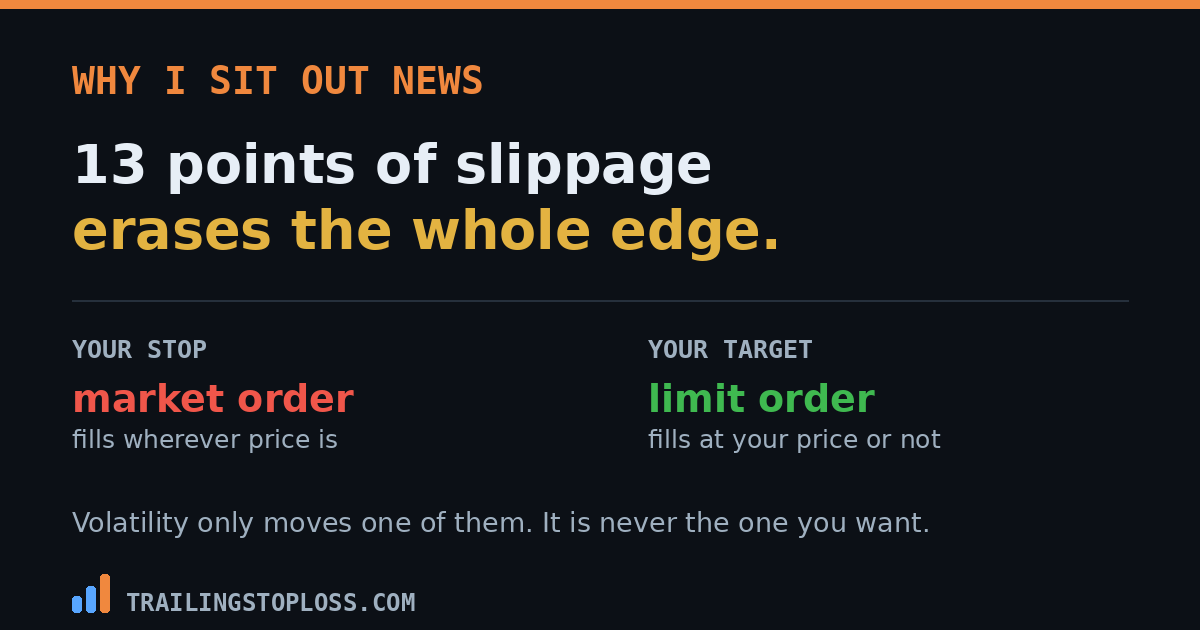
Not because I’m scared of volatility. Because volatility only moves one side of my trade, and it’s never the side I want. A stop is a market order that fills wherever price happens to be; a target is a limit order that fills at my price or not at all. Every point of chaos hurts my losers and does nothing for my winners.
Run the arithmetic and a genuinely profitable scalp dies at 13 points of average slippage. On NQ during a CPI print, 13 points is a rounding error.
The asymmetry nobody mentions
Here’s the mechanic that decides it, and it has nothing to do with nerve.
When price hits your stop, your platform sends a market order. It fills at whatever price exists at that instant. In a normal session that’s your price or a tick worse. During a high-impact print, the book is empty for a moment and your order fills wherever the next resting bid happens to sit — which can be 30 or 60 points away.
When price hits your target, your platform fills a limit order. A limit order fills at your price or better, and in practice that means at your price. Volatility does not hand you a bonus. If NQ rips 80 points through your target, you get exactly the target you set.
What that does to a working edge
Take a scalp that genuinely works — 45% win rate at 2:1, a 20-point stop on NQ. Here’s what happens to it as fills degrade.
| Fill conditions | Slippage on stops | Expectancy | Change |
|---|---|---|---|
| Normal session | 0 pts | +0.37R | — |
| Normal, one tick | 0.25 pts | +0.35R | −5% |
| Busy open | 2 pts | +0.30R | −17% |
| News print | 8 pts | +0.12R | −67% |
| News print | 15 pts | −0.05R | −113% |
| Bad print | 25 pts | −0.34R | −193% |
The edge dies at 13 points of average slippage. Not a catastrophe — an average. A scalper whose stops fill 13 points worse than intended, on average, is breaking even with a method that would otherwise return +0.37R a trade. Past that, a profitable strategy is a losing one and nothing about the analysis changed.
Eight points of slippage — which is modest for a CPI release — already costs two thirds of the edge.
What one bad fill costs on a prop account
The expectancy math is abstract. This isn’t.
Two MNQ on a 20-point stop is $80 of risk. Against a $2,500 drawdown that’s 31 losing trades of room — right around the 20 to 25 the account should be sized for.
| Fill | Points lost | Dollars (2 MNQ) | Normal losses used |
|---|---|---|---|
| As intended | 20.0 | $80 | 1.0× |
| 2 pt slip | 22.0 | $88 | 1.1× |
| 8 pt slip | 28.0 | $112 | 1.4× |
| 15 pt slip | 35.0 | $140 | 1.8× |
| 40 pt gap | 60.0 | $240 | 3.0× |
One 40-point gap through your stop spends three trades’ worth of room. Two in a week and you’ve given up a fifth of the account to fills — not to bad reads, not to broken discipline, just to the mechanics of where a market order lands when the book is thin.
A trailing drawdown counts the fill, not your intent. “My stop was 20 points” is not a defense against a breach. If your firm uses an intraday trail that includes open P&L, a release-driven spike can breach you on a position you were already closing — which is a large part of why an intraday trail is five to six times more likely to end an account than a static one.
The part that’s specific to how I trade
I take continuation scalps off the 1H with 4H context, usually one a day. A hold runs twenty minutes to an hour and a half. That window is the problem.
I’m not choosing whether to trade a release. I’m choosing whether to be already positioned when one lands. Those are different decisions and only the second one is real. By the time the number prints, my entry is long since taken, my stop is sitting in the book, and the only thing left to find out is where it fills.
So the rule is simple: if a high-impact release lands inside my expected hold, I don’t take the entry. Not flatten at the print — don’t enter. Flattening into a release means eating the spread twice and then trying to re-enter into the worst liquidity of the day, which is how a sit-out turns into two trades.
What I actually do
- Check the calendar before the session, not during. CPI, PPI, NFP, FOMC, and the ECB rate decision are the ones that move NQ. The calendar is on the site and takes ten seconds.
- No new entry inside 90 minutes of a high-impact print. That covers my longest normal hold with room to spare.
- If I’m already in when I spot one, I’m out before it — at my price, early, calmly. Not at 8:29:55.
- The 8:30 ET releases usually cost me the morning, and that’s fine. One trade a day means missing one day costs one trade, not a week of compounding.
- I don’t take the re-entry for an hour. The post-print hour looks like a trend and behaves like a coin flip. My setup was measured in normal conditions and those aren’t normal conditions.
I’m not avoiding news because volatility is frightening. I’m avoiding it because my edge was measured in conditions that don’t exist for those fifteen minutes, and running a strategy outside the conditions it was measured in is just guessing with extra steps. Sitting out isn’t caution. It’s refusing to trade a setup I have no data on.
The honest limits
Some people do trade releases, deliberately and profitably. They size down hard, use wide stops that account for the range, or trade the post-print structure rather than the spike. That’s a different strategy with its own measured expectancy, not my strategy applied to a worse moment. If you’ve actually measured yours across fifty prints, you know more than this article does.
The slippage figures are illustrative. They’re the shape of the problem, not a measurement of your platform on a particular day. Real slippage depends on your broker, your order routing, the specific release and how far the number lands from consensus. Check your own fills — most platforms will show you the difference between your stop price and your fill price, and it’s the most useful number in the report nobody reads.
And avoiding news doesn’t create an edge. It protects one. If the method doesn’t work in normal conditions, skipping CPI just loses the money more slowly.
The short version
I don’t trade news events because slippage is one-directional. A stop is a market order that fills wherever price is; a target is a limit order that fills at your price or not at all — so volatility widens your losses and never your wins. Modeling a working scalp at 45% and 2:1 with a 20-point NQ stop, eight points of slippage costs two thirds of the expectancy and thirteen points erases it completely, turning +0.37R a trade into zero. On a 50K prop account running two MNQ, a single 40-point gap through the stop costs $240 against an $80 intended risk — three normal losses of drawdown from one fill. Because I hold continuation scalps twenty to ninety minutes, the real decision isn’t whether to trade a release but whether to be already positioned when one lands, so I take no new entry within 90 minutes of a high-impact print and skip the hour after it. That isn’t caution. My edge was measured in normal conditions, and those fifteen minutes aren’t normal conditions.
Frequently asked questions
Should you trade during news events?
Not with a strategy whose expectancy was measured in normal conditions. Slippage during high-impact releases is one-directional: stops are market orders that fill wherever price is, while targets are limit orders that fill at your price or not at all. Modeling a 45% win rate at 2:1 with a 20-point NQ stop, eight points of slippage costs about two thirds of the edge and thirteen points erases it entirely. Traders who do trade releases profitably use a different strategy built for those conditions, not the same one applied to a worse moment.
Why is slippage worse on stop losses than on targets?
Because they are different order types. A stop triggers a market order, which fills at whatever price exists at that instant — during a release the order book thins out and the fill can land 30 or 60 points from your intended level. A target is a limit order, which only fills at your price or better, so extra volatility hands you nothing. Every point of additional range is taken out of the loss side of the trade and none is added to the win side.
Which economic releases move NQ the most?
CPI, PPI, non-farm payrolls, FOMC rate decisions and statements, and the ECB rate decision are the consistent movers for US index futures. The practical test isn’t the name of the release but whether it lands inside your expected hold time — a scalper holding twenty to ninety minutes needs to check the calendar before entering, because by the time the number prints the entry is taken and the stop is already resting in the book.
Should I close my position before a news release?
Better not to have opened it. Flattening into a release means paying the spread twice and then trying to re-enter into the worst liquidity of the day, which turns one sit-out into two trades. A cleaner rule is to take no new entry within a window that covers your longest normal hold — 90 minutes works for a scalper. If you are already positioned and spot a release coming, exit early and calmly at your own price rather than seconds before the print.
Can news slippage breach a prop firm account?
Yes, and the drawdown counts the fill rather than your intent — “my stop was 20 points” is not a defense against a breach. On a 50K account running two MNQ with a 20-point stop, intended risk is $80, but a 40-point gap through the stop costs $240, or three normal losses of room from a single trade. Firms using an intraday trailing drawdown that includes open profit are more exposed still, since a release-driven spike can breach a position you were already closing.
Related on this site: why trailing drawdowns end accounts · picking an account size from your stop · why you’ll never get comfortable with losing · the economic calendar
Expectancy figures come from 20,000 simulated trades at a 45% win rate and 2:1 reward-to-risk with slippage applied to stop fills only; contract values are CME standard for MNQ and NQ. Slippage in practice varies by broker, routing and release — check your own fill reports rather than these illustrative figures. Nothing here is financial advice. Futures trading carries substantial risk of loss.