The History of Online Prop Firms: From the Pit to the Challenge Fee
The model started in futures, not forex. It was invented in 2012 by a Chicago floor trader who had blown out almost six figures, and it was based on the NFL Scouting Combine. Forex adapted it three years later from Prague. Everything since — the boom, the collapse of 2024, the shape of the industry today — descends from those two decisions.
And the whole thing rested on a regulation that stopped existing in June 2026.
The ancestors: Chicago pits and 1990s arcades
“Prop trading” originally meant something else entirely: a bank or firm trading its own capital rather than executing for clients. Through the 1980s and 1990s that was Susquehanna, DRW, the big bank desks — institutions with balance sheets, hiring graduates.
The closer ancestor to what exists now appeared in the late 1990s, when electronic exchanges opened and independent day-trading shops emerged in the US. Firms like Schonfeld, Bright Trading and EchoTrade recruited stock day traders, typically requiring a capital deposit or paid training before granting access to the firm’s buying power.
That’s the recognizable shape: an individual, a gate, and someone else’s leverage on the other side. What it lacked was the internet. You went to an office, sat at a desk, and were known to the people funding you.
2010–2012: Topstep and the Combine
Michael Patak was a floor trader at the Chicago Board of Trade, trading Dow futures. By his own account he blew out close to six figures learning the job.
The firm’s name records that. In a physical trading pit, the top step was reserved for the largest and best traders — the clearest view of the market, and a visible hierarchy everyone below was working toward. Patak stood below it. (Topstep)
He founded Patak Trading Partners in 2010, and in July 2012 launched TopstepTrader from the floor of the Chicago Board of Trade. The evaluation model was borrowed from an unlikely source: the NFL Scouting Combine, where college players demonstrate ability to scouts in a structured assessment rather than a game. Anyone can enter, the criteria are published, and performance decides the outcome.
Applied to trading, that became the Trading Combine — a simulated account with a profit target, a daily loss limit and a drawdown, open to anyone willing to pay the entry fee. Wikipedia credits Topstep as the first company to run a large-scale funded trader model. The firm rebranded from TopstepTrader to Topstep in 2020.
Every structural feature of a modern prop evaluation was present in 2012: a recurring fee, a simulated account, a profit target, a trailing drawdown, and a payout split on success. Fourteen years and roughly two thousand firms later, almost nothing about the shape has changed. What changed is the price, the marketing and the number of people selling it.
2015: Prague adapts it to forex
Three years after Topstep, four people in the Czech Republic launched a company called Získej účet — “Get an Account”. It later took the initials of four of the people involved, Filip, Tomáš, Marek and Otakar, and became FTMO. (FTMO)
FTMO’s contribution was adapting the futures combine to retail forex and CFDs, and splitting the assessment into two stages — the Challenge and the Verification. That two-step structure became the default across the forex side of the industry in a way Topstep’s single-step model never did.
The adaptation mattered more than it looks. Futures are exchange-traded on CME with a regulated venue behind them. Retail forex is an over-the-counter market where the “account” is a demo environment and the payout is a reward for performance on a simulation. FTMO’s model was built on that basis and disclosed as such — but it also meant the forex branch of the industry had no exchange, no clearing house and, for years, very little regulatory attention.
2018–2022: the expansion
Apex Trader Funding launched in 2018, The Funded Trader in 2021, Tradeify in 2022, and hundreds of others across the same window. Two things made the timing work.
CME launched Micro E-mini futures in 2019 at one-tenth the size of E-minis, which is what made a 50K account with a small drawdown tradeable at all. And COVID lockdowns arrived with stimulus payments, spare time and zero-commission brokerage — the largest cohort of new retail traders in history.
Search interest for the sector rose roughly 1,264% between December 2015 and April 2024. The industry grew to an estimated $20 billion globally with over 2,000 firms, though those figures come from participants rather than audited filings.
2023–2024: the reckoning
Two events, ten months apart, broke the forex side of the industry.
August 2023: the CFTC and My Forex Funds
The CFTC filed against Traders Global Group, operating as My Forex Funds, alleging fraud involving roughly $310 million across more than 135,000 customers. Operations were frozen. At the time MFF was the largest retail prop firm in the world, and it effectively ceased to exist overnight.
The sequel is less well known and matters more. In May 2025 a federal court dismissed the case with prejudice and sanctioned the CFTC roughly $3.1 million, after a Special Master found the agency had made false statements in sworn declarations — the transfer cited as evidence of assets being dissipated was a legitimate tax payment the CFTC had documentation for before filing. Canadian assets were ordered returned in December 2025. The firm began contacting traders about outstanding 2023 payouts in April 2026.
The largest firm in the industry was destroyed by an enforcement action that a court later found was brought in bad faith. Both halves of that sentence are true, and the industry has mostly only absorbed the first.
Early 2024: MetaQuotes
The second blow came from a software vendor, not a regulator. MetaQuotes — which licenses MetaTrader 4 and 5 — terminated True Forex Funds’ license without warning, then moved against prop firms serving US clients more broadly.
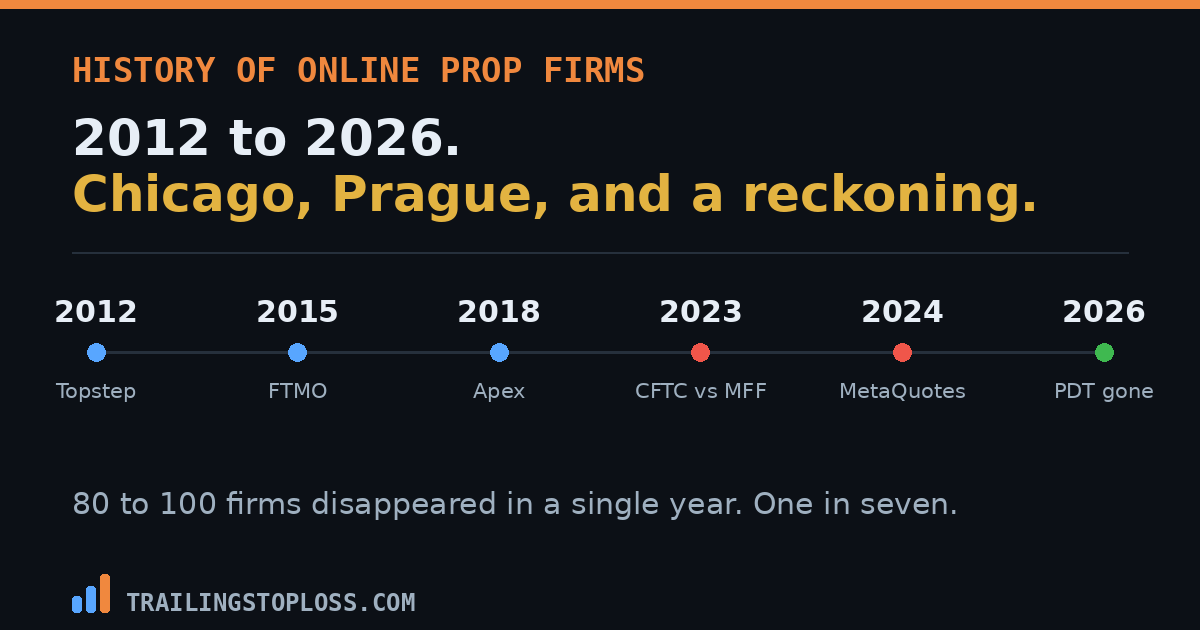
For firms whose entire operation ran on MT4 or MT5, losing the license meant losing the product. Even FTMO suspended US operations. Brokeree Solutions tracked 82 prop firms through 2024 and found only 71 still operating by Q4 — roughly one in seven gone in a year. Finance Magnates Intelligence put the total disappearing that year at 80 to 100.
The lesson traders took from it was about platform dependency: a firm that doesn’t control its own software has a single point of failure no rulebook discloses. It’s the same vulnerability that surfaced again in July 2026, when NinjaTrader terminated Alpha Futures’ contract.
2025–2026: consolidation, and the trend reversing
What emerged from the shakeout was smaller, better capitalized and structurally different.
The survivors got very large. FTMO reported approximately $329 million in revenue through its parent holding in 2024, up 53% year on year, with $211 million in cash at year end — the kind of balance sheet that makes a firm difficult to dislodge.
The majors came back to the US. The5ers, FundedNext and FTMO all re-entered during 2025, with FTMO the only one offering MetaTrader 5 to US traders, through a partnership with OANDA.
CFD firms moved into futures. The US futures market was where the demand was, and forex-native brands followed it. FundedNext launched futures; The5ers was expected to follow.
And the direction reversed. For years, brokers launched prop arms. By 2025 prop firms were becoming brokers. In 2026 Topstep — the firm that started it — registered Topstep Brokerage LLC as an introducing broker with the CFTC and NFA membership, letting funded traders move prop-side payouts into a personal live futures account.
That last one closes a circle. The industry began when a floor trader built a simulated assessment because there was no other way to get evaluated. Fourteen years later, the same firm is a registered broker offering real accounts.
June 2026: the foundation moves
The Pattern Day Trader rule required $25,000 in equity to day trade US equities actively, from 2001 onward. It never applied to futures. For twenty-five years, that exemption is what made a funded futures account the cheapest legitimate route to active day trading below that threshold.
On 14 April 2026 the SEC approved FINRA’s amendment to Rule 4210, and on 4 June 2026 the $25,000 minimum, the four-trade counter and the PDT designation all ceased to exist, replaced by a risk-based intraday margin standard.
The gate fell from $25,000 to the ordinary $2,000 margin minimum. Whether that reshapes the industry the way MetaQuotes did is the open question of the next two years — we’ve written about what it changes in more detail.
The timeline
| Year | What happened |
|---|---|
| Late 1990s | US equity day-trading arcades — Schonfeld, Bright Trading, EchoTrade |
| 2010 | Patak Trading Partners founded on the CBOT floor |
| July 2012 | TopstepTrader launches the Trading Combine — the first online funded-trader model |
| 2015 | FTMO founded in Prague as Získej účet; adapts the model to forex with a two-step challenge |
| 2018 | Apex Trader Funding launches |
| 2019 | CME Micro E-minis; zero commissions at US brokers |
| 2020–21 | COVID retail boom; The Funded Trader founded 2021 |
| Aug 2023 | CFTC files against My Forex Funds — largest firm in the world frozen |
| Early 2024 | MetaQuotes revokes licenses; 80–100 firms disappear that year |
| May 2025 | MFF case dismissed with prejudice; CFTC sanctioned ~$3.1m |
| 2025 | Majors re-enter the US; prop firms start becoming brokers |
| Jun 2026 | Pattern Day Trader rule eliminated |
What the history actually teaches
- Futures came first, and by three years. Anyone describing this as a forex innovation has the order backwards. The combine was built for CME futures by a CBOT floor trader; forex adapted it.
- The model has barely changed since 2012. Fee, simulation, target, drawdown, split. Every firm marketing a revolutionary structure is selling a fourteen-year-old design with different numbers.
- Existential risk has never come from trading. The two events that reshaped the industry were a regulator and a software vendor. Neither appears in any firm’s rulebook, and neither is something you can assess from a comparison table.
- Longevity is the only signal that has held up. The firms that survived 2024 were the ones with capital, their own platforms, and published payout records. That’s why we weight operating history rather than headline offers.
- And the foundation just moved. A sector built in the shadow of a rule now has to justify itself without it.
The honest limits
Founding dates are firmer than the numbers around them. Topstep 2012, FTMO 2015 and Apex 2018 are well documented, and Topstep’s and FTMO’s own sites corroborate their own histories. Market sizing, firm counts and revenue figures come from participants and industry press, and none are audited.
“First” is a contested word. Topstep is widely credited with the first large-scale online funded-trader model, and Wikipedia states it directly. Smaller or earlier attempts may exist that left no record — the claim is about scale and influence, not about being unprecedented.
The MetaQuotes account is assembled from trade press. MetaQuotes made no detailed public statement about its enforcement, so the sequence is reconstructed from reporting and affected firms, and the term “unofficial crackdown” is the industry’s phrasing rather than a documented policy.
The short version
Online prop firms began in futures, not forex. Michael Patak, a Dow futures floor trader who had blown out close to six figures, founded Patak Trading Partners in 2010 and launched TopstepTrader from the floor of the Chicago Board of Trade in July 2012, modeling the evaluation on the NFL Scouting Combine — the first large-scale online funded-trader model. Its ancestors were 1990s US equity day-trading arcades like Schonfeld and Bright Trading. FTMO adapted the model to retail forex from Prague in 2015, founded as Získej účet and adding the two-step challenge that became the forex standard. Micro E-minis in 2019 and the COVID retail boom drove roughly 1,264% growth in search interest, then two shocks broke the forex side: the CFTC’s August 2023 action against My Forex Funds — later dismissed with prejudice, with the agency sanctioned around $3.1 million — and MetaQuotes revoking MetaTrader licenses in early 2024, after which one firm in seven disappeared. What survived is larger and better capitalized, and in 2026 Topstep registered as a broker, closing the circle it opened in 2012.
Frequently asked questions
Which was the first online prop firm?
Topstep, launched as TopstepTrader in July 2012 from the floor of the Chicago Board of Trade by Michael Patak, a former Dow futures floor trader. It is widely credited as the first company to run a large-scale online funded-trader model, and it created the Trading Combine evaluation that every subsequent firm adapted. The parent company, Patak Trading Partners, was founded in 2010.
Did futures or forex prop firms come first?
Futures, by three years. Topstep launched its futures evaluation in 2012; FTMO brought the model to retail forex and CFDs from Prague in 2015, adding the two-step Challenge and Verification structure that became standard on the forex side. The wider ancestor of both was the US equity day-trading arcade of the late 1990s — firms like Schonfeld, Bright Trading and EchoTrade that gave stock day traders access to firm buying power after a deposit or training.
Why is it called Topstep?
From the physical trading pit. The top step was reserved for the largest and best traders — it gave the clearest view of the market and served as a visible hierarchy for everyone below. Founder Michael Patak started below that step and, by his own account, blew out close to six figures before learning that progress came from discipline and structure rather than talent. The firm’s evaluation model was borrowed from the NFL Scouting Combine.
What caused the 2024 prop firm collapse?
Two shocks. In August 2023 the CFTC filed against My Forex Funds, then the largest retail prop firm in the world, alleging roughly $310 million in fraud across 135,000 customers and freezing operations — though a court dismissed that case with prejudice in May 2025 and sanctioned the CFTC around $3.1 million. Then in early 2024 MetaQuotes revoked MetaTrader licenses from prop firms serving US clients, which removed the product entirely for firms built on MT4 and MT5. Of 82 firms tracked through 2024, only 71 were still operating by Q4.
How has the prop firm model changed since 2012?
Structurally, remarkably little. The 2012 Trading Combine already had a recurring fee, a simulated account, a profit target, a daily loss limit, a trailing drawdown and a profit split on success — the same components every firm sells today. What changed is price competition, marketing reach through affiliate channels, the addition of micro contracts in 2019 that made small accounts tradeable, and consolidation into fewer, larger, better-capitalized operators after 2024.
Related on this site: what built the prop firm boom · the 25 firms we flag · true cost rankings · biggest futures firms by user count
Founding dates and company histories are drawn from Topstep’s and FTMO’s own published accounts and contemporaneous trade press. Market sizing, firm counts and revenue figures come from industry participants and are not audited. The MetaQuotes sequence is reconstructed from trade reporting, as the company made no detailed public statement. Nothing here is financial advice. Futures trading carries substantial risk of loss.