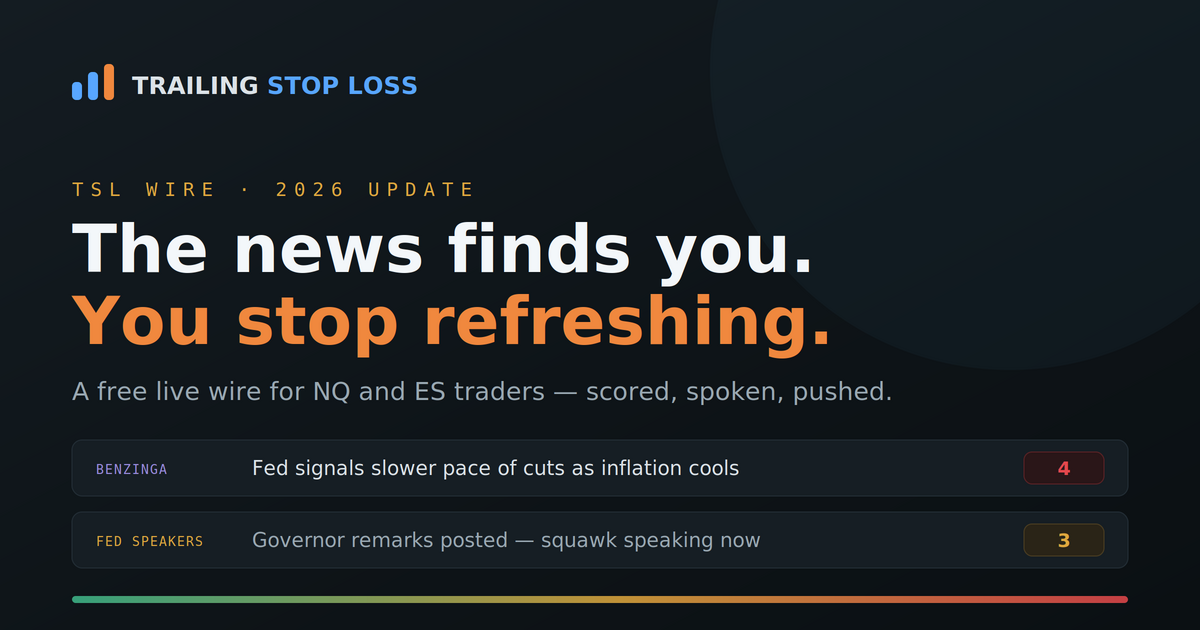
TSL Wire in 2026: the news finds you, so you can stop refreshing fourteen tabs
TSL Wire now takes headlines straight off a primary wire, scores every one of them for how much it actually matters to NQ and ES, speaks the important ones out loud, and pushes the big ones to your phone. It runs around the clock on its own hardware. It is still free, and it still does not care whether you click an affiliate link.

What actually changed
The first version of TSL Wire polled a handful of news feeds every twenty seconds and matched keywords against them. That was fine, in the way that a smoke alarm with a dead battery is fine. It worked, but two delays stacked on top of each other: the publisher’s own lag, then however long until the next poll. On a headline that moved the tape, “fine” meant arriving after the move.
The wire now runs on a push connection to Benzinga, delivered through Alpaca’s free real-time news websocket. Push, not poll — the headline arrives the moment it prints instead of whenever the next cycle happens to come around. Benzinga is a primary wire, not an aggregator republishing somebody else’s copy, and it is the same feed sitting behind a fair number of squawk services that charge monthly for it. Source: Alpaca — Streaming Real-Time News
Around that sits a widened set of primary sources, chosen for the same reason: they publish before the wires write them up. The Federal Reserve’s monetary policy releases and its speeches-and-testimony feed both land the moment the Fed posts them, which matters because “Fed speaker remarks” is a scheduled catalyst on every calendar and nobody schedules what the speaker will actually say. Alongside those: the ECB, the White House, the Bureau of Labor Statistics, the EIA, and three CNBC feeds as a general net. Source: Federal Reserve — RSS feeds
Every headline gets graded before you see it
Volume is the problem nobody mentions when they sell you a news feed. A primary wire publishes hundreds of items a day and most of them are single-name noise that has no bearing on an index future. Handing a trader all of it is not a service, it is a denial-of-service.
So every headline that survives an initial filter goes to a language model — Claude Haiku — which returns four things: which contract it touches (NQ, ES, both, or neither), the likely direction, the theme, and an impact score from 1 to 5. That score is what drives everything downstream. The squawk speaks 3 and above. Your phone buzzes at 4 and above. The rest sit quietly in the wire where you can scroll them if you want.
Why a model and not keywords
Keyword scoring cannot read a negative. “Fed official says rate cut unlikely” contains the same words as “Fed cuts rates,” and a word-counter grades them identically. It also has no sense of proportion: in testing, a punditry piece about prediction-market impeachment odds scored a 5, while an actual OPEC+ supply decision scored a 2. That is not a tuning problem. That is the ceiling of the technique.
How it tracks the tape without you searching
The design goal is narrow and worth stating plainly: you should never have to go looking. No refreshing a news site between setups, no second monitor of open tabs, no wondering whether the thing that just moved price has an explanation yet. The wire watches; you trade. How a headline travels through TSL Wire Diagram showing news sources feeding a filter, then a Claude classifier, then splitting to the on-screen wire, the spoken squawk, and a phone push notification. .bx{fill:#161E24;stroke:#232E36;rx:9} .lb{font-family:’Space Grotesk’,Arial,sans-serif;font-size:14px;font-weight:600;fill:#DCE3E8} .sm{font-family:’IBM Plex Mono’,monospace;font-size:10.5px;fill:#63737E} .ln{stroke:#3D4B55;stroke-width:1.6;marker-end:url(#ar);fill:none} .tag{font-family:’IBM Plex Mono’,monospace;font-size:10px;fill:#E0A83E} SOURCES Benzinga wirewebsocket · ~1 second Fed · ECB · BLSprimary sources CNBC · Finnhubgeneral net Econ calendarschedule + actuals Filterdrops ~70% Claude scores it impact 1–5, direction, theme, contract YOU, NOT LOOKING Phone pushimpact 4+ · instant Spoken squawkimpact 3+ · out loud On-screen wireeverything, scrollable Nothing here requires you to click, search, or refresh. The only decision you make is which impact level is worth interrupting you. A headline’s route from the wire to your attention — or deliberately not to it.
There are three exits, and the impact score decides which one a headline takes. A 2 lands silently in the wire. A 3 gets spoken aloud while you keep watching your chart. A 4 or a 5 reaches your phone through Firebase push, which matters when you have stepped away from the desk and something has gone sideways in the Middle East. You choose the thresholds; the defaults are just where we landed after watching real sessions.
The panel beside the wire tracks the economic calendar — schedule from ForexFactory, released figures backfilled from the St. Louis Fed’s FRED database — plus earnings dates for the index heavyweights and a sector-rotation strip built from ETF proxies. All of it updates itself. None of it needs a tab. Source: FRED — Federal Reserve Bank of St. Louis
What it will not do, stated plainly
Every tool article on the internet ends with a list of features. Here is the other list, because it is the one that saves you from being annoyed later.
| It does not | Why, and what to use instead |
|---|---|
| Print econ numbers instantly | Actuals come from FRED, which is a statistics database, not a press wire. It ingests a release some time after it prints. The wire itself will usually carry the number first — the calendar is the record, not the fast path. |
| Stream tick data | No order flow, no DOM, no price feed. Keep your charting platform. This is the news half of the screen. |
| Tell you what to trade | An impact score is a measure of attention, not a signal. A 5 means look up, not click buy. |
| Guess at missing data | When a figure cannot be sourced, the row stays blank and says so. |
The blank-is-better principle
That last row is not a platitude. The calendar recently tried to fill an ADP employment figure from a data series that had been quietly retired in 2022 — a four-year-old number, presented against today’s forecast, which would have read as a wildly bullish surprise. A freshness check caught it and left the field empty instead. An earlier bug filled the FOMC rate decision with the monthly average effective rate, showing a 15bp dovish surprise that never happened; that mapping was removed rather than patched. A blank field is mildly annoying. A confident wrong number on a high-impact release is how people lose money.
It runs whether or not anyone is watching
Less glamorous, more important: the wire moved onto dedicated always-on hardware and now runs as a proper background service. It starts on boot, restarts itself if it crashes, and writes a log nobody has to sit and watch. Previously it ran in a terminal window on a working machine, which meant that every time it died it stayed dead until somebody noticed — usually hours later, usually during the session.
A separate monitor checks the public feed every five minutes and sends an alert if it goes stale, so a silent failure has a maximum lifespan now. This is the part of the update with no user-facing feature attached to it, and it is probably the change that improves the experience most.
Where to find it
The wire is free, on the web, with no signup. It is also built into the TSL Prop Desk Android app as its own tab, where high-impact headlines arrive as push notifications. There is no paid tier, no trial, and no upsell at the end of this article — TSL is funded by affiliate relationships on the prop firm side, and the wire exists because the person who built it wanted it on his own screen. Live tool: TSL Wire
Open the wire
Free, no account, works in any browser. Turn the squawk on and leave it running.Launch TSL Wire →
Questions people actually ask
Is TSL Wire really free?
Yes, and there is no account to create. The costs it does carry — data feeds, the classifier, hosting — are small enough to absorb, and the site is funded through prop firm affiliate relationships rather than through this tool. If that ever changes, it will be stated on this page rather than discovered at a paywall. How fast is “fast,” specifically?
Headlines from the Benzinga websocket typically reach the wire in about a second, because it is a push connection to a primary wire rather than a poll against an aggregator. Feeds that arrive by RSS — CNBC, government sources — carry whatever lag the publisher has, which can be several minutes. The source label on each row tells you which one you are looking at. What does the impact number mean?
It is a 1-to-5 estimate of how much a headline should move index futures, produced by a language model reading the headline in context. 1 and 2 are background. 3 is worth hearing. 4 and 5 are worth interrupting you for. It is a triage rating, not a trade recommendation, and it is occasionally wrong in both directions. Can I use it for stocks rather than futures?
Partly. The sources are general financial news, so single-name headlines do come through. But the scoring is tuned for what moves NQ and ES, so a story that matters enormously to one mid-cap will score low here. It is built for index futures traders and it shows. Does the squawk work on any browser?
It uses the browser’s built-in speech synthesis, so support varies. Firefox and Chrome have been the most reliable in testing; some Edge builds have crashed on long utterances. If the chime plays but nothing speaks, try a different browser before assuming the feature is broken. Why is the economic calendar sometimes missing the actual number?
Because the released figure is pulled from FRED, which republishes official data on its own schedule rather than at the moment of release. When the number has not been posted yet, the row says so instead of showing a stale figure. On a release morning the news wire itself will normally carry the number before the calendar does.
TSL Wire in 2026: the news finds you, so you can stop refreshing fourteen tabs
TSL Wire now takes headlines straight off a primary wire, scores every one of them for how much it actually matters to NQ and ES, speaks the important ones out loud, and pushes the big ones to your phone. It runs around the clock on its own hardware. It is still free, and it still does not care whether you click an affiliate link.
What actually changed
The first version of TSL Wire polled a handful of news feeds every twenty seconds and matched keywords against them. That was fine, in the way that a smoke alarm with a dead battery is fine. It worked, but two delays stacked on top of each other: the publisher’s own lag, then however long until the next poll. On a headline that moved the tape, “fine” meant arriving after the move.
The wire now runs on a push connection to Benzinga, delivered through Alpaca’s free real-time news websocket. Push, not poll — the headline arrives the moment it prints instead of whenever the next cycle happens to come around. Benzinga is a primary wire, not an aggregator republishing somebody else’s copy, and it is the same feed sitting behind a fair number of squawk services that charge monthly for it. Source: Alpaca — Streaming Real-Time News
Around that sits a widened set of primary sources, chosen for the same reason: they publish before the wires write them up. The Federal Reserve’s monetary policy releases and its speeches-and-testimony feed both land the moment the Fed posts them, which matters because “Fed speaker remarks” is a scheduled catalyst on every calendar and nobody schedules what the speaker will actually say. Alongside those: the ECB, the White House, the Bureau of Labor Statistics, the EIA, and three CNBC feeds as a general net. Source: Federal Reserve — RSS feeds
Every headline gets graded before you see it
Volume is the problem nobody mentions when they sell you a news feed. A primary wire publishes hundreds of items a day and most of them are single-name noise that has no bearing on an index future. Handing a trader all of it is not a service, it is a denial-of-service.
So every headline that survives an initial filter goes to a language model — Claude Haiku — which returns four things: which contract it touches (NQ, ES, both, or neither), the likely direction, the theme, and an impact score from 1 to 5. That score is what drives everything downstream. The squawk speaks 3 and above. Your phone buzzes at 4 and above. The rest sit quietly in the wire where you can scroll them if you want.
Keyword scoring cannot read a negative. “Fed official says rate cut unlikely” contains the same words as “Fed cuts rates,” and a word-counter grades them identically. It also has no sense of proportion: in testing, a punditry piece about prediction-market impeachment odds scored a 5, while an actual OPEC+ supply decision scored a 2. That is not a tuning problem. That is the ceiling of the technique.
How it tracks the tape without you searching
The design goal is narrow and worth stating plainly: you should never have to go looking. No refreshing a news site between setups, no second monitor of open tabs, no wondering whether the thing that just moved price has an explanation yet. The wire watches; you trade.
There are three exits, and the impact score decides which one a headline takes. A 2 lands silently in the wire. A 3 gets spoken aloud while you keep watching your chart. A 4 or a 5 reaches your phone through Firebase push, which matters when you have stepped away from the desk and something has gone sideways in the Middle East. You choose the thresholds; the defaults are just where we landed after watching real sessions.
The panel beside the wire tracks the economic calendar — schedule from ForexFactory, released figures backfilled from the St. Louis Fed’s FRED database — plus earnings dates for the index heavyweights and a sector-rotation strip built from ETF proxies. All of it updates itself. None of it needs a tab. Source: FRED — Federal Reserve Bank of St. Louis
What it will not do, stated plainly
Every tool article on the internet ends with a list of features. Here is the other list, because it is the one that saves you from being annoyed later.
| It does not | Why, and what to use instead |
|---|---|
| Print econ numbers instantly | Actuals come from FRED, which is a statistics database, not a press wire. It ingests a release some time after it prints. The wire itself will usually carry the number first — the calendar is the record, not the fast path. |
| Stream tick data | No order flow, no DOM, no price feed. Keep your charting platform. This is the news half of the screen. |
| Tell you what to trade | An impact score is a measure of attention, not a signal. A 5 means look up, not click buy. |
| Guess at missing data | When a figure cannot be sourced, the row stays blank and says so. |
That last row is not a platitude. The calendar recently tried to fill an ADP employment figure from a data series that had been quietly retired in 2022 — a four-year-old number, presented against today’s forecast, which would have read as a wildly bullish surprise. A freshness check caught it and left the field empty instead. An earlier bug filled the FOMC rate decision with the monthly average effective rate, showing a 15bp dovish surprise that never happened; that mapping was removed rather than patched. A blank field is mildly annoying. A confident wrong number on a high-impact release is how people lose money.
It runs whether or not anyone is watching
Less glamorous, more important: the wire moved onto dedicated always-on hardware and now runs as a proper background service. It starts on boot, restarts itself if it crashes, and writes a log nobody has to sit and watch. Previously it ran in a terminal window on a working machine, which meant that every time it died it stayed dead until somebody noticed — usually hours later, usually during the session.
A separate monitor checks the public feed every five minutes and sends an alert if it goes stale, so a silent failure has a maximum lifespan now. This is the part of the update with no user-facing feature attached to it, and it is probably the change that improves the experience most.
Where to find it
The wire is free, on the web, with no signup. It is also built into the TSL Prop Desk Android app as its own tab, where high-impact headlines arrive as push notifications. There is no paid tier, no trial, and no upsell at the end of this article — TSL is funded by affiliate relationships on the prop firm side, and the wire exists because the person who built it wanted it on his own screen. Live tool: TSL Wire
Open the wire
Free, no account, works in any browser. Turn the squawk on and leave it running.
Launch TSL Wire →Questions people actually ask
Is TSL Wire really free?
Yes, and there is no account to create. The costs it does carry — data feeds, the classifier, hosting — are small enough to absorb, and the site is funded through prop firm affiliate relationships rather than through this tool. If that ever changes, it will be stated on this page rather than discovered at a paywall.
How fast is “fast,” specifically?
Headlines from the Benzinga websocket typically reach the wire in about a second, because it is a push connection to a primary wire rather than a poll against an aggregator. Feeds that arrive by RSS — CNBC, government sources — carry whatever lag the publisher has, which can be several minutes. The source label on each row tells you which one you are looking at.
What does the impact number mean?
It is a 1-to-5 estimate of how much a headline should move index futures, produced by a language model reading the headline in context. 1 and 2 are background. 3 is worth hearing. 4 and 5 are worth interrupting you for. It is a triage rating, not a trade recommendation, and it is occasionally wrong in both directions.
Can I use it for stocks rather than futures?
Partly. The sources are general financial news, so single-name headlines do come through. But the scoring is tuned for what moves NQ and ES, so a story that matters enormously to one mid-cap will score low here. It is built for index futures traders and it shows.
Does the squawk work on any browser?
It uses the browser’s built-in speech synthesis, so support varies. Firefox and Chrome have been the most reliable in testing; some Edge builds have crashed on long utterances. If the chime plays but nothing speaks, try a different browser before assuming the feature is broken.
Why is the economic calendar sometimes missing the actual number?
Because the released figure is pulled from FRED, which republishes official data on its own schedule rather than at the moment of release. When the number has not been posted yet, the row says so instead of showing a stale figure. On a release morning the news wire itself will normally carry the number before the calendar does.