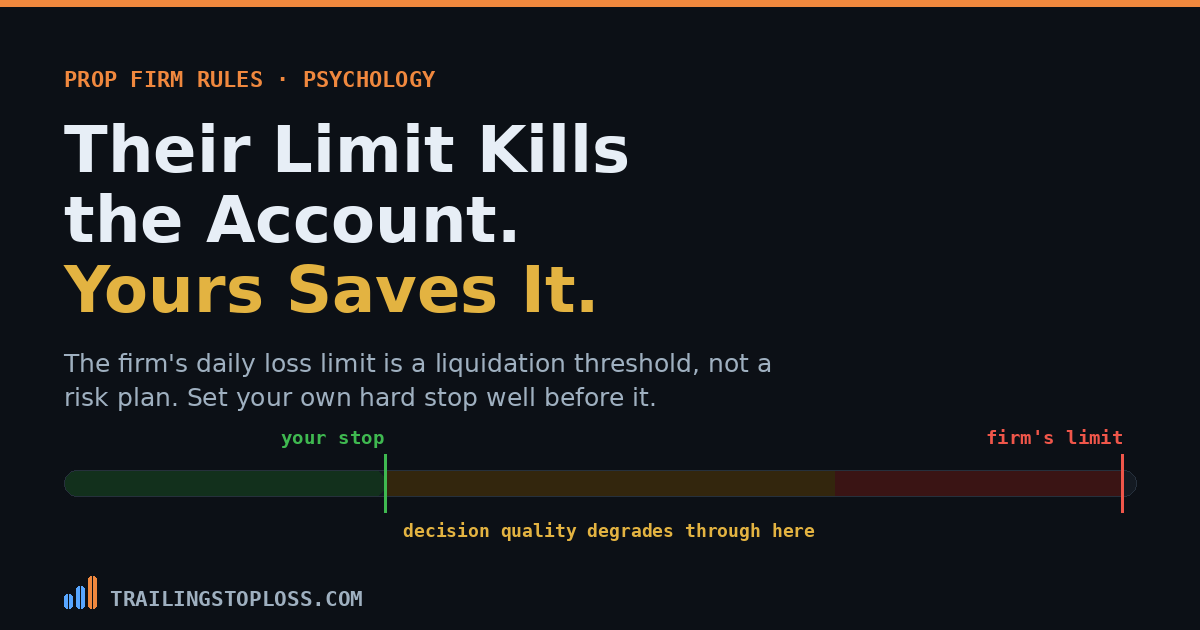
Your Daily Loss Limit Should Be Lower Than the Prop Firm’s
The firm’s number is the point where they stop you trading. It was never designed to be the point where you stop trading — and the distance between those two numbers is where most funded accounts actually die.
A daily loss limit is a liquidation threshold. Treating it as a risk plan is like treating a margin call as a position-sizing method.
What the firm’s limit actually is
Start by being precise about the rule you’re trading under, because “daily loss limit” covers three quite different mechanics in 2026. A hard breach closes the account permanently and is now rare. A soft breach auto-flattens your positions and locks you out for the rest of the session while the account survives — that’s the modern standard. And a growing number of firms have no daily limit at all, leaving the trailing drawdown as your only constraint. (Damn Prop Firms)
The second variable matters more than most traders realise: how the firm measures your equity floor. Intraday trailing drawdown follows your highest unrealised equity tick by tick, so a spike against an open position can breach you even when the idea is still valid and even when you’d have closed green. End-of-day trailing only updates at session close, so midday dips don’t move the floor — and it typically locks once it reaches your starting balance plus a small buffer. (Prop Firm App)
| Mechanic | What happens | What it does to your day |
|---|---|---|
| Hard breach DLL | Account closed permanently | Every trade near the limit is existential. Rare now, but check. |
| Soft breach DLL | Positions flattened, locked out for the day, account survives | The firm imposes the stop you should have imposed yourself. |
| No DLL | Only the trailing drawdown constrains you | Nothing stops a bad day becoming a dead account. |
| Intraday trailing | Floor follows peak unrealised equity, never falls | An adverse spike can end you while you’re right. |
| End-of-day trailing | Floor updates once at close | Room to be temporarily wrong. |
These mechanics vary by firm, by plan within the same firm, and sometimes by choice at checkout. Firms also change them without much announcement — several revised their models during 2026 alone. Read your own account’s terms rather than a comparison table, including this one.
Notice what none of those mechanics do: none of them protect your next trade. The firm’s limit exists to cap the firm’s exposure. It is not a coaching tool, and it isn’t calibrated to the point where you stop making good decisions. (Damn Prop Firms)
Why the approach to the limit changes you
Thaler and Johnson’s 1990 work is the clearest account of what happens in your head as the day goes red. Alongside the house money effect, they documented its mirror image: the break-even effect — in the presence of prior losses, outcomes that offer a chance to return to your original position become especially attractive. Risk that you’d have refused at the open becomes appealing precisely because you’re down. (Thaler & Johnson, Management Science)
So the trader at minus $600 on a $1,000 limit isn’t evaluating the next setup on its merits. They’re evaluating it as the thing that might make the day not have happened. That’s a different question, and it has a different answer — which is why the size goes up, the setup gets looser, and the stop gets wider exactly when it should be the reverse. (Thaler & Johnson, SSRN)
The detail that changes what you should do
There’s a further finding that’s unusually practical. Imas showed that whether a loss has been realised changes subsequent risk-taking in opposite directions: after a realised loss — money actually moved, position actually closed — people took less risk on the next decision. After an unrealised loss, still open and still floating, they took more. (Winning and losing in online gambling, PMC)
Sitting in a losing position is therefore the single worst state to make your next decision from. Closing it — actually taking the loss rather than holding it open hoping — measurably reduces how much risk you reach for next. The instinct to “give it room” while you decide what to do isn’t neutral; it keeps you in the state most likely to produce the trade that ends the account. (Winning and losing in online gambling, PMC)
Where your own number goes
That’s the whole argument in one picture. Eight losing trades is the firm’s arithmetic. By the third, the break-even effect is already shaping your choices; by the fifth you’re taking trades that wouldn’t have made the plan at 9:30. A personal stop at two losing trades leaves the account intact, leaves tomorrow available, and — the part people miss — ends the session while you’re still the trader who wrote the plan. (Thaler & Johnson, Management Science)
Setting the number
- Express it in dollars, not feelings. “I’ll stop when it’s not working” is not a limit. “$500” is.
- Two losing trades, or 1–2% of the account, whichever is smaller. A useful default, not a law — but it should land well inside the firm’s number, not near it.
- Decide it before the open. A limit set at 11am while down $700 is a negotiation, and you already know who wins.
- Make it enforceable. Most platforms support a daily loss lockout. Use it. Willpower is the wrong tool at exactly the moment you’ll be asked to apply it.
- Include commissions. Costs did roughly two thirds of the damage in the Taiwan day-trading data — traders there lost about 7 basis points per day gross and 23.9 net. Your limit should count what leaves the account, not what the chart says.
If you’re on an intraday trailing account, your personal limit needs to account for open-trade excursion, not just closed losses. The floor moves on unrealised equity, which means a position that goes your way and comes back has already tightened your room permanently. Size for the spike, not the close.
What to do when you hit it
Flatten first, and mean it. The realisation effect says the open loss is what keeps you reaching for risk, so closing the position is not just bookkeeping — it changes the decision you make next. Then close the platform, log the day, and go. Not “watch for a bit”. A visible chart plus a red day is the exact combination the research describes. (Winning and losing in online gambling, PMC)
Log it as a completed trading day rather than a failure. A day that ended at your own limit with the account intact is your rule working — the same way a stop-out on a single trade is your stop working. If the only days you record as successes are green ones, you’ve built a scoring system that rewards exactly the behaviour that kills accounts. (Review of Asset Pricing Studies, 2020)
The honest counterweight
A personal limit set too tight has a real cost. If you stop after two losing trades on a strategy that genuinely needs a larger sample per session, you’ll systematically cut sessions that would have finished green, and you’ll conclude your edge is worse than it is. The number has to come from your own data — how your results actually distribute across a session — not from a round figure that sounds disciplined. (Review of Asset Pricing Studies, 2020)
There’s also a version of this that’s avoidance wearing discipline’s clothes: stopping at the first sign of red because losing is uncomfortable, then calling it risk management. The test is whether the number was set in advance and applied consistently. A limit you decided at 9:15 and hit at 10:40 is a rule. A limit that moves depending on how you feel is just a mood with a dollar sign on it. (Thaler & Johnson, SSRN)
The short version
The firm’s daily loss limit protects the firm. It sits far past the point where your decisions stop being any good, because the break-even effect makes recovery trades more attractive the deeper you go — and because an open, unrealised loss pushes you toward more risk rather than less. Set your own number in dollars before the open, put it well inside the firm’s, enforce it at the platform where you can, flatten completely when you hit it, and log the day as complete. The firm’s limit tells you when they stop you. Yours tells you when you stop yourself, and only one of those is risk management. (Thaler & Johnson, Management Science)
Frequently asked questions
What should my personal daily loss limit be?
A common starting point is two losing trades, or 1–2% of the account, whichever is smaller — and comfortably inside whatever the firm imposes. The number matters less than the fact it’s expressed in dollars, decided before the open, and enforced rather than negotiated. Refine it from your own session data once you have a meaningful sample.
What happens if I hit the prop firm’s daily loss limit?
It depends on the mechanic. A soft breach — the modern standard — flattens your positions and locks you out for the rest of the session, but the account survives and you return the next day. A hard breach closes the account permanently, though that’s now rare. Some firms have no daily limit at all, in which case the trailing drawdown is your only constraint. Check your specific plan’s terms, since these differ between firms and even between plans at the same firm.
Why do I take worse trades when I’m down for the day?
It’s the break-even effect, documented by Thaler and Johnson in 1990: in the presence of prior losses, outcomes offering a chance to get back to even become especially attractive. You stop evaluating the setup on its merits and start evaluating it as the thing that could undo the day. That’s why size increases and entry standards loosen exactly when they should tighten.
Should I close a losing trade or give it room when I’m near my limit?
Close it. Research on realised versus unrealised losses found people take less risk after a loss that’s actually been realised, and more risk after one still floating. Holding an open loser keeps you in the state most likely to produce the trade that ends the account, so flattening isn’t just bookkeeping — it changes what you do next.
What’s the difference between intraday and end-of-day trailing drawdown?
Intraday trailing follows your highest unrealised equity tick by tick, so an adverse spike against an open position can breach the account even if the trade would have closed green. End-of-day trailing only updates at session close, so intraday dips don’t move the floor, and it typically locks once it reaches your starting balance plus a small buffer. Intraday is materially harsher, and it means your personal limit needs to account for open-trade excursion rather than just closed losses.
Can a daily loss limit be too tight?
Yes. If your strategy needs a larger sample per session, stopping after two losses will systematically cut sessions that would have finished green and make your edge look worse than it is. The limit should come from how your results actually distribute across a session, not from a round number that sounds disciplined. Stopping at the first red because losing feels bad is avoidance, not risk management.
Related on this site: ending your day on one good trade · the break-even reflex · rage trading · prop firm true cost rankings · compare firm rules
Firm rules were accurate at the time of writing and change frequently — always confirm against your own account’s terms. Nothing here is financial advice. Futures trading carries substantial risk of loss and is not suitable for every investor.