The Anxiety Before the Open: When You Know the Math and Still Dread the Trade
You’ve done the work. You know the win rate holds. You know a 3:1 payoff only needs 25% to break even. And at 8:15 your chest is tight anyway, because today’s trade might be a loser — as if that were an aberration rather than the single most likely thing that happens.
Knowing your numbers doesn’t remove the feeling, because the feeling was never made of numbers. But you can point it at the right target, and you can stop treating it as a problem to eliminate.
You’re dreading the normal outcome
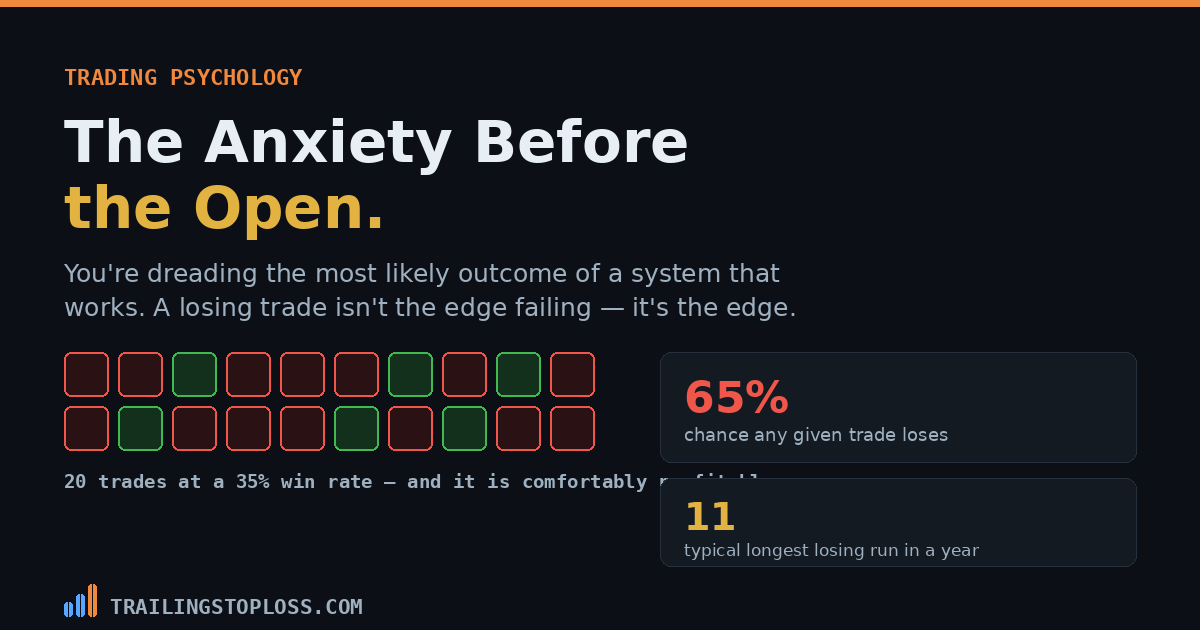
Start with the arithmetic you already accept. A 3:1 setup with a 35% win rate produces an expectancy of +0.40R per trade — comfortably profitable, well clear of the 25% you need to break even. Now ask what the most likely result of the next single trade is.
| The thing you’re anxious about | How likely it is |
|---|---|
| Today’s trade loses | 65% — the most likely single outcome |
| Three losses in a row | 27.5% |
| Five losses in a row | 11.6% |
| Longest losing run over a 250-trade year | typically 11 trades |
| Cost of one loss against a year’s expectancy | about 1% |
Read the first row again. You are anxious about the expected case. Not a disaster, not a tail risk — the modal outcome of a system you’ve already validated. That’s worth sitting with, because it reframes the whole feeling: the dread isn’t a signal that something might go wrong. It’s a reaction to the system working exactly as designed.
A losing trade is not evidence against your edge. At 35%, it’s evidence of your edge — it’s what 65% of the sample looks like. The edge doesn’t live in the trade. It lives in the distribution, and you can’t feel a distribution at 8:15 in the morning.
Why knowing the math doesn’t fix the feeling
Because the anxiety isn’t an error in your reasoning — it’s an error in your forecasting. Wilson and Gilbert’s work on affective forecasting documents the impact bias: people systematically overestimate both the intensity and the duration of their emotional reactions to future events. And the effect is strongest for negative ones. (Wilson & Gilbert, Current Directions in Psychological Science)
Two mechanisms drive it, and both are recognisable from the trading chair. Focalism is the tendency to underestimate how much everything else in your day will influence how you feel — at 8:15 the trade is the entire world, and by 2pm it’s one item among twenty. And people consistently fail to anticipate how quickly they’ll psychologically make sense of a negative event in ways that speed recovery from it. (Wilson & Gilbert, Current Directions in Psychological Science)
Which means the dread is forecasting a version of the loss that doesn’t arrive. You picture being wrecked by it. In practice you take the stop, log it, make some sense of it, and by lunchtime it’s a line in a spreadsheet. The anticipated loss is reliably worse than the experienced one — and you have the receipts, because you’ve already lived through hundreds of them. (Negative valence effect, PMC)
Stop trying to calm down
This is the most useful single finding for a pre-open routine, and it runs directly against what everyone tells you. Alison Wood Brooks found that an overwhelming majority of people — around 85% — believe the right response to pre-performance anxiety is to try to relax. Across studies involving karaoke singing, public speaking and maths performance, that turns out to be the weaker strategy. (Brooks, Journal of Experimental Psychology: General)
The reason is mechanical. Anxiety and excitement are both high-arousal states — racing heart, alertness, elevated cortisol. Calm is low-arousal. So “calm down” asks for a physiological shift and a shift from negative to positive, while “get excited” only asks for the second. Reappraisal that keeps the arousal is easier, and participants who reappraised anxiety as excitement performed better and adopted an opportunity mindset instead of a threat mindset. (Harvard Business School)
The intervention was almost embarrassingly small: saying “I am excited” out loud, or simply reading the words “get excited”. You are not trying to feel nothing before the open. You’re relabelling a state you’re already in — and the physical sensation you’re relabelling is the same one that makes you sharp at 8:29. (Brooks, Journal of Experimental Psychology: General)
A pre-open routine built on this
Every item here is about redirecting the anxiety rather than suppressing it. Suppression is the strategy with the worst evidence behind it, and it’s what most traders default to. (Harvard Business School)
- Write the trade down before the open, in if-then form. “If price closes back above the level with the 4H trend intact, then I enter at the close.” Once it’s written, the decision is made and the pre-open window has nothing left to litigate. Implementation intentions have a medium-to-large effect on follow-through across 94 tests.
- Say “I’m ready” or “I’m excited” out loud. Feels absurd. Costs three seconds. It’s the intervention that actually tested well, and it works because it keeps the arousal instead of fighting it.
- Pre-commit to the loss. Write the exact dollar figure you’re risking and confirm out loud that you’re fine with it — before the open. Anxiety thrives on an undefined downside; a number you’ve already accepted is much harder to dread.
- Look at the distribution, not the trade. Keep your last 50 outcomes visible as a strip of red and green squares. It makes losses look like what they are — texture — rather than events.
- Rate execution, not result. A trade you took correctly that lost is a successful day. If only green days count as wins, you’ve built a scoring system that guarantees anxiety about something you don’t control.
- Put the routine on a clock. Levels at 8:00, plan written by 8:20, then away from the screen until the setup triggers. Unstructured waiting is what the anticipatory state expands to fill.
Don’t take the trade early to end the discomfort. That’s the anxiety choosing your entry, and it converts a planned setup into an impulsive one — which then produces a genuinely bad outcome and teaches you that the dread was justified. The feeling resolving is not the same as the setup arriving.
What the anxiety is sometimes telling you
Not every version of this is noise, and treating it all as something to reframe would be its own mistake.
Check your size first. Anxiety scales with position size far more reliably than with probability. If the dread is sharp, the honest question is whether you’re risking an amount that’s genuinely uncomfortable — in which case the feeling is accurate information about your sizing, not a bias to be talked out of. Halve it and see whether the feeling halves too. That’s a diagnostic you can run tomorrow.
Check whether the plan is actually written. Dread attaches most strongly to undefined things. If the setup lives in your head rather than on paper, some of the anxiety is your judgment correctly reporting that you don’t have a plan yet. (Brooks, Journal of Experimental Psychology: General)
And check the sample. If you’ve recently changed the strategy, the market regime, or your account size, then your confidence in the edge is based on data that no longer applies — and unease about that is rational rather than emotional. The fix is a smaller size while you rebuild the sample, not a reframe.
One more thing worth saying plainly, because most trading content won’t. If the anxiety is severe, if it’s persistent, or if it’s showing up outside trading hours — sleep, appetite, general dread on days you’re not trading — that’s outside what a routine or a research citation can address, and it’s worth talking to a doctor or therapist about. Performance anxiety before a high-stakes decision is ordinary. Anxiety that’s colonising the rest of your life is a different thing, and it’s treatable.
The short version
At a 35% win rate on a 3:1 setup, the most likely outcome of any single trade is a loss — so the thing you’re dreading before the open is the system functioning normally, not failing. The math doesn’t dissolve the feeling because the feeling comes from affective forecasting rather than probability: you overestimate how bad the loss will be and how long it will last, and you underestimate how fast you’ll move on. Trying to calm down is the weaker response, because calm is low-arousal and anxiety isn’t. Relabel it as readiness, write the trade down before the open so there’s nothing left to decide, pre-commit to the dollar risk, keep the distribution in view, and score yourself on execution. The edge lives in the distribution. You just have to keep showing up to collect it. (Wilson & Gilbert, Current Directions in Psychological Science)
Frequently asked questions
Why am I anxious before a trade when I know my win rate is profitable?
Because knowing the probability and forecasting the feeling are different processes. Research on affective forecasting shows people systematically overestimate the intensity and duration of their emotional reaction to negative events, and underestimate how quickly they’ll make sense of them and recover. Your reasoning is fine — your emotional forecast is the part that’s miscalibrated.
Should I try to calm down before the open?
Probably not. Around 85% of people believe calming down is the right approach, but studies across karaoke singing, public speaking and maths performance found that reappraising anxiety as excitement works better. Anxiety and excitement are both high-arousal states while calm is low-arousal, so “get excited” is a much smaller shift than “calm down”. Saying “I am excited” out loud was enough to improve performance.
Is it normal to expect a losing trade?
At a 3:1 payoff with a 35% win rate, a loss is the single most likely result of any given trade — 65% of the time. Three losses in a row happens 27.5% of the time, five in a row 11.6%, and over a 250-trade year the longest losing run is typically around 11 trades. All of that is consistent with a system that’s comfortably profitable.
How much does one losing trade actually matter?
Very little. On one trade a day, a single trade is 0.4% of your year’s sample, and one loss costs roughly 1% of a year’s expected return at +0.40R per trade. The anxiety treats it as decisive because it’s the only trade you can see from where you’re standing at 8:15.
What should I do in the hour before the open?
Write the trade as an if-then rule so nothing is left to decide once price is moving, state the exact dollar amount you’re risking and accept it out loud, relabel the arousal as readiness rather than trying to suppress it, and then get away from the screen until the setup triggers. Unstructured waiting is what anticipatory anxiety expands to fill.
When is pre-trade anxiety telling me something real?
When your size is genuinely too large — anxiety tracks position size more reliably than probability, so halving it and seeing whether the feeling halves is a useful test. When the plan isn’t written down, since dread attaches to undefined things. And when the sample behind your confidence no longer applies because you’ve changed strategy, regime or account size. If the anxiety is severe, persistent, or present outside trading hours, that’s worth discussing with a doctor or therapist rather than solving with a routine.
Related on this site: why you freeze on a setup you’ve already proven · why managing a trade usually means ruining it · ending your day on one good trade · free P&L calendar
Worked figures use a 35% win rate at 3:1 to illustrate the mechanism; your own numbers will differ. Nothing here is financial or medical advice. Futures trading carries substantial risk of loss and is not suitable for every investor.