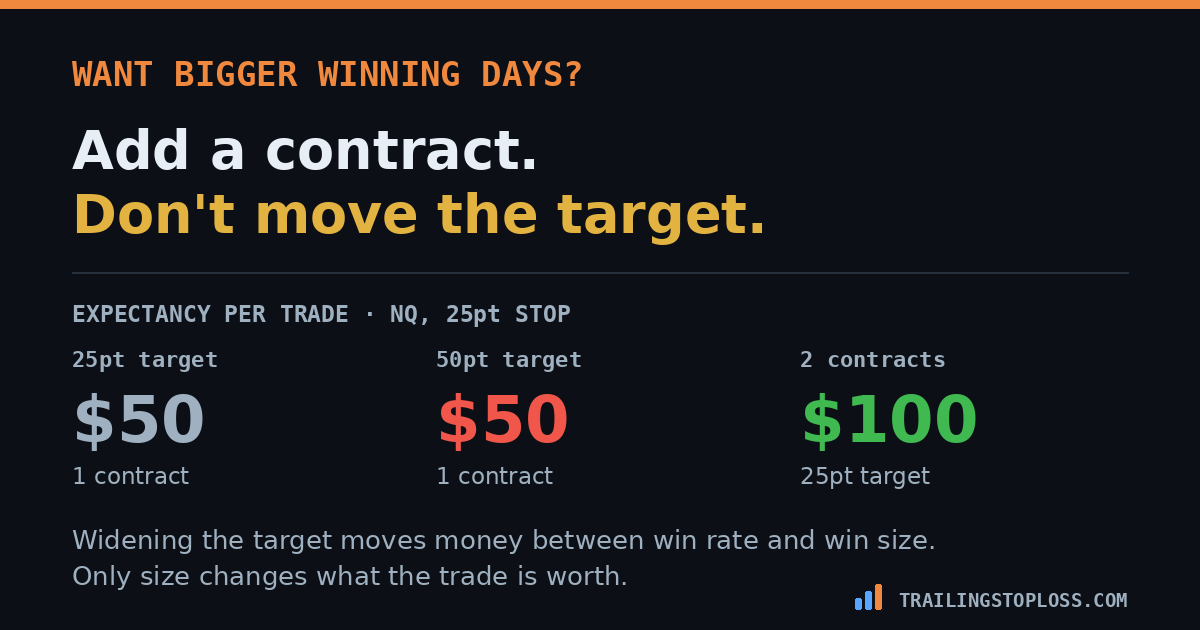
Want Bigger Winning Days? Add a Contract, Don’t Move the Target.
You’re hitting 25 points on NQ for $500 and you want $1,000 days. The instinct is to go for 50 points. The arithmetic says take two contracts to the same 25 points instead — and the reason isn’t that wider targets are harder, it’s that widening a target doesn’t increase your expectancy at all. It just moves money from one column to another.
Same trade, same stop, 25 or 50 or 75 point target: expectancy stays at $50 every time. Add a contract and it doubles.
The thing nobody says about wider targets
Start from a working setup: 25-point stop, 25-point target, 55% win rate on NQ. That’s $500 either way, and $50 of expectancy per trade.
Now move the target out. The further your target, the less often price reaches it before your stop — and under fair geometry those two effects cancel almost exactly:
| Target | Win rate | Per win | Expectancy per trade |
|---|---|---|---|
| 25 points | 55% | $500 | $50 |
| 50 points | 37% | $1,000 | $50 |
| 75 points | 28% | $1,500 | $50 |
The expectancy column doesn’t move. That’s not a coincidence or a modeling artifact — it’s what happens when you stretch a target against a fixed stop. You’re not creating value, you’re trading win rate for win size at roughly a fair exchange rate.
Now do the other thing. Two contracts, same 25-point target:
| Approach | Win rate | Per win | Expectancy per trade |
|---|---|---|---|
| 1 contract @ 25pt | 55% | $500 | $50 |
| 1 contract @ 50pt | 37% | $1,000 | $50 |
| 2 contracts @ 25pt | 55% | $1,000 | $100 |
Both routes produce a $1,000 winning day. One of them happens 1.5 times as often as the other, and only one of them actually changed what the trade is worth.
Position size multiplies an edge you’ve already measured. Target distance redistributes it — and redistributes it into a region of the chart where you have no data on whether your edge still exists.
But doubling size isn’t free either
This is where most “just size up” advice stops, and it’s the half that costs people accounts. Two contracts doubles your profit and doubles your loss. Against a fixed drawdown, that halves the number of losing trades you can absorb.
Simulating 250 trading days against a $12,500 drawdown — which is what one NQ contract at $500 a trade actually needs to give you 25 trades of room:
| Approach | Expectancy | Trades of room | Survived the year | Median year |
|---|---|---|---|---|
| 1 contract @ 25pt | $50 | 25 | 98% | $13,000 |
| 1 contract @ 50pt | $50 | 25 | 81% | $14,500 |
| 1 contract @ 75pt | $50 | 25 | 59% | $19,000 |
| 2 contracts @ 25pt | $100 | 12 | 66% | $30,000 |
| 3 contracts @ 25pt | $150 | 8 | 26% | $57,000 |
Two things jump out. Widening the target costs survival and buys almost nothing — 81% instead of 98%, for $1,500 more in a median year. And sizing up costs survival too, which is the part the enthusiastic version of this advice leaves out.
The number that settles it
Both routes spend survival. The question is what each one buys with it.
| Approach | Survival given up | Median year gained | Dollars per point of survival |
|---|---|---|---|
| 1 contract @ 50pt | 17 pts | $1,500 | $88 |
| 1 contract @ 75pt | 39 pts | $6,000 | $154 |
| 2 contracts @ 25pt | 32 pts | $17,000 | $531 |
| 3 contracts @ 25pt | 72 pts | $44,000 | $611 |
Size converts risk into money four to six times more efficiently than target width does. If you’re going to spend survival — and any increase in output spends some — spend it on the lever that actually moves expectancy.
Widening the target is the worst row on the board. It gives up a third of your survival margin and buys a rounding error, because the expectancy never moved in the first place.
The part the model understates
Everything above assumes a fair exchange rate between win rate and win size. In practice the exchange rate is worse than fair, for three reasons the simulation doesn’t capture.
Your edge is local. You measured 55% at 25 points. You have no data at 50. Most intraday setups are reading a specific condition — a retest holding, an imbalance filling, momentum continuing through a level — and that condition has a natural distance it’s informative over. Past it, you’re holding a position on a thesis that already played out.
Time is risk. A 50-point move takes longer than a 25-point move, and the longer you’re in, the more chance something arrives that has nothing to do with your setup. A release landing inside your hold isn’t a risk you opted into; it’s one that shows up while you’re already positioned.
And you’ll manage it worse. Watching an open profit go to +40 and come back to zero is a different psychological event from a clean +25 fill, and it’s the one that produces the tightening and breakeven stops that cost another chunk of expectancy. The wider target doesn’t just lower your win rate, it increases the chance you interfere.
So what should you actually do
- Scale size, keep the target. Your target was validated. Your size is a free parameter that multiplies it.
- Only size up if the room is there. Two contracts at $500 means $1,000 a trade, which wants $25,000 of drawdown at 25 trades of room. If you don’t have it, the correct move is a bigger account, not a bigger position in a small one.
- Add contracts one at a time, on sample. Not after a good week. A hundred trades of boring execution at the current size, then one more contract.
- If you can’t afford a second contract, you can’t afford $1,000 days yet. That’s the honest answer, and widening the target is the expensive way to avoid hearing it.
- Micros exist precisely for this. MNQ lets you scale in tenth-contract increments — 25 points is $50 on MNQ against $500 on NQ, so you can go from one unit to two without doubling anything that matters.
If you have measured, on a real sample, that your setup keeps working past your current target — that a meaningful share of trades reaching 1R continue to 2R — then the exchange rate isn’t fair and the wider target wins. That’s a measurement, not a hope, and it’s exactly what the 30-day test running on this site is designed to find out. Until the data exists, assume the exchange rate is fair and the target is doing nothing for you.
The honest limits
The fair-exchange assumption is the whole model. It comes from treating price as a random walk between your stop and your target, which is a reasonable default and not a law. If your setup has genuine directional persistence, wider targets beat this analysis — and if it has mean reversion, they do even worse than shown.
The survival figures assume independent daily results at a fixed win rate. Real trading clusters, so treat the percentages as illustrating the shape of the trade-off rather than forecasting your account.
And none of this is an argument for sizing up now. The efficiency finding says that if you increase output, size is the better lever. It doesn’t say you should increase output. Most traders’ highest-value change is still the opposite direction — fewer contracts, more room, longer survival.
The short version
Hitting 25 points on NQ for $500 and want $1,000 days: take two contracts to the same target rather than stretching to 50 points. Under fair geometry a 25, 50 or 75 point target against the same 25-point stop all produce identical expectancy — $50 a trade — because the win rate falls as fast as the reward rises, dropping from 55% to 37% to 28%. Widening the target redistributes money between win rate and win size without creating any. Adding a contract is the only change that doubles expectancy, to $100. Both routes cost survival against a drawdown, but they buy very different amounts with it: widening to 50 points gives up 17 points of survival for $1,500 of median annual result, while a second contract gives up 32 for $17,000 — size converts risk into money four to six times more efficiently. The precondition is room: two contracts at $500 risk wants about $25,000 of drawdown, and if you don’t have it, the answer is a bigger account rather than a bigger position.
Frequently asked questions
Should I increase my profit target or my position size?
Size, provided you have the account room. Stretching a target against a fixed stop lowers your win rate at roughly the same rate it raises your reward, so expectancy per trade stays flat — a 25, 50 or 75 point NQ target against a 25-point stop all return about $50 a trade. Adding a contract doubles expectancy outright because it multiplies an edge you have already measured instead of redistributing it.
Why doesn’t a bigger target make more money?
Because the probability of reaching a target falls as the target moves further from your entry, and under fair geometry it falls at close to the rate that compensates for the larger reward. Moving an NQ target from 25 to 50 points roughly halves the win rate from 55% to 37% while doubling the win, leaving expectancy unchanged. You have traded frequency for size at a fair exchange rate rather than created value.
Is doubling position size risky?
Yes, and that is the half usually left out. Two contracts doubles the loss as well as the win, halving the number of losing trades that fit inside your drawdown. In simulation, going from one to two contracts dropped the chance of surviving 250 days from 98% to 66%. It is still the better way to spend that risk — it buys roughly $531 of median annual result per point of survival given up, against $88 for widening the target — but it is not free.
How much account do I need to trade two NQ contracts?
At a 25-point stop, two NQ contracts risk $1,000 a trade. Allowing 25 losing trades of room inside the drawdown means roughly $25,000 — far beyond the $2,500 a typical 50K prop account carries. One full NQ contract alone needs about $12,500. This is what micros are for: MNQ risks $50 per 25 points, so the same scaling decision fits an ordinary funded account.
When is a wider profit target actually correct?
When you have measured that your setup keeps working past your current target — specifically, that a meaningful share of trades reaching 1R continue to 2R or beyond. If that’s true the exchange rate isn’t fair and the wider target wins. It requires data from a real sample rather than an assumption, because most intraday setups read a condition that is only informative over a limited distance, after which you are holding on a thesis that has already played out.
Related on this site: the 30-day 1:1 vs 1:2 vs 1:3 test · should you trail your stop · picking an account size from your stop · the day after your best day
Figures come from 30,000 modeled 250-day careers at a 55% base win rate on a 25-point NQ stop, with target hit probability derived from fair random-walk geometry and survival measured against a $12,500 drawdown. Contract values are CME standard for NQ at $20 per point. The model assumes independent results and no directional persistence; a setup with measured follow-through past its current target would beat this analysis. Nothing here is financial advice. Futures trading carries substantial risk of loss.