The Most Dangerous Day of Your Month Is the One After Your Best Day
Everyone writes about revenge trading. Almost nobody writes about what happens after a big green day — when you feel sharp, the size creeps up, and you’re playing with what feels like the market’s money rather than your own. On a trailing drawdown account, that’s the behavior that quietly ends careers, and it doesn’t kill you the way you’d expect.
It doesn’t kill you with a huge loss. It kills you with an ordinary one, against a floor your good day moved.
The house money effect
The behavior has a name. Thaler and Johnson documented the house money effect in 1990: people take substantially more risk with money they perceive as recently won than with money they perceive as earned. A gambler up $500 will make bets he’d never make with $500 from his wallet, because the $500 is mentally filed under a different account — not really his yet.
Its counterpart is the break-even effect: the same people, once behind, take bigger risks to get back to flat. Together they describe most of retail trading. The loss side is well covered — revenge trading, sizing up to recover a drawdown. The win side gets written up as confidence.
It isn’t confidence. It’s the same mental accounting error pointed the other way, and on a funded account it has a mechanism all its own.
What escalation actually does to the numbers
Take a trader with a real edge — 45% win rate at 2:1, one trade a day, $100 of risk on a $2,500 drawdown — and let their size grow with each consecutive winning day, resetting after a loss. Two hundred and fifty days, thousands of careers.
| Behavior | Survived | Median | Worst 5% | Best 5% |
|---|---|---|---|---|
| Flat size, always | 100% | $8,600 | $4,700 | $12,500 |
| +25% per win, cap 2× | 99% | $10,350 | $5,625 | $15,800 |
| +50% per win, cap 3× | 98% | $12,100 | $6,100 | $18,950 |
| +100% per win, cap 4× | 91% | $15,200 | $7,300 | $24,700 |
Look at what escalation does to every column except the first. The median goes up. The best outcomes go up. Even the worst 5% goes up. Every statistic a trader would actually look at says escalating after wins was a good decision.
The only column that gets worse is survival, from 100% to 91%. That’s roughly one career in eleven that no longer has an account — and if you’re the one, none of the other columns ever applied to you.
Your own results are one draw from that table. Escalate after a win and nine times in ten you end the year with more money and a spreadsheet that says the aggression was right. You will never see the tenth version of yourself, and that version is the entire cost. This is the same trap as breaking your own rules — the median outcome pays, so judging by results teaches you to keep doing it.
The part that surprised me
I expected to find that blowups happen on oversized positions. The obvious story is that you size up four times, take a big loss, and the account is gone.
That isn’t what happens. In the simulated careers that died, the fatal trade was at base size — every time. Not once did an account die on an escalated position.
It makes sense once you see it. Escalation only happens after a win, so you’re never at large size during a losing streak — and losing streaks are what end accounts. The big positions are all clustered in your good weeks.
So if escalation isn’t killing you with a big loss, what is it doing?
Your good day moves the floor
Run the same behavior against both kinds of drawdown and the mechanism appears.
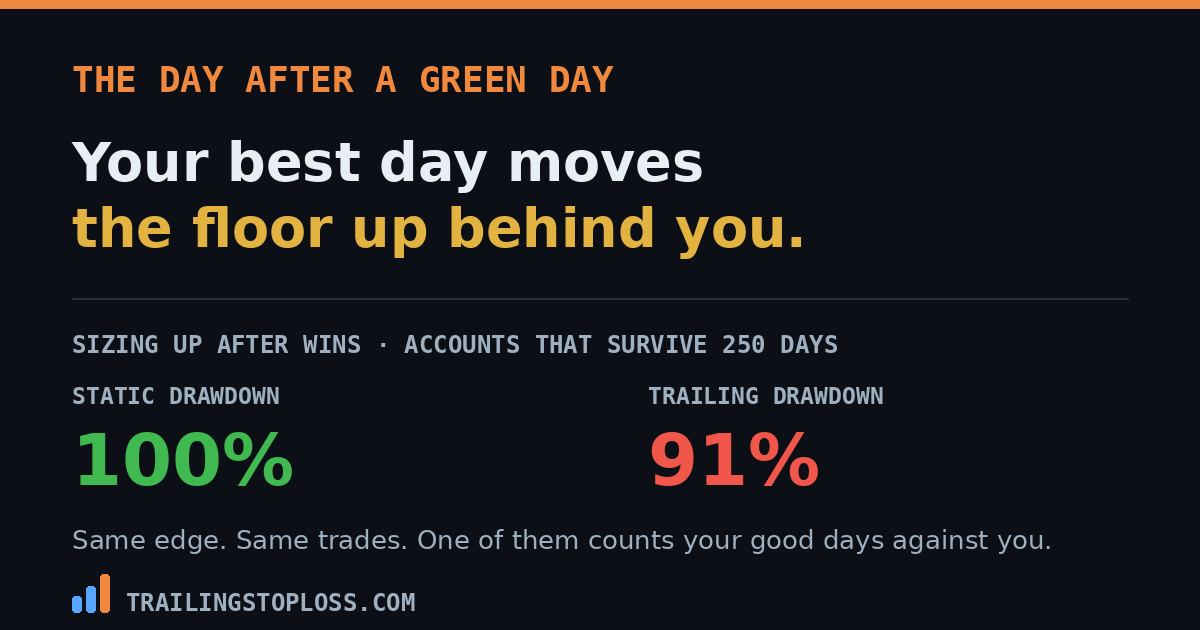
| Behavior | Trailing drawdown | Static drawdown |
|---|---|---|
| Flat size | 100% survive | 100% survive |
| +50% per win | 98% survive | 100% survive |
| +100% per win | 91% survive | 100% survive |
Under a static drawdown, escalating after wins costs essentially nothing. Under a trailing one, it’s the whole problem.
Here’s why. A trailing drawdown measures from your high-water mark. A big winning day raises that mark — and the breach level follows it up, immediately, while you’re feeling good about yourself. You haven’t withdrawn the money. You haven’t banked anything. What you’ve done is move the floor closer to where price is about to go.
This is the cruel version of why trailing drawdowns end accounts. It isn’t only that they punish retracements. It’s that they convert your best days into reduced future margin for error, and they do it at exactly the moment you feel most entitled to take a swing.
What it feels like from the inside
None of this registers as recklessness. That’s the problem. What it registers as:
- “I’m seeing it clearly today.” You’re not seeing it more clearly. You won a trade, which at a 45% win rate happens constantly and means nothing about your current perception.
- “I can afford the risk now.” On a trailing account you can’t — your buffer didn’t grow with your equity, it moved up underneath it.
- “I should press while it’s working.” Two green days in a row is not a signal. At a 45% win rate you’ll get two in a row roughly every five days, forever, with no edge change at all.
- “It’s the market’s money.” It’s your drawdown, and the firm counts it in dollars, not in how recently you earned them.
What to do about it
The fixes are structural, because in-the-moment judgment is exactly the thing that’s compromised.
- Fix position size in advance, in writing, for the week. Not per trade — per week. That removes the decision from the day you’d make it badly.
- Treat a big green day as a stop signal, not a green light. If you’re up more than about 2R on the day, you’re done. The marginal trade after a great day is the worst-priced one you’ll take.
- Know where your floor moved before you trade again. After any large winning day on a trailing account, look up your new breach level. It is not where it was yesterday, and most traders never check.
- Scale size on sample, never on streak. A hundred trades of stable execution is a reason to size up. Three green days is not, and the two feel identical from the inside.
- If you can, pick static. A static drawdown makes this entire failure mode close to free — which is worth real money at purchase time, and is one of the structural terms to filter firms on before price.
The honest limits
This is a model, not your account. It assumes independent daily results at a fixed win rate and payoff. Real trading clusters, real edges drift, and the specific percentages will move with your own numbers. The direction is robust; treat 91% as an illustration rather than a forecast.
Not all size increases are the house money effect. Scaling deliberately, on a planned schedule tied to sample size and account growth, is sound and this article isn’t an argument against it. The distinction is whether the decision was made before the winning day or because of it.
And the psychology research is largely lab-based. Thaler and Johnson worked with experimental gambles, not funded traders. The effect is well replicated, but the bridge from a laboratory bet to your Tuesday is an inference, not a measurement.
The short version
The house money effect — documented by Thaler and Johnson in 1990 — is the tendency to take more risk with money that feels recently won than with money that feels earned. Simulating a genuine edge at 45% and 2:1 against a $2,500 trailing drawdown, escalating size through winning streaks improves the median result, the best outcomes and even the worst 5%, while dropping survival from 100% to 91%: every statistic you would check says the aggression worked, and the only cost is a one-in-eleven chance you no longer have an account. The surprise is the mechanism. Accounts that died did so on base-size positions, not oversized ones — because escalation only happens after wins, and losing streaks are what kill you. What escalation really does is raise your high-water mark faster, which drags the trailing breach level up behind it, so an ordinary run of losses lands against a floor your best day moved. Under a static drawdown the same behavior costs nothing at all. Fix size for the week in advance, treat a big green day as a stop signal, and check where your floor moved before trading again.
Frequently asked questions
What is the house money effect in trading?
The tendency to take more risk with money that feels recently won than with money that feels earned, documented by Thaler and Johnson in 1990. A trader up on the day will size into trades they would never take with the same amount from their own savings, because the profit is mentally filed under a separate account. Its counterpart is the break-even effect, where the same person takes bigger risks once behind in order to get back to flat.
Why is the day after a big winning day risky?
Two reasons combine. Psychologically, recent profit feels like a buffer that permits larger risk, and a couple of green days feels like evidence of sharpness rather than the normal clustering any win rate produces. Mechanically, on a trailing drawdown account a big winning day raises your high-water mark, and the breach level follows it up immediately — so your margin for error shrinks at exactly the moment you feel most entitled to press.
Does increasing size after a winning streak actually lose money?
Usually not, and that’s what makes it dangerous. In simulation, escalating through winning streaks raised the median result, the best outcomes and even the worst 5% — every metric a trader would examine. The single column that got worse was survival, falling from 100% to 91% over 250 days. Because your own trading is one draw from that distribution, roughly nine times in ten your records will tell you the aggression was correct.
Do accounts blow up on oversized positions?
Not in this model. Every simulated account that died did so on a base-size position, never on an escalated one. Escalation only happens after a win, so large positions cluster in good weeks, while losing streaks — which is what actually ends accounts — are always traded at base size. The damage from escalation is indirect: it raises the high-water mark faster, which on a trailing drawdown raises the breach level behind you.
How do I stop sizing up after a good day?
Remove the decision from the moment. Fix position size in writing for the whole week rather than per trade, treat a day up more than about 2R as a signal to stop trading rather than to press, and check where your breach level moved after any large winning day on a trailing account. Scale size on sample — a hundred trades of stable execution — never on a streak of three good days, because the two feel identical from the inside and only one of them means anything.
Related on this site: why trailing drawdowns end accounts · why their rules hold when yours don’t · why you’ll never get comfortable with losing · why most traders blow their accounts
Simulation figures come from 8,000–20,000 modeled careers of 250 trading days at a 45% win rate and 2:1 reward-to-risk, $100 base risk against a $2,500 drawdown, assuming independent results; real trading clusters and edges drift, so treat the percentages as illustrating the mechanism rather than forecasting your account. Nothing here is financial advice. Futures trading carries substantial risk of loss.