How to Pick a Prop Firm and Account Size (In That Order)
Almost everyone does this backwards: pick the firm from a discount code, pick the biggest account they can afford, then work out position size afterwards. Do it the other way round. Your stop distance determines the account size, the account size narrows the firms, and price is the last thing you look at rather than the first.
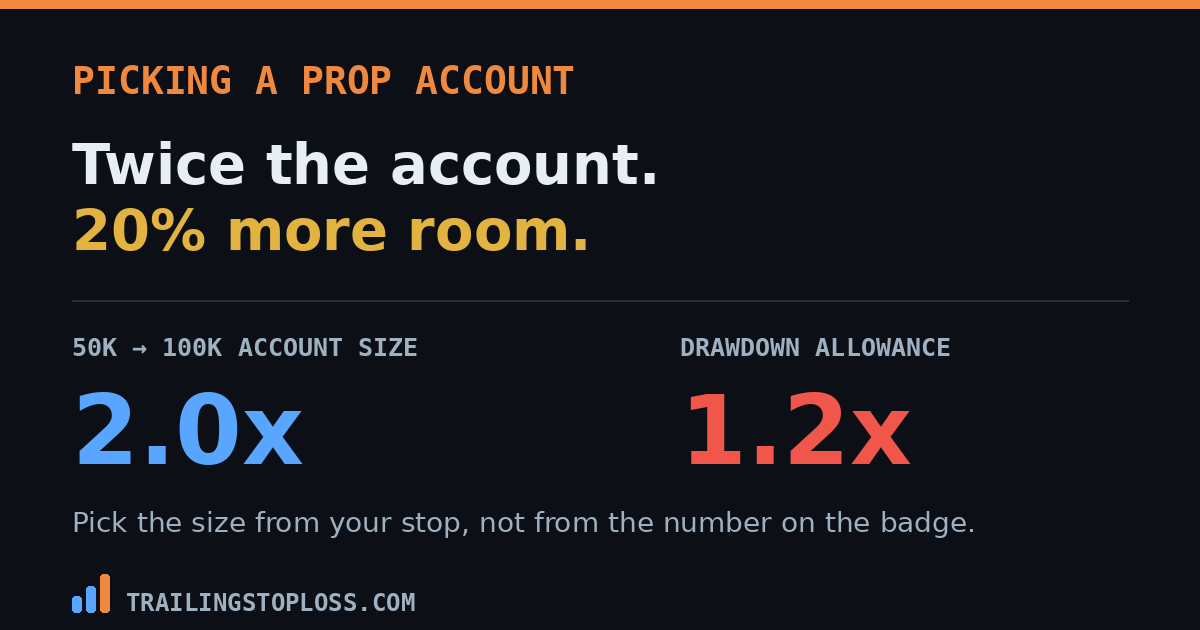
And doubling the account from 50K to 100K buys you roughly 20% more risk capacity, not twice as much.
Step one: the account size comes from your stop
The number on the badge is buying power. The number that decides whether you survive is the drawdown allowance, and those two don’t scale together.
| Account | Typical drawdown | As % of account | Risk/trade at 25R of room |
|---|---|---|---|
| 25K | $1,500 | 6.0% | $60 |
| 50K | $2,500 | 5.0% | $100 |
| 100K | $3,000 | 3.0% | $120 |
| 150K | $5,000 | 3.3% | $200 |
Read the 50K and 100K rows together. The account doubles; the drawdown goes from $2,500 to $3,000. You’re paying more for 20% more room. Proportionally, the larger accounts are tighter, not looser — which is the opposite of how they’re sold.
So work from the stop you actually use. The rule that matters is 20 to 25 losing trades of room inside the drawdown, because at ten, a median losing streak ends the account regardless of whether your setup works.
What that buys on NQ
| Account | Risk/trade | MNQ, 10pt stop | MNQ, 20pt stop | NQ, 10pt stop |
|---|---|---|---|---|
| 25K | $60 | 3 micros | 1 micro | 0.3 minis |
| 50K | $100 | 5 micros | 2 micros | 0.5 minis |
| 100K | $120 | 6 micros | 3 micros | 0.6 minis |
| 150K | $200 | 10 micros | 5 micros | 1 mini |
MNQ is $2 a point, NQ is $20. The conclusion is stark: you cannot responsibly trade a single E-mini NQ contract on anything below a 150K account, and even there it’s exactly one. Everything smaller is a micros account whether the marketing says so or not — which is also why the jump from micros to minis is a 900% increase in one step.
If you use a 20-point stop on NQ and you’re not already funded, the 50K supports two micros at sane risk and the 100K supports three. The honest reason to take the 100K is if you specifically need that third contract; the honest reason to take the 50K is that it’s cheaper to fail on. Buying the 150K because it sounds more serious puts you in an account with 3.3% of room and a larger fee.
Step two: three terms that decide the rest
Once the size is fixed, most firms drop out on structure before price is even relevant.
1. Does the drawdown trail, and off what?
End-of-day trailing that locks at your starting balance is the most forgiving: clear the initial trail and your original balance becomes a permanent floor. Intraday trailing that includes unrealized profit is the harshest — a spike you never banked still ratchets your breach level up behind you. At the same dollar allowance, a trailing drawdown is roughly five to six times more likely to end the account than a static one.
If you keep breaching on price coming back through your entry rather than on bad trading, this is your variable, and it’s worth paying more for.
2. Is there a payout ceiling?
This is the term nobody leads with and it caps the entire relationship. Apex 4.0 closes each Performance Account permanently after six payouts, confirmed in Apex’s own help center. Funded Futures Family runs a $100,000 lifetime cap per user with per-request maximums on top.
Neither is disqualifying. Both change what the account is worth, which changes how much you should be willing to risk to save a payout cycle.
3. Monthly or one-time?
Monthly billing keeps running while you’re not trading — and taking two weeks off after a drawdown is usually the correct move. One-time pricing removes that penalty. It’s also why the true cost of a monthly firm is roughly double its headline price: almost nobody reaches a first payout inside one cycle.
Step three: now look at price
Compare on cost to a first payout, not on the evaluation fee. That means the fee, plus activation, plus however many billing cycles it realistically takes to qualify. Across firms we track, the same 50K account ranges from about $42 to roughly $380 on that basis — a ninefold spread for the same buying power.
Two things to check before trusting any quoted figure, including ours:
- Confirm the discount at checkout. Promo codes in this sector rotate weekly and expire without notice. A published rate from three months ago is a guess.
- Check the reset price. Failing an evaluation is the most likely outcome, so the cost of the second attempt is part of the real price. Funded resets on some firms run into four figures.
A shortlist you can apply in ten minutes
- What’s my usual stop, in dollars? Multiply by 25. That’s the drawdown allowance you need, and it picks the account size for you.
- Does the drawdown trail, and does it lock? If you’ve breached on retracements before, take end-of-day.
- Is there a payout cap or an account-closing schedule? Find it before you buy, not after your fourth payout.
- Monthly or one-time? If you’ll take breaks — and you should — one-time is worth a premium.
- What does it cost to reach a first payout, including a reset? Not the sticker price.
- What’s the firm’s rating against review volume? Our floor is 3.2 above 5,000 reviews, 3.8 below. And check the flagged list before anything else.
Buy the smallest account that supports your stop at 25R of room, on a one-time fee, from a firm with end-of-day drawdown and no payout cap. Expect to fail the first evaluation and budget for two. The goal of the first purchase isn’t to get funded — it’s to find out cheaply whether you can follow your own rules under a real drawdown.
The honest limits
The drawdown figures are indicative. They’re typical industry values by account size, not any one firm’s terms. Allowances vary, and several firms offer multiple drawdown types on the same size. Check the specific plan.
25R of room is a rule of thumb, not a law. It comes from simulating a profitable strategy against a trailing drawdown, where ten trades of room blows up most of the time and twenty-five rarely does. If your win rate is high and your streaks short, you can run tighter — but most people overestimate both.
And we take affiliate commission from some of the firms we track. The test that matters isn’t disclosure, it’s whether we demote partners: we removed two in September for falling below our rating floor, both with dates on the flagged list.
The short version
Pick the account size from your stop, not from the badge. Aim for 20 to 25 losing trades of room inside the drawdown allowance, which on typical industry figures means about $100 a trade on a 50K and $120 on a 100K — because doubling the account only increases the drawdown from $2,500 to $3,000. On NQ that means micros at every size below 150K, where one E-mini on a 10-point stop finally fits. Then filter firms on three structural terms before price: whether the drawdown trails and whether it locks, whether there’s a payout ceiling or an account-closing schedule, and whether billing is monthly or one-time. Only then compare cost to a first payout including a reset, which ranges roughly $42 to $380 for the same 50K. Buy the smallest account that fits your stop, expect to fail the first attempt, and budget for two.
Frequently asked questions
What size prop account should I start with?
The smallest one that supports your usual stop with 20 to 25 losing trades of room inside the drawdown. On typical industry allowances that’s about $100 of risk per trade on a 50K and $120 on a 100K. Bigger accounts are proportionally tighter, not looser — a 100K is twice the buying power of a 50K but only about 20% more drawdown room — so buying up mainly increases the fee and the pressure.
Is a 100K account better than a 50K?
Only if you specifically need the extra contract. The 100K typically carries a $3,000 drawdown against the 50K’s $2,500 — twice the account for 20% more room, at a higher fee. In risk terms the larger account is tighter as a percentage of size. The 50K is also cheaper to fail on, which matters because failing the first evaluation is the most likely outcome.
Can I trade full-size NQ contracts on a funded account?
Not responsibly below a 150K. NQ is $20 a point, so a 10-point stop risks $200 — which is exactly 25 losing trades of room against a $5,000 drawdown, and more than the entire sane risk budget on a 50K or 100K. Everything smaller is a micros account in practice, whatever the marketing implies. MNQ at $2 a point is what actually fits.
What should I check before buying an evaluation?
Whether the drawdown trails and whether it locks at your starting balance; whether there’s a payout ceiling or a schedule that closes the account after a set number of payouts; whether billing is monthly or one-time; the cost to a first payout including a likely reset rather than the sticker price; the firm’s rating against its review volume; and whether it appears on a flagged list. Confirm any discount at checkout, since promo rates rotate weekly.
Should I pick a monthly or one-time prop firm?
One-time, unless a monthly firm is clearly better on other grounds. Subscriptions keep billing while you’re not trading, and taking time off after a drawdown is usually the right response — so the structure penalizes the behavior you want. Monthly firms also cost roughly double their headline price in practice, because very few traders reach a first payout inside a single billing cycle.
Related on this site: true cost rankings · why most traders blow their accounts · the firms we flag · micros vs minis
Drawdown allowances are typical industry figures by account size, not the terms of any single firm; confirm the specific plan before purchasing. Contract values are CME standard for MNQ and NQ. We take affiliate commission from some firms we track. Nothing here is financial advice. Futures trading carries substantial risk of loss.