Your Trading Journal Is Lying to You (and You Can Fix It in One Step)
Every trading site tells you to journal. None of them mention that a note written after the trade closes is a reconstruction rather than a record — corrupted by the one cognitive bias that comfortably survived psychology’s replication crisis.
You cannot un-know the outcome. So the moment a trade resolves, your memory of what you saw before it resolved quietly rewrites itself to match.
The bias that didn’t fall over
A lot of famous psychology has collapsed in the last decade. Power posing was recanted by its own author. Ego depletion failed a registered replication. Money priming evaporated under preregistration. So it’s worth being specific that hindsight bias is not in that category — it has hundreds of replications and a 122-study meta-analysis behind it. (Atticus Li, replication crisis hub)
Baruch Fischhoff named it in 1975. Given an outcome, people rated that outcome as more inevitable, and misremembered their own earlier estimates as having been closer to the truth. He called the mechanism creeping determinism: the past reorganizes into a clean causal chain where each step led unavoidably to the next, and it “creeps” because the rewriting is unconscious — the inevitable-looking version feels like the one you actually experienced. (Behavioral analysis, Fischhoff 1975)
The cleanest demonstration is the one with Ruth Beyth. They asked people to assign probabilities to outcomes of Nixon’s 1972 trips to China and the Soviet Union, then afterwards asked them to recall the numbers they’d given. People consistently misremembered their own forecasts as having favored whatever actually happened. Not other people’s forecasts. Their own, in writing, weeks earlier. (Hindsight bias, overview)
Hawkins and Hastie later split it into three components, and each one has a direct trading analogue. (Cognitive Train)
| Component | What it sounds like | In your journal |
|---|---|---|
| Memory distortion | “I said it would happen” | You record seeing a signal you didn’t see |
| Inevitability | “It had to happen” | The loss looks structurally doomed rather than probabilistic |
| Foreseeability | “I knew it would happen” | You conclude you should have known, and add a rule |
What this does to a trade review
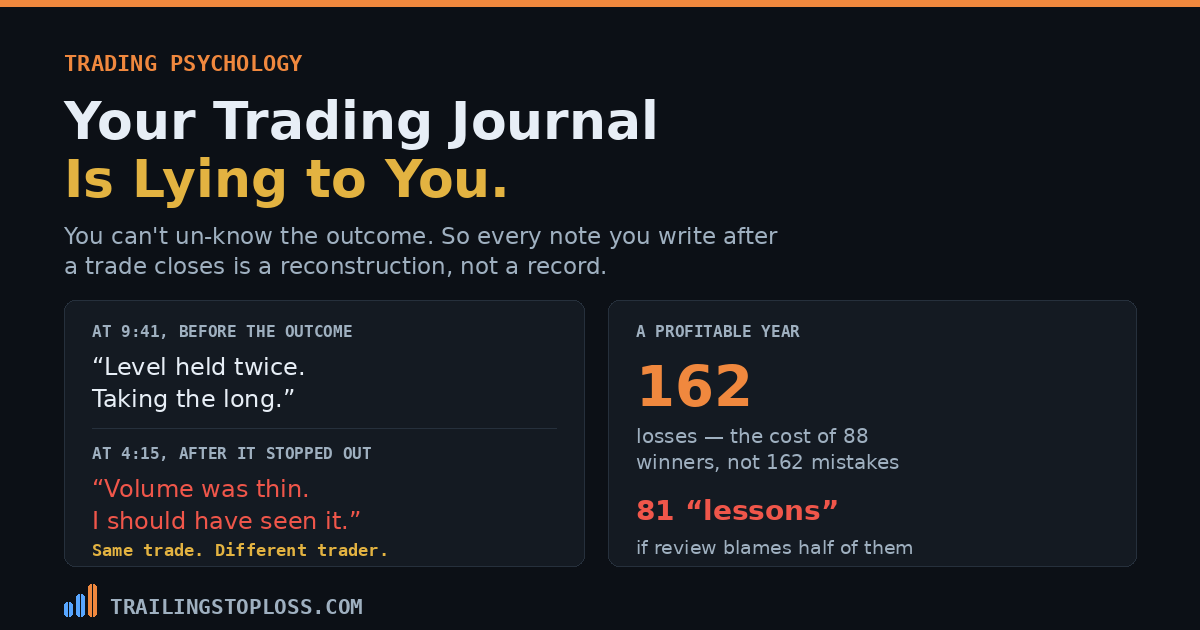
Here’s the ordinary version. At 9:41 you take a long because a level held twice. At 4:15 it’s stopped out, and you sit down to write up what happened.
The damage isn’t the inaccurate note. It’s that the note becomes a rule. “Check volume before entry” gets added to a checklist, on the strength of a memory that was manufactured by the outcome. Do that fifty times a year and you accumulate a system built from noise.
The arithmetic of manufactured lessons
Consider a genuinely good year: 250 trades at a 35% win rate on a 3:1 setup, which is +0.40R per trade and comfortably profitable.
| Outcome | Count |
|---|---|
| Winners | 88 |
| Losers | 162 |
| “Lessons” if review finds a cause in 30% of losses | 49 |
| “Lessons” if review finds a cause in 50% of losses | 81 |
| “Lessons” if review finds a cause in 80% of losses | 130 |
Those 162 losses are not 162 mistakes. They’re the price of the 88 winners — a system needing 25% to break even and delivering 35%. But a review process that examines each loss after knowing it lost will find a plausible cause in most of them, because hindsight supplies one on request. You end the year with dozens of rules extracted from draws of noise.
Each manufactured rule makes your setup narrower. Enough of them and you’ve filtered your way out of a working edge — then the win rate drops, which triggers more review, which manufactures more rules. That’s the mechanism behind strategy hopping, and it’s driven by a review habit everyone told you was virtuous.
It corrupts the wins too
Losses get the attention, but hindsight is symmetrical and the winning side is arguably more dangerous. Review a 4R winner and creeping determinism assembles a story in which you read the market correctly and the move was there to be seen. That story is indistinguishable, from the inside, from having been lucky.
Which lands you exactly where the self-attribution research says traders get into trouble: confidence updating on outcomes while ability stays flat. Hindsight is the machinery that converts a good outcome into a memory of good judgment, and the journal is where it gets written down and made permanent.
The one-step fix
You can’t debias yourself by trying harder — the bias is unconscious, and knowing about it doesn’t remove it. What works is a record made before the outcome exists, because a note written at 9:41 cannot be contaminated by what happens at 4:15.
Write your reasoning before you enter, not after you exit. One line is enough: what you see, why you’re taking it, and what would make you wrong. A pre-trade note is data. A post-trade note is a story about data.
Then the review process changes shape entirely. Instead of asking “why did this lose”, which hindsight will always answer, you ask a question it can’t fake:
- Did the thing I wrote down actually happen? If you wrote “long while above 20,140” and you were stopped below it, the trade was correct and the market disagreed. That’s not a lesson, that’s variance.
- Did I do what I said I’d do? A binary you controlled, recorded in advance, immune to the outcome. This is the column that measures something real.
- Was my “what would make me wrong” any good? The single most useful field, because it’s a falsifiable prediction you made before knowing the answer.
- Only then, what did I learn? And apply a threshold — a pattern needs to show up across many trades before it earns a rule. One loss is never evidence of anything.
If you keep a P&L calendar or any journal with a notes field, the practical change is to fill it in at entry rather than at the end of the day. Same tool, same field, completely different evidential value.
The honest counterweight
Two things worth stating rather than glossing over.
The specific original experiment has had mixed replication. A preregistered replication of Fischhoff’s Experiment 2 in a Brazilian sample of 431 people found no significant difference between retrospective and prospective judgments, with an aggregate effect size of just d = 0.12. (Preregistered replication, Sciety)
That matters, and it’s why the meta-analysis carries more weight than any single study. Other close replications published in 2021 did find support for hindsight bias in both retrospective and prospective judgments. The overall picture is a real effect of moderate size that’s been documented across medical diagnosis, legal proceedings, sports, personnel decisions and accident analysis — not a knockout single result. (Journal of Experimental Social Psychology, 2021)
And journaling is still worth doing. Nothing here argues for abandoning it — the argument is about when you write. A post-trade journal recording objective facts, entry, exit, size, R multiple, is perfectly reliable, because numbers don’t get rewritten by outcome knowledge. It’s the narrative fields that need protecting, and only those.
The short version
Hindsight bias is one of the few big psychology findings that survived the replication crisis, with a 122-study meta-analysis behind it. Once you know an outcome you cannot un-know it, and your memory of what you believed beforehand shifts toward it — Fischhoff called it creeping determinism, and he demonstrated it by catching people misremembering their own written forecasts. That makes a trade note written after the close a reconstruction rather than a record. The cost is that manufactured causes become rules: in a profitable 250-trade year with 162 losses, a review process that finds a plausible cause in half of them produces 81 lessons drawn from noise, each one narrowing a setup that was working. The fix is a single change of timing. Write what you see, why you’re taking it, and what would make you wrong before you enter — then review against that record rather than against your memory. Numbers can be logged afterwards safely; stories cannot. (Fischhoff, 1975)
Frequently asked questions
Is trade journaling actually useful?
Yes, but timing determines how much of it is trustworthy. Objective fields — entry, exit, size, R multiple, duration — are reliable whenever you record them, because numbers aren’t rewritten by outcome knowledge. Narrative fields are different: a note about what you saw and why, written after the trade resolved, has been reshaped by knowing how it turned out. Write those before you enter and the journal becomes evidence rather than recollection.
What is hindsight bias in trading?
The tendency to see a past outcome as more predictable than it was, and to misremember your own earlier judgment as having been closer to what happened. Baruch Fischhoff named it in 1975 and called the mechanism creeping determinism — the past reorganizes into a clean causal chain in which each step looks unavoidable. In trading it shows up as being certain, after the loss, that you saw warning signs you may never have weighed at the time.
Why does reviewing my losing trades make my trading worse?
Because reviewing a loss whose outcome you already know reliably produces a plausible cause, whether or not one exists. A 35% win rate over 250 trades means 162 losses in a profitable year — the price of 88 winners, not 162 mistakes. If review assigns a cause to half, that’s 81 new rules extracted from ordinary variance, each narrowing a setup that was working. That’s the mechanism behind endless strategy tweaking.
How should I review trades properly?
Review against what you wrote before entry, not against your memory. Ask whether the thing you specified actually happened, whether you did what you said you’d do, and whether your stated invalidation was any good. Only then ask what you learned — and require a pattern across many trades before it earns a rule. A single loss is never evidence of anything in a system that loses most of the time by design.
Does hindsight bias affect winning trades too?
Yes, and arguably more dangerously. Reviewing a big winner produces a story in which you read the move correctly, which from the inside is indistinguishable from having been lucky. That feeds directly into confidence updating on outcomes while actual ability stays flat — and writing it in a journal makes the false attribution permanent and reviewable.
Has hindsight bias survived the replication crisis?
Broadly yes, though not uniformly. It has hundreds of replications and a 122-study meta-analysis, and it’s documented across medicine, law, sport and accident analysis — unlike power posing or ego depletion, which collapsed. That said, one preregistered replication of Fischhoff’s original Experiment 2, with 431 participants, found no significant difference and a small aggregate effect of d = 0.12, while other 2021 replications did find support. Treat it as a real effect of moderate size rather than a single decisive study.
Related on this site: why traders get worse after they start winning · why consistency reveals an edge · what cutting winners early does to your stats · free P&L calendar
Worked figures use a 35% win rate at 3:1 over 250 trades to illustrate the mechanism; your own numbers will differ, which is the point of recording them properly. Nothing here is financial advice. Futures trading carries substantial risk of loss.