Why Traders Get Worse Right After They Start Winning
Pass the evaluation, trade well for three weeks, then give it all back. It’s the most common arc in funded trading, and it isn’t a discipline collapse. It’s a learning bug — one with a formal model behind it.
Overconfidence doesn’t make traders wealthy. The process of becoming wealthy makes traders overconfident. That’s the finding, and the direction of causation is the whole story.
Nobody starts overconfident
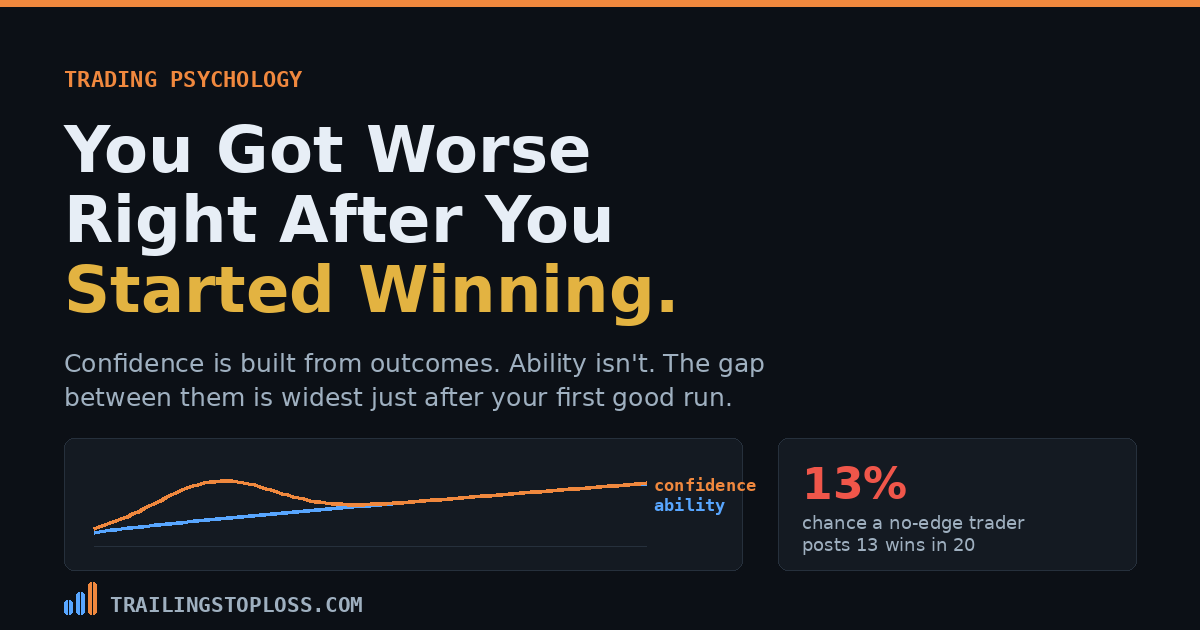
In 2001, Gervais and Odean published a model in the Review of Financial Studies describing how traders learn about their own ability. Their trader begins with no idea how good he is and infers it from his results. The bug is in the inference: when he succeeds, he takes too much credit, weighting skill over favourable conditions. Do that repeatedly and confidence detaches from ability. (Review of Financial Studies)
The paper anchors this in a much older observation from attribution research — people attribute success to their own dispositions and failure to external forces. Apply it to a trading log and the pattern is familiar: the winner was my read, the loser was a news spike. Both entries are plausible. Only one of them updates your self-assessment. (Gervais & Odean, working paper)
The model’s timing is the part that should interest anyone on a funded account. Expected overconfidence rises in the early stages of a trading career and only later, with more experience, does the trader come to recognise his actual ability. The dangerous window isn’t year five. It’s right after the first run that works. (Gervais & Odean, SSRN)
The finding nobody quotes
Buried in the same abstract is a claim that inverts how most traders think about their own results: although more past successes do indicate greater probable ability, a more successful trader may actually have lower expected profits next period than a less successful one — because his greater overconfidence leads him to trade too aggressively. (Gervais & Odean, SSRN)
Read that twice. Not “success doesn’t guarantee future success” — the ordinary caveat everyone nods along to. The stronger claim: the winning trader can be the worse bet going forward, precisely because he won. And there’s a corollary that explains why this never gets weeded out. Since overconfidence is generated by success, overconfident traders aren’t the poorest traders, and their survival in the market isn’t threatened. The bias persists because the people carrying it are doing fine — just less well than they should be. (Review of Financial Studies)
Why prop trading manufactures this
An evaluation is a designed early-career success event. You pass, you get capital, and the passing is naturally read as evidence of ability — which is what it’s marketed as. But look at the sample size you actually cleared. (Review of Asset Pricing Studies, 2020)
| Result over 20 trades | Chance of achieving it with no edge at all (true 50%) |
|---|---|
| 11 wins or better | 41.2% |
| 12 wins or better | 25.2% |
| 13 wins or better | 13.2% |
| 14 wins or better | 5.8% |
A coin-flip trader posts 13 wins from 20 roughly one time in eight. That’s not a rare event — run four evaluations and it’s likelier than not that one of them looks like skill. The evaluation is a filter, but it’s a much coarser one than passing it feels like. (Gervais & Odean, working paper)
To demonstrate statistically that a 55% win rate beats a coin flip takes on the order of 600 trades. Even a genuine 60% needs around 150. Whatever your first funded month told you about your ability, it was not that. It was a sample far too small to separate an edge from a good tape.
How it shows up
The mechanism produces a specific, recognisable sequence — and every step feels justified at the time, which is what makes it hard to catch from the inside. (Review of Financial Studies)
| What you do | What you tell yourself | What’s actually happening |
|---|---|---|
| Size up | “I’ve proven the setup works” | Confidence updated on outcomes, not evidence |
| Take marginal setups | “I’m reading the tape well right now” | Standards loosened by recent wins |
| Widen or skip stops | “I know where this is going” | Success attributed to judgment rather than plan |
| Trade more often | “I’m in rhythm” | The documented behaviour of overconfident traders |
| Blame the loss on news | “That was unlucky, not wrong” | Failure attributed externally — no learning occurs |
That last row is the load-bearing one. Trading more aggressively lowers expected profits, but the reason the correction never arrives is the attribution: losses get filed under circumstances, so they never update the self-assessment that produced the aggression. The feedback loop is open at one end. (Gervais & Odean, SSRN)
What actually counters it
You can’t decide to be less overconfident — it’s an output of how outcomes get processed, not a stance you adopt. What you can change is what your confidence is allowed to update on. (Gervais & Odean, working paper)
- Score execution, not P&L. Did you take the setup as written, size as written, exit as written? That’s a yes or no per trade, and it’s the only score that reflects something you controlled.
- Attribute wins in writing. For every winner, record why it worked: plan, or tape. Forcing the distinction is uncomfortable, and it’s the direct counter to taking too much credit.
- Fix size in advance, in writing, for a fixed period. Not “size up when confident” — a number, reviewed monthly, changed only on a rule you set beforehand. This severs the link between recent outcomes and current risk.
- Set a review threshold in trades, not weeks. “I’ll reassess at 200 trades” is a real checkpoint. “I’ll reassess when it’s going well” is the bias with a calendar.
- Track your no-trade and losing days as completed days. If only green days register as success, the scoring system rewards exactly what the model says will hurt you.
The counterweight
Confidence isn’t the problem, and an article that leaves you afraid of your own good results has done damage of a different kind. You need enough of it to take the setup when it appears — hesitation has its own well-documented cost, and the trader who freezes on a proven setup is not better off than the one who sizes up slightly too fast. (Journal of Financial Markets)
The distinction is what the confidence is built on. Confidence from a written plan you’ve executed 300 times is earned. Confidence from three green weeks is an inference from a sample that can’t support it. Same feeling, completely different foundation — and only the second one grows fastest at exactly the moment you can least afford it. (Review of Financial Studies)
It’s also worth saying the model predicts recovery. Overconfidence rises early and then, with more experience, traders come to better recognise their own ability. Most people do calibrate eventually. The question is only whether the account survives long enough for that to happen — which is an argument for surviving the first six months at small size, not for trading bigger once things start working. (Gervais & Odean, SSRN)
The short version
Nobody starts overconfident. You become it by taking too much credit for wins, and the model says the effect peaks early in a trading career — right where a passed evaluation puts you. The sharpest version of the finding is that a more successful trader can have lower expected profits next period than a less successful one, because success is what generated the aggression. Since 13 wins from 20 happens to a no-edge trader about one time in eight, the run that convinced you probably wasn’t evidence. Score execution rather than money, write down why each winner worked, fix your size in advance, and set a review threshold in trades. Confidence follows results automatically. Making sure it follows the right results is the whole job. (Review of Financial Studies)
Frequently asked questions
Why do I get worse after a winning streak?
Because confidence updates on outcomes while ability doesn’t. Gervais and Odean’s model shows traders infer their own ability from results and take too much credit for successes, so a good run moves self-assessment far more than it moves skill. The resulting overconfidence leads to trading more aggressively, which lowers expected profits — and the effect is strongest early in a trading career.
Does passing a prop firm evaluation prove I have an edge?
Much less than it feels like. A trader with no edge at all — a true 50% win rate — posts 13 or more wins from 20 trades about 13% of the time, and 11 or more about 41% of the time. An evaluation is a filter, but a coarse one. Demonstrating statistically that a 55% win rate beats a coin flip takes on the order of 600 trades.
What is self-attribution bias in trading?
The tendency to credit successes to your own skill and failures to outside circumstances. In a trading journal it looks like “my read was right” on winners and “a news spike got me” on losers. Both may be true, but only the first updates your self-assessment — so confidence rises on wins and never falls on losses, which is precisely the asymmetry that produces overconfidence.
Can a more successful trader be worse going forward?
Yes, and that’s the model’s sharpest claim. More past successes do indicate greater probable ability, but a more successful trader may have lower expected profits in the next period than a less successful one, because greater overconfidence leads to trading too aggressively. Notably, overconfident traders aren’t the poorest traders and their survival isn’t threatened — which is why the bias persists rather than being weeded out.
How do I stop overconfidence without losing the confidence I need?
Change what confidence is allowed to update on rather than trying to feel less of it. Score execution — did you follow the plan — instead of P&L. Record for each winner whether it worked because of the plan or because of the tape. Fix position size in advance for a set period so recent outcomes can’t move current risk. Confidence built on a plan executed hundreds of times is earned; confidence built on three green weeks is an inference from too small a sample.
Does overconfidence go away with experience?
The model says yes — expected overconfidence rises in the early stages and then declines as traders come to better recognise their actual ability. The practical problem is survival: the peak arrives early, often right after a first funded account, and the question is whether the account lasts long enough for calibration to happen. That’s an argument for staying small through the first stretch, not for sizing up once things start working.
Related on this site: why you freeze on a setup you’ve already proven · ending your day on one good trade · why managing a trade usually means ruining it · all trading psychology
Nothing here is financial advice. Futures trading carries substantial risk of loss and is not suitable for every investor.