FTMO Just Entered Futures. The Rules Are Better Than Most of the Board.
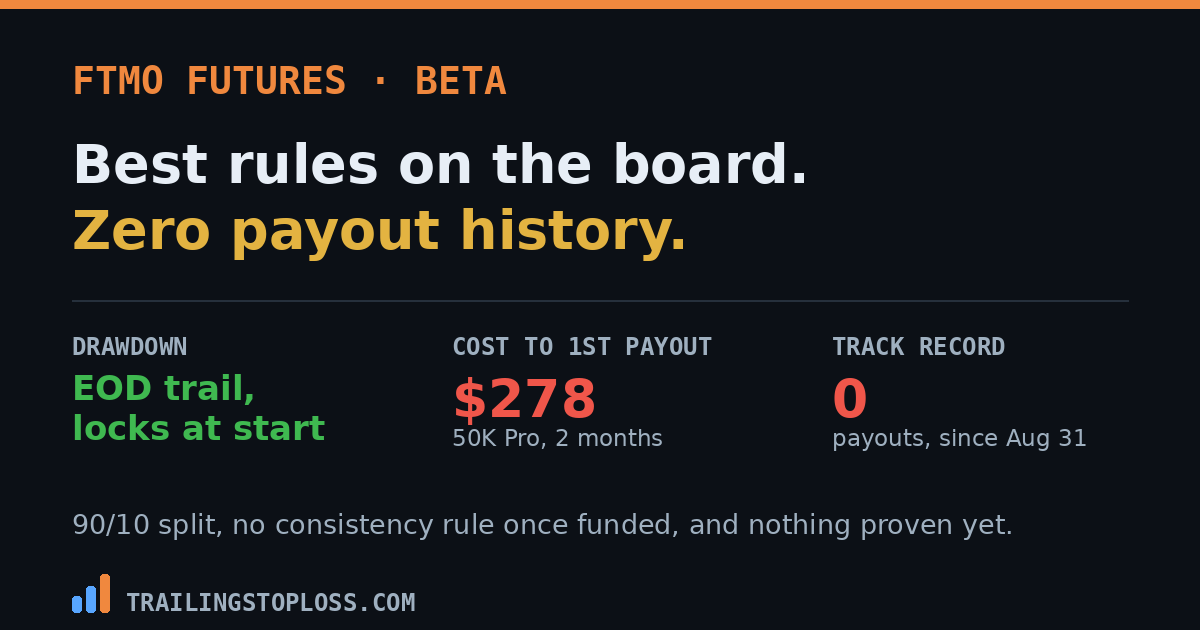
The largest CFD prop firm in the world opened FTMO Futures in beta on 31 August 2026. It arrives with an end-of-day trailing drawdown that locks at your starting balance, no consistency rule on the funded account, and a 90/10 split — a rule set that beats most incumbents on the two mechanics that actually end accounts. It also arrives with zero payout history and monthly billing that puts its true cost near the top of our board.
And on the Pro plan, withdrawing 100% of your profit breaches the account. FTMO says so itself.
What launched
FTMO Futures is a separate product from the FTMO Challenge, with its own rules pages, its own subscription pricing and its own social accounts. Nothing carries over — the 10% static drawdown, the 80% split and the refundable fee are all CFD mechanics that FTMO Futures does not share. (FTMO Futures)
| Term | Growth | Pro |
|---|---|---|
| Account sizes | $50K / $100K / $150K | $50K / $100K / $150K |
| Monthly fee (from) | $119 | $139 |
| Profit split | 90/10 | 90/10 |
| Withdrawable per cycle | 50% of profit | 100% of profit |
| Payout cap | up to $4,000 | $5,000–$8,000 by size |
| Daily loss limit | None in eval, soft when funded | Applies |
| Drawdown | EOD trail, locks at start | EOD trail, locks at start |
| Consistency rule | Best day ≤40% of profit (eval only) | Best day ≤50% of profit (eval only) |
Structurally it’s one evaluation phase on a simulated CME account, then a sim-funded account, then — for top performers only, by invitation — a live account backed by FTMO’s capital. Trading runs on Tradovate, NinjaTrader and TradingView, across 30 CME contracts: 19 E-minis and 11 micros. No activation fee, no minimum trading days, news trading allowed. (FTMO Futures rules)
The two rules that matter, and FTMO gets both right
The drawdown is end-of-day and it locks. Your breach level only moves at the close, and once it reaches your starting capital it stops moving permanently. That means normal intraday swings can’t chase you out, and progress once earned stays earned. At the same dollar allowance, an intraday trailing drawdown is roughly five to six times more likely to end an account than a static one — so this is not a cosmetic difference.
There’s no consistency rule once you’re funded. The best-day cap applies during the evaluation only. Plenty of futures firms run consistency requirements on the funded account, where they function as a payout brake rather than a risk control.
FTMO also quotes a profit-target-to-drawdown ratio as low as 1:1, meaning the target you have to hit equals the room you have to hit it in. That’s unusually balanced at these account sizes, and it’s the claim the CEO led the press release with. (FTMO press release)
The trap in the Pro plan
On Pro, once your drawdown floor has locked at your starting balance, requesting all of your available profit drops your balance to that floor — and hitting the floor is a breach. FTMO flags this directly on its own FAQ. Growth can’t hit it, because only half your profit is withdrawable. It’s an arithmetic consequence of combining a locked floor with 100% withdrawals, not a hidden clause, but it is exactly the kind of rule that costs somebody an account in month three.
There’s a second mechanic worth knowing: your contract limit on a funded account climbs through tiers based on end-of-day profit above your starting balance. Taking a payout lowers your balance, which lowers your profit above start, which can drop you a tier. Withdraw everything and you’re back to the base tier.
Before your first payout you also clear a one-time buffer equal to your maximum drawdown. On a Pro 50K that’s $3,000 of profit banked before a single dollar comes out. After that, Pro allows daily requests.
What it costs against the board
Here’s where the enthusiasm meets our own true-cost methodology. FTMO Futures is monthly, and almost nobody reaches a first payout inside one billing cycle.
| Path to first payout | 1 cycle | 2 cycles | 3 cycles |
|---|---|---|---|
| Growth 50K | $119 | $238 | $357 |
| Pro 50K | $139 | $278 | $417 |
| Pro 150K | $269 | $538 | $807 |
For comparison, the cheapest 50K on our board runs about $70 all-in, and the range across the firms we track tops out near $380. A realistic two-cycle run at FTMO Futures Pro lands at $278 — not disqualifying, but firmly in the upper half, and that’s before a reset.
The offsetting number is the drawdown. A Pro 50K carries $3,000 of room against a typical $2,500 — 20% more, which at 25 losing trades of room is $120 of risk per trade instead of $100. Three MNQ micros on a 20-point stop rather than two. You’re paying more and getting slightly more room to use it in.
Why FTMO is here at all
This is the CFD-to-futures migration finishing its run. MetaQuotes’ crackdown on unlicensed MetaTrader access for US retail clients pushed CFD props out of the American market, and futures props filled the gap. The5ers launched futures in February and added single stock futures on 8 September. FundedNext moved earlier. FTMO is the largest firm to make the jump, and it follows its December 2025 acquisition of OANDA. (LeapRate)
FTMO says it has paid out more than $650 million to traders since 2015 and claims 4.5 million customers. Both figures belong to the CFD business. They say something about the entity’s ability to fund and operate a program; they say nothing about whether this product pays.
Our position: tracked, not recommended
We’re adding FTMO Futures to the tracker and not to the recommended list. That isn’t a flag. It’s what “beta, launched three weeks ago, zero payouts processed” honestly warrants.
- The rules earn a look. If you’ve been breached by an intraday trail on a retracement, the EOD-locking drawdown is worth paying for.
- The cost doesn’t beat the board. On monthly billing you’re at roughly $278 for a realistic two-cycle run at 50K Pro, against $70 at the cheap end.
- Growth is the sane entry. It’s $20 cheaper a month, has no daily loss limit in the evaluation, and structurally cannot trigger the withdraw-everything breach.
- Wait for payout evidence if you can. Three to six months of traders posting cleared payouts is the thing no rules page can substitute for.
- Check eligibility first. The beta excludes residents of Arkansas, Delaware, Louisiana, Montana and South Carolina.
The honest limits
Everything above is from FTMO’s own pages and its press release. There is no independent payout record to check it against, because there isn’t one yet. Rules pages describe intent; payout history describes behavior, and we have only the first.
Beta terms change. FTMO has labeled this explicitly as beta rather than a finished offering. Pricing, caps and eligibility can move before it settles, so verify against the live rules page rather than this article.
And we take affiliate commission from some firms we track — not this one, currently. The test that matters isn’t disclosure, it’s whether we demote partners: we removed two in September for falling below our rating floor, both dated on the flagged list.
The short version
FTMO opened FTMO Futures in beta on 31 August 2026 — Growth and Pro plans at $50K, $100K and $150K, $119 to $269 a month, 90/10 split, on Tradovate, NinjaTrader and TradingView across 30 CME contracts. The rule set is genuinely better than most of the futures board on the two mechanics that end accounts: an end-of-day trailing drawdown that locks permanently at starting capital, and no consistency rule once funded. The catch on Pro is that withdrawing 100% of profit drops your balance to that locked floor and breaches the account, which FTMO flags itself; Growth can’t hit it because only half is withdrawable. Cost is the weak spot — monthly billing puts a realistic two-cycle run at 50K Pro near $278 against roughly $70 at the cheap end of our board. And there is no payout history at all. Tracked, not recommended, until traders start posting cleared payouts.
Frequently asked questions
What is FTMO Futures?
A futures prop product FTMO opened in beta on 31 August 2026, separate from its long-running CFD challenge business. It runs one evaluation phase on a simulated CME account, then a sim-funded account, with a discretionary live account for top performers. Two plans, Growth and Pro, at $50K, $100K and $150K, priced from $119 to $269 a month. None of the CFD product’s rules carry over.
Is FTMO Futures worth using?
The rules are strong — an end-of-day trailing drawdown that locks permanently at starting capital, no consistency rule on the funded account, a 90/10 split and no activation fee. The problems are cost and evidence: monthly billing puts a realistic two-cycle run at 50K Pro near $278 against roughly $70 at the cheap end of the market, and the product has processed no payouts at all yet. Worth tracking, hard to recommend over firms with a record.
What’s the difference between FTMO Futures Growth and Pro?
Growth is the cheaper entry: from $119 a month, no daily loss limit during the evaluation, a soft limit once funded, payouts after four qualifying days with caps up to $4,000, and 50% of profit withdrawable. Pro starts at $139, allows 100% withdrawals with caps of $5,000 to $8,000 by size, and offers a profit-target-to-drawdown ratio as low as 1:1. Both share the 90/10 split and the end-of-day locking drawdown.
Can withdrawing profit breach an FTMO Futures account?
On Pro, yes. Once the drawdown floor has locked at your starting balance, requesting all of your available profit drops the balance to that floor, and hitting the floor is a breach. FTMO states this on its own FAQ. Growth cannot hit it because only half of profit is withdrawable. Taking a payout also lowers your end-of-day profit above starting balance, which can drop your contract limit to a lower tier.
Who can trade FTMO Futures?
FTMO says the offering is available internationally, subject to its terms and geographic restrictions. Under the current beta eligibility page, residents of Arkansas, Delaware, Louisiana, Montana and South Carolina are excluded. Because it is explicitly a beta, eligibility and terms can change — check the live rules page before purchasing.
Related on this site: how to pick a prop firm and account size · true cost rankings · the firms we flag · the biggest futures prop firms
All product terms come from FTMO’s own futures rules, FAQ and press-release pages, read 24 September 2026, plus contemporaneous industry reporting on the launch. FTMO Futures is explicitly in beta and terms may change; verify against the live rules page before purchasing. We do not currently hold an affiliate relationship with FTMO Futures. Nothing here is financial advice. Futures trading carries substantial risk of loss.