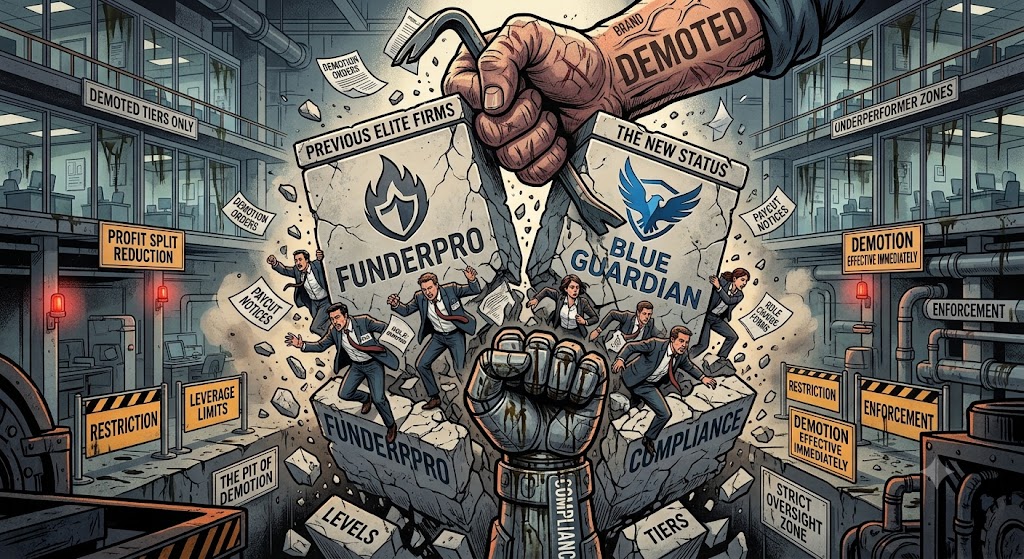
We made money from both of these firms. FunderPro and Blue Guardian were affiliate partners — every signup through our links paid us a commission — and in June 2026 we cut those links anyway. Not because the firms vanished, and not because they stopped paying us. We pulled them because a pattern showed up in how they pay traders, and an honest broker doesn’t get to look away from that just because the check clears on our end. Here’s exactly what we found and what changed.
Why we’d ever cut a paying partner
Most prop firm “review” sites rank on commission. The firm that pays the biggest bounty floats to the top, the affiliate keeps quiet about the payout complaints, and the reader eats the difference when their withdrawal gets denied. We run the opposite way: monetization breaks ties between firms we already trust, it never buys a firm a pass on the one thing that actually matters — whether you can get your money out. That’s the whole editorial standard.
This isn’t theoretical for us. We watched a firm we’d covered, FundingTicks, collapse in January 2026 and retroactively rewrite its rules to avoid paying out funded traders. After living through that, “but they’re an affiliate partner” stopped being a sentence we’re willing to finish. When the data on a partner turns, the link comes off — full stop. We document the receipts in the True Cost hub.
FunderPro: the “shared environment” denial machine
FunderPro’s Trustpilot score has slid to roughly 3.1 across more than 1,600 reviews, and the one-star share has been climbing steadily since late 2025 rather than leveling off — the direction matters more than the number. A firm settling into a stable 3-point-something is one thing; a firm actively bleeding goodwill while it grows is another. The Trustpilot trend tells the story.
The pattern underneath the score is what moved us. Traders report passing the evaluation, getting funded, collecting one to three clean payouts — and then, right as a larger withdrawal comes due, hitting an account closure or denial citing a “shared IP” or “shared environment” violation. The timing is the tell: the alleged infraction is only ever discovered at the moment the firm would otherwise have to pay. The reviews cluster around exactly that sequence.
Worse, the denial emails traders post are close to identical — same phrasing, same vague “environment” language, same lack of specifics a trader could actually contest. That reads less like case-by-case fraud investigation and more like a template fired off at withdrawal time. A real compliance process produces evidence; a copy-paste rejection produces a screenshot that looks suspiciously like everyone else’s. Compare the denial screenshots side by side.
None of this means FunderPro never pays — it does, regularly, which is precisely why it’s a demotion and not an exclusion. But when the denials concentrate at the second or third payout and lean on an unfalsifiable “shared environment” rule, we’re not comfortable being the link that put you there. The affiliate code is gone; the firm stays on the board, flagged. Its real costs are still listed for reference.
Blue Guardian: profit confiscation by “shared device”
Blue Guardian’s Trustpilot rating has fallen to around 3.6 across more than 2,200 reviews, down from the low-to-mid fours earlier in the year — one of the sharper reputation slides among any firm we track. We’d already quietly demoted it out of our featured spotlight months ago; the June audit finished the job. The rating history is public.
The specific mechanism is uglier than FunderPro’s. Blue Guardian has repeatedly used a “shared device” policy to confiscate profits and ban accounts — including cases where the trader documented a multi-month gap on pre-owned hardware and the firm’s own compliance team acknowledged there was no overlapping activity, then enforced the ban anyway. When “your laptop once belonged to someone else” becomes grounds to keep your money, the rule isn’t protecting anyone; it’s a trapdoor. Trader accounts describe this repeatedly.
As with FunderPro, the denials tend to surface deep into the payout relationship — frequently around the fourth withdrawal — and are compounded by dashboard sync issues that hide a supposed rule breach until the moment money is requested. A poorly disclosed open-loss rule does the rest. Individually, each is a “bad UX” excuse; stacked together and timed to payouts, they form a pattern. The complaint timeline lines up.
The mechanics of a demotion
Concretely: both firms lost their affiliate links everywhere on the site, dropped out of the deals roster, and were stamped with a caution flag that follows them across every page — firm listings, comparison tables, and the homepage Pulse, where they now sit in the “recently flagged” column instead of the deals strip. Their Trustpilot scores and true-cost figures stay visible, because hiding a flagged firm would defeat the entire point. The deals page now lists only firms we’ll still stand behind.
| Firm | Trustpilot move | Core issue | Status |
|---|---|---|---|
| FunderPro | 4.0 → 3.1 (1,607 reviews) | “Shared IP / environment” denials at the 2nd–3rd payout, near-identical template emails | Demoted · caution · no affiliate link |
| Blue Guardian | 4.4 → 3.5 (2,236 reviews) | “Shared device” profit confiscation; denials around the 4th payout; hidden rule syncing | Demoted · caution · no affiliate link |
The takeaway for traders
The lesson isn’t “avoid these two firms forever.” It’s that a low headline price or a fat discount code means nothing if the payout terms hide a trapdoor — a vague “shared environment” clause, a “shared device” rule, an open-loss limit that only surfaces at withdrawal. Read the payout section of any firm’s terms the way you’d read a margin call, and run the real number before a code talks you into the wrong account. Start with the True Cost hub.
Common questions
Are FunderPro and Blue Guardian scams?
Did you drop them because they stopped paying you commissions?
Can I still use them if I want to?
What’s the difference between “demoted” and “avoid/excluded”?
Would you ever re-list them as partners?
Editorial note: TrailingStopLoss flags firms regardless of affiliate relationships. FunderPro and Blue Guardian were partners at the time of demotion; their affiliate links were removed in the June 2026 audit. Ratings cited reflect Trustpilot data as of June 2026 and will shift over time.