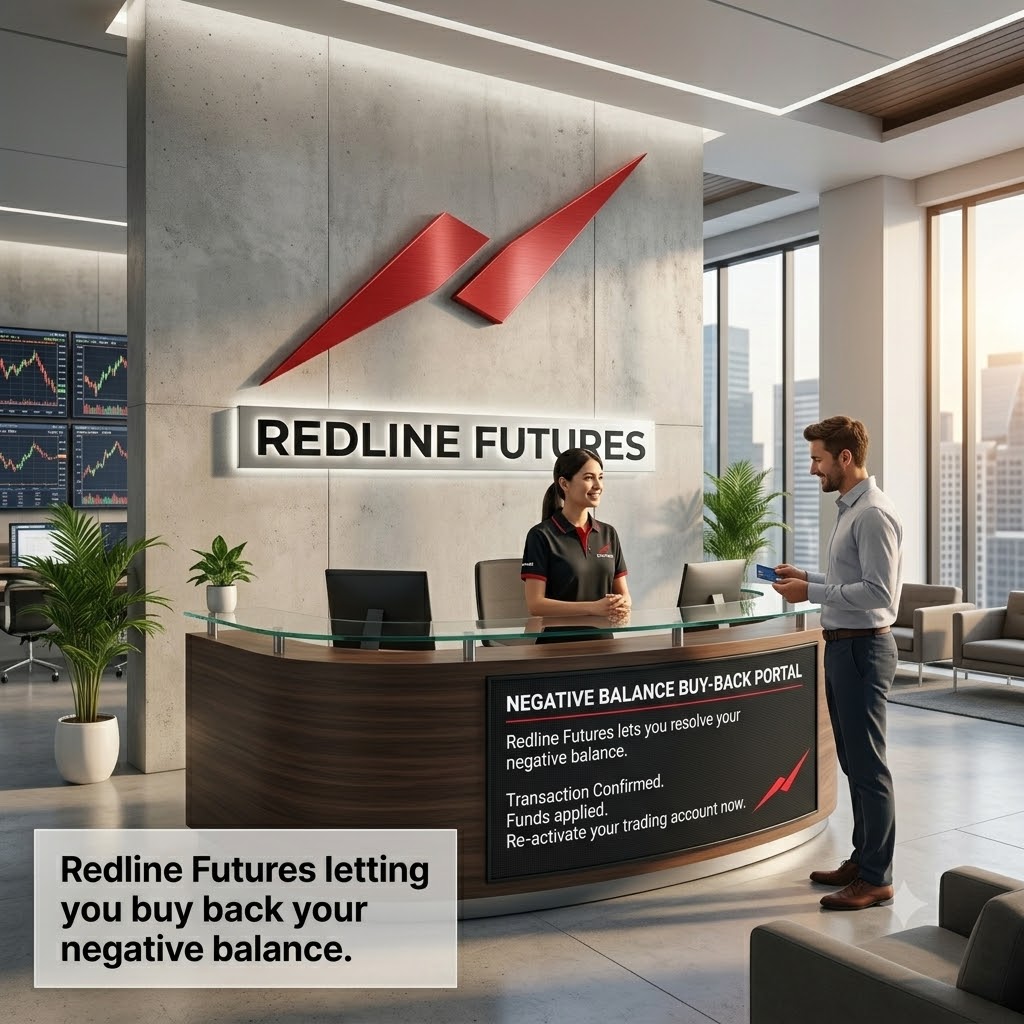
Redline Futures Funding has added a new line to its dashboard “Powerups” menu, and it is a quietly remarkable one: Balance Boost, a paid feature that lets a trader top their account back up after the balance has gone negative. In other words, you can now buy your way out of a loss you have already taken. The feature went live alongside Redline’s wider 90/10 split rollout and is accessed through the Powerups page in the trader dashboard. PropScorer
What Balance Boost actually does
Strip away the marketing and the mechanic is simple. Hit a rough patch, watch your simulated balance dip below where it should be, and rather than reset the evaluation or eat the breach, you open the Powerups tab and purchase additional balance. Redline prices this per $100 added, so the cost scales with how deep the hole is. The same menu also sells “conduct waivers” priced from $300 to $1,000 — each one covering a single payout — and a “Profit Bonus” with pricing the firm says it will reveal at launch. Redline Futures Funding
Why this raises an eyebrow
The honest read is that this is a pay-to-un-fail button, and the framing matters because Redline accounts are simulated. The firm is upfront that orders route to a simulator on a CME-licensed dxFeed market-data feed rather than to a live exchange, with payouts coming from firm capital. When the “balance” you are buying back is sim balance, selling traders more of it after they go negative is closer to selling extra lives in a video game than to anything resembling real capital management — and it points the incentive in a direction worth naming out loud. Redline Futures Funding
The structural tension is straightforward: a firm that earns when you fail and then charges you again to keep going is not obviously aligned with you passing cleanly. That is not unique to Redline — reset fees do the same thing across the industry — but Balance Boost is a more direct version of it, because it monetizes the breach itself rather than the do-over. For the full picture on how these fees stack up, see our prop firm true cost hub.
The trust footprint is still thin
Context is everything with a firm this young. Redline launched in 2026 and currently sits at a PropScore of 49/100 with a health score of 42/100, with reviewers repeatedly noting that the paper rules look trader-friendly while external trust proof remains limited. The standard caveat applies harder than usual here: flexible-sounding terms from a months-old operator are a promise, not a track record. PropScorer
That caveat is not hypothetical. Redline’s Trustpilot page carries glowing same-day-payout reviews sitting right next to detailed complaints, including a trader who says a payout was denied over a dashboard error the firm acknowledged but refused to correct manually — then offered a free $50K evaluation as “compensation” for a payout worth more than ten times that. Another recurring complaint claims the advertised end-of-day drawdown behaves like an intraday limit in practice. Mixed signals like these are exactly why a buy-back-your-balance feature deserves scrutiny rather than a press release. Trustpilot
Mind the drawdown model before you boost anything
If you are going to engage with Redline at all, understand which floor you are buying back. Redline’s trailing drawdown applies to the evaluation and to funded “Gas” accounts, where the floor ratchets up with your highest closed P&L and never resets down. Funded “Electric” accounts and instant-funded “Diesel” accounts instead use a static end-of-day drawdown set at the start of each day. Balance Boost only matters relative to whichever of those is governing your account, and on a trailing model the floor you paid to escape will keep climbing behind you. Redline Futures Funding
| Powerup | What it does | Stated pricing |
|---|---|---|
| Balance Boost | Adds balance after you go negative | Per $100 added |
| Conduct waiver | Covers one payout | $300–$1,000 per purchase |
| Profit Bonus | Not yet detailed | Announced at launch |
The bottom line
Balance Boost is not automatically a scandal — it is an optional add-on, plenty of traders will never touch it, and Redline does publish its rules pages openly. But a feature that sells you out of a loss you already took, attached to a 2026 firm with a thin trust record and live payout complaints, is the kind of thing that belongs on a watch list rather than a recommended list. Treat Redline as a monitored newcomer, read the drawdown rules before you spend a dollar, and remember that the cleanest way to avoid needing a balance boost is to not need one. For more newcomers we are keeping an eye on, browse the Prop Firms desk.
Frequently asked questions
What is Redline Futures Funding’s Balance Boost?
Balance Boost is a paid dashboard “Powerup” that lets a trader add balance back to a Redline account after it has gone negative. It is priced per $100 added and is accessed through the Powerups page in the trader dashboard. Because Redline accounts are simulated, the balance being added is sim balance, not real capital.
How much does Balance Boost cost?
Redline prices Balance Boost per $100 of balance added, so the total cost depends on how much you are restoring. The related conduct-waiver Powerup is priced from $300 to $1,000 per purchase, with each waiver covering a single payout, and a Profit Bonus Powerup has pricing the firm says will be announced at launch.
Is Redline Futures Funding legit?
Redline is a real, openly operating firm founded in 2026 that publishes its rules, but its trust footprint is still young. It currently carries a PropScore around 49/100, and its Trustpilot page mixes positive fast-payout reviews with detailed complaints about a denied payout tied to a dashboard error. Treat it as a monitored newcomer rather than a default choice, and read the payout and drawdown rules carefully first.
Does Balance Boost work on every Redline account?
What it can restore depends on your drawdown model. Evaluations and funded Gas accounts use a trailing drawdown whose floor ratchets up with your highest closed profit and never resets down, while funded Electric and instant-funded Diesel accounts use a static end-of-day drawdown. On a trailing account, the floor you paid to escape keeps climbing behind you, so a boost buys time, not a clean slate.