Why So Many Traders Play Poker (And What Actually Transfers)
Susquehanna, one of the largest options market makers in the world, puts new traders through 100+ hours of poker before they touch a real position. Its own site says the game is how it teaches decision-making under uncertainty. The overlap is real — but the most valuable thing poker teaches is the one traders reliably refuse to learn, and one of its core lessons is actively dangerous in markets.
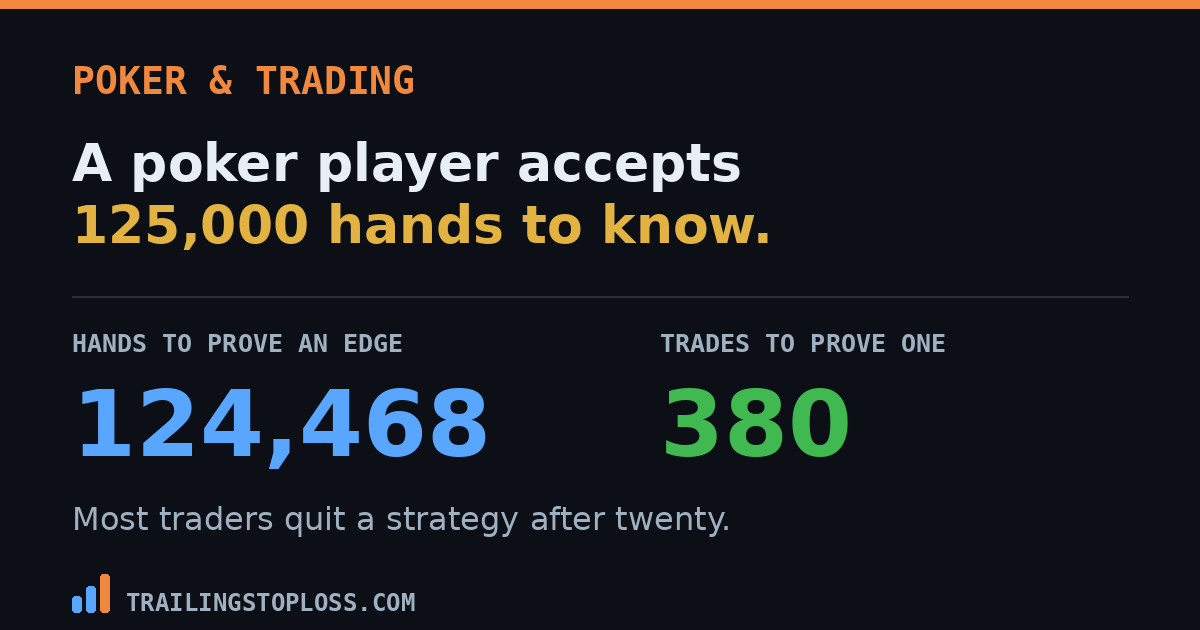
A serious poker player accepts 125,000 hands as the price of knowing whether they’re any good. Most traders quit a strategy after twenty trades.
This isn’t a metaphor. Firms actually do it.
Susquehanna International Group states it plainly on its own website: the firm uses poker to teach new traders about decision-making under uncertainty, because traders go through similar thought processes when evaluating the expected value of a trade and deciding how to price risk. (SIG)
That isn’t a team-building exercise. New hires spend over 100 hours on poker during a ten-week training program before managing risk. SIG employs Bill Chen and Jerrod Ankenman — World Series of Poker bracelet winners and co-authors of The Mathematics of Poker — and co-founder Jeff Yass has been known to sit in on the games to watch how new traders bluff. Thousands of employees enter the firm’s annual tournament, and at least three have won WSOP events. The games involve no money. (Montco Today)
Todd Simkin, who ran trader development there for decades, put the case in one line: good decision-making under uncertainty is still the key characteristic of a strong trader. Poker is simply the cleanest way to drill it.
What genuinely transfers
Bet sizing, which is the whole game in both
Simkin’s example is the one worth keeping. Holding pocket aces against a single opponent, you’re roughly a 4-to-1 favorite — and you still don’t put all your chips in, because a 4-to-1 favorite loses one time in five. The identical logic governs position size on your highest-conviction setup.
This is the most direct transfer, and it’s the thing that actually ends most accounts. A poker player who sized every hand at 20% of their bankroll would be broke within a month, and every serious player knows this before they know anything else. Traders routinely run the equivalent and call it conviction.
Folding, and the cost of not doing it
Poker’s most-repeated lesson is that folding is free. You surrender the hand, keep the stack, and wait. The opportunity cost of a fold is precisely zero, and a good player folds the large majority of hands they’re dealt.
Trading has the identical structure — you can take no trade today — and almost none of the same culture. Nobody congratulates you for the setup you didn’t take. Poker at least has the vocabulary: sitting out is a move, not an absence of one.
Separating decision quality from outcome
A poker player can make a correct call and lose, and the culture explicitly recognizes this — it’s called a bad beat and nobody thinks the decision was wrong. Traders have no equivalent concept. A losing trade feels like a mistake, which is how journals end up inventing rules out of noise.
The lesson traders refuse to take
Here’s where the overlap stops being flattering. Poker’s defining cultural trait is patience with sample size, and it’s the part nobody imports.
A winning cash-game player might make 5 big blinds per 100 hands with a standard deviation around 90bb per 100. Work through the statistics and the sample needed to be 95% confident that winrate is genuinely above zero comes out at roughly 124,000 hands — about two and a half years at a thousand hands a week.
Serious players accept that. They track it, they know their sample is small, they don’t conclude anything from a losing week.
| Edge | Sample for 95% confidence | At one trade a day |
|---|---|---|
| Poker: 5bb/100 | 124,468 hands | 2.4 years online |
| Trading: 55% at 1:1 | 380 trades | 1.5 years |
| Trading: 40% at 2:1 | 207 trades | 0.8 years |
| Trading: 35% at 3:1 | 87 trades | 0.3 years |
The trading numbers are smaller — a bigger per-trade edge needs fewer repetitions. And traders still won’t wait. A strategy gets abandoned after a bad fortnight, which at one trade a day is twenty trades: roughly a quarter of the minimum sample for the most favourable case in that table, and a twentieth of it for the least.
A poker player needs six hundred times more repetitions than a 3:1 trader to establish their edge — and is far more likely to actually collect them. The constraint was never the math. It’s that poker culture treats sample size as the cost of entry, and trading culture treats it as an inconvenience.
Where the analogy breaks, and it matters
Most articles on this subject stop at the flattering half. The disanalogy is the more useful part.
Poker’s probabilities are fixed. Markets’ aren’t.
A flush draw is 35% to complete on the turn and river. That was true in 1970, it’s true now, and it will be true in fifty years. The deck does not adapt. You can compute your equity before you act, exactly, every time.
You cannot compute the probability that your setup works. You can only estimate it from past trades — and the process generating those trades is non-stationary. Participants change, volatility regimes change, the behavior you were exploiting can be arbitraged away. In poker, a losing stretch is almost always variance. In trading, it might be variance or it might be your edge disappearing, and the same data is consistent with both.
That makes the poker virtue of “trust the math over a large sample” genuinely hazardous when imported without care. The poker player who grinds through 50,000 losing hands is usually right to. The trader who grinds through 500 losing trades may be funding a strategy the market stopped paying for.
Poker has a bankroll. Trading has a drawdown.
Poker bankroll rules are about avoiding ruin while variance plays out — lose your stack, rebuy, the game continues. A prop account has a trailing drawdown that ends the account permanently, and it measures from your peak. There’s no rebuy and no next session. Poker sizing intuitions transfer; poker’s assumption that you’ll still be at the table tomorrow does not.
You can choose your table. You can’t choose your market.
Table selection is arguably the single largest source of edge in live poker — finding the weak game rather than playing better in a hard one. There is no equivalent. NQ at 9:30 contains whoever it contains, including the market makers described in what institutions actually have. The skill that most reliably makes money in poker has no counterpart in your trading day.
So why do traders play?
Three honest reasons, only two of them good.
It’s the same cognitive task with faster feedback. A trader might take 250 decisions a year. An online poker player takes that many in an hour. If you want reps at pricing uncertainty, poker delivers them at a rate markets never will — which is precisely why SIG uses it as a training tool rather than a hobby.
It’s a closed system, so you can actually learn. Because the probabilities are fixed and computable, you can check whether a decision was correct independently of whether it worked. Markets almost never let you do that, and it’s the reason feedback in trading is so unreliable.
And it scratches the same itch. Worth being honest about this one. Both activities offer variable-ratio rewards under uncertainty, which is the most reinforcing schedule known. Some of the overlap in who plays both is about skill. Some of it is about the fact that they feel the same, and that’s not a recommendation.
What to actually take from it
- Size like a poker player. Never risk a share of the account that a normal losing run can end. This is the one transfer that reliably pays.
- Adopt the sample-size culture, not the number. You need far fewer trades than hands — the table above tops out under 400. The point is to have a figure in mind before you start and refuse to draw conclusions before you reach it.
- Separate decision from outcome, but verify the deck hasn’t changed. A losing trade isn’t evidence of a bad decision. A losing hundred might be evidence the edge is gone. Poker doesn’t teach you to distinguish those, because it never has to.
- Learn to fold without narrating it. No trade is a position. It costs nothing and nobody will applaud it.
- Don’t mistake the feeling for the skill. If you play because it’s the same buzz rather than the same discipline, you’re reinforcing the habit you were trying to train out.
The honest limits
Nobody has measured whether poker players trade better. SIG’s use of it is a strong signal — a firm of that size doesn’t spend 100 hours per hire on a whim — but it’s a training method they believe in, not a published result. No study compares the trading performance of poker players against anyone else.
The sample-size figures are standard calculations, not measurements. They assume independent trials and stable win rates, which poker roughly satisfies and trading does not. Treat them as illustrating the scale of the gap rather than as a target to tick off.
And selection effects muddy the whole thing. The traders who played poker first were already the sort of people drawn to probabilistic risk-taking. Whether poker made them better traders, or the same temperament produced both, is not something you can untangle from anecdotes.
The short version
Susquehanna, one of the world’s largest options market makers, puts new hires through 100+ hours of poker before they manage risk, and says on its own site that it uses the game to teach decision-making under uncertainty. What transfers genuinely is bet sizing — a 4-to-1 favorite still loses one time in five, so you never commit the stack — along with folding freely and separating decision quality from outcome. What doesn’t transfer is the sample-size culture, which is the most valuable thing poker has: a winning cash player needs roughly 124,000 hands to establish their edge with confidence and accepts it, while a 3:1 trader needs 87 and quits after twenty. And one poker virtue is actively dangerous in markets — the deck’s probabilities never change, so a losing stretch is always variance, whereas in trading the same data is equally consistent with your edge having disappeared. (SIG)
Frequently asked questions
Why do trading firms teach poker?
Susquehanna states that it uses poker to teach new traders about decision-making under uncertainty, because pricing a trade and pricing a hand involve the same expected-value reasoning. New hires play over 100 hours during a ten-week training program before managing risk. The firm employs World Series of Poker bracelet winners, and its co-founder has been known to sit in on the games to watch how recruits bluff. The games involve no money.
What does poker actually teach that helps trading?
Three things. Bet sizing: a 4-to-1 favorite loses one time in five, so you never commit the whole stack no matter how strong the hand. Folding: surrendering a hand costs nothing, and good players fold most of what they’re dealt. And separating decision quality from outcome — poker culture has the concept of a bad beat, where a correct decision loses, while trading culture treats every losing trade as a mistake.
How is poker different from trading?
Poker’s probabilities are fixed and computable — a flush draw is 35% on the turn and river, permanently. You can calculate your equity exactly before acting. Trading probabilities can only be estimated from past trades, and the process generating them changes over time. So in poker a losing stretch is almost always variance; in trading the same data is equally consistent with your edge disappearing. Poker also has table selection, which is a huge source of edge and has no trading equivalent.
How many hands does a poker player need to know they’re winning?
Around 124,000 for a 5bb/100 winner with typical variance, to be 95% confident the winrate is genuinely above zero — roughly two and a half years at a thousand hands a week. The trading equivalent is far smaller because the per-trade edge is bigger: about 380 trades at a 55% win rate on 1:1, 207 at 40% on 2:1, and 87 at 35% on 3:1. The difference isn’t the math, it’s that poker culture accepts the wait.
Does playing poker make you a better trader?
No study has tested it. Susquehanna’s commitment is a meaningful signal, since a firm that size doesn’t spend 100 hours per hire on something it considers decorative, but it’s a training method rather than a published result. Selection effects also confuse the picture — people drawn to probabilistic risk-taking tend to do both, so it’s hard to tell whether poker improves trading or the same temperament produces both.
Related on this site: why most traders blow their accounts · which trading method actually wins · why institutions win and you don’t · why your journal invents rules
Sample-size figures are standard statistical calculations assuming independent trials and stable win rates — an assumption poker roughly satisfies and trading does not. Training program details come from Susquehanna’s own published material and press coverage. Nothing here is financial advice. Futures trading carries substantial risk of loss.