The Easiest Market to Day Trade (The Answer Isn’t What You’ve Been Told)
Search this question and you’ll get forex, because forex brokers pay the most affiliate commission. The honest answer is a futures contract — and once you measure “easy” as cost-to-opportunity rather than vibes, it’s the one usually described as the hard one. Here’s the arithmetic, and then the part nobody selling you a course will mention.
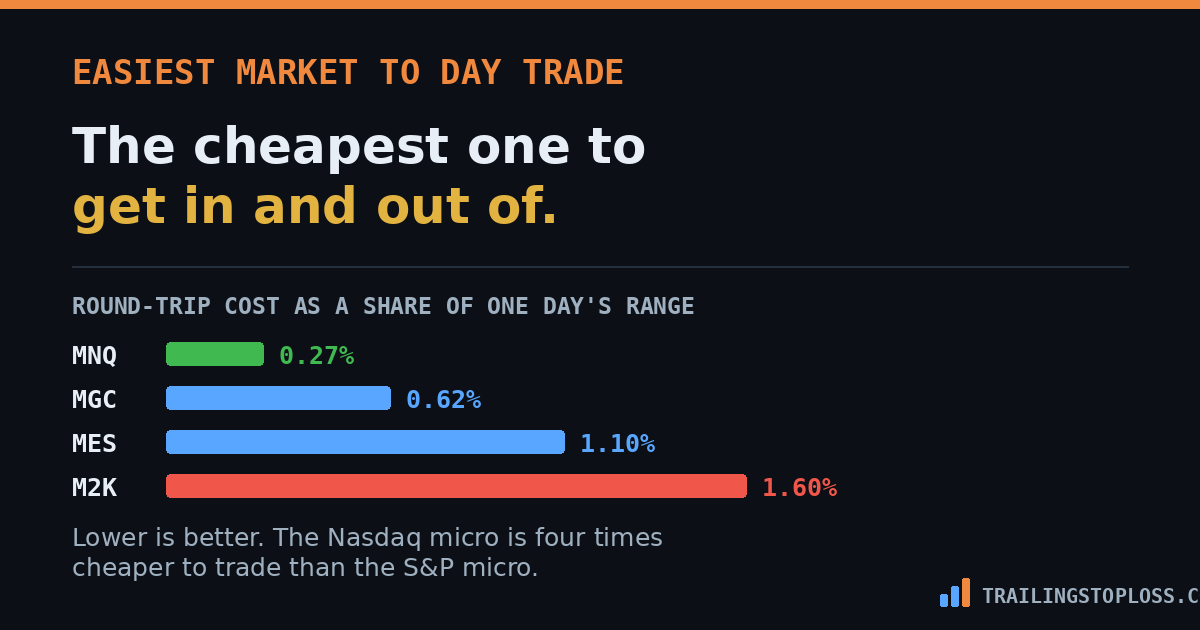
MNQ costs 0.27% of a day’s range to get in and out of. MES costs 1.10% — four times more.
Define “easy” first, or the question is meaningless
Most answers to this question mean “feels comfortable.” That’s not measurable and it’s not what determines whether you make money. Three things actually are:
- Friction versus opportunity. What share of the day’s available movement do you surrender just to enter and exit? Every trade pays this, win or lose.
- Selection burden. How many decisions must you make before you even have a trade to manage?
- Affordability. Can one contract’s normal stop distance fit inside the account you can actually buy?
Rank the candidates on those three and the picture changes considerably.
Friction: the number that surprised me
Round-trip cost is one tick of spread plus commission — call it $1.50 round trip on a micro. What matters isn’t the dollar figure but what fraction of the day’s range it consumes, because the range is the opportunity you’re trying to capture.
| Contract | Tick value | Typical daily range | Round trip | % of range |
|---|---|---|---|---|
| MNQ — Nasdaq-100 | $0.50 | 300–450 pts | $2.00 | 0.27% |
| MGC — Gold | $1.00 | ~30–50 pts | $2.50 | 0.62% |
| MES — S&P 500 | $1.25 | 40–60 pts | $2.75 | 1.10% |
| MCL — Crude | $1.00 | ~1.5–2.5 pts | $2.50 | 1.25% |
| MYM — Dow | $0.50 | ~250–350 pts | $2.00 | 1.33% |
| M2K — Russell | $0.50 | ~20–30 pts | $2.00 | 1.60% |
The Nasdaq micro is four times cheaper to trade than the S&P micro, measured against what there is to win. Its tick is smaller in dollars and its range is enormous, so the toll you pay per round trip barely registers.
This runs directly against the standard advice, which is to start on ES because it’s calmer. Calmer is true. Cheaper is not — and if you’re taking several trades a day, friction compounds in a way that “calm” does not compensate for. (Range figures)
Selection burden: why futures beat stocks outright
This is the axis people skip, and it’s the largest one.
A stock day trader makes a decision before every single trade that a futures trader never makes: which symbol. That means screening, gap scanning, float and borrow checks, earnings calendars, halt risk and news exposure on a single company. Every one of those is a judgment call, most traders have never measured their skill at any of them, and a bad pick ruins a good setup.
Trading one futures contract eliminates that entire category. You have one instrument, one set of behaviors to learn, one session to know. Whatever you gain in skill compounds into the same product rather than being spread across five hundred of them.
No pattern day trader rule, so no $25,000 minimum to trade more than three times a week. A defined RTH session with a real open and close. Deep micro contracts for sane sizing. And 60/40 tax treatment on Section 1256 contracts, which beats short-term capital gains on equities. None of these make you profitable; all of them remove obstacles.
Affordability: what one contract demands
The third axis is whether a sane stop fits your account. Using roughly one 5-minute ATR as a stop, and 25 of those as the room you need:
| Contract | Typical 5-min ATR | Risk on 1 contract | Drawdown needed |
|---|---|---|---|
| M2K — Russell | ~2–3 pts | $12 | $312 |
| MYM — Dow | ~35–60 pts | $22 | $562 |
| MES — S&P 500 | 3–7 pts | $25 | $625 |
| MCL — Crude | ~0.20–0.35 | $25 | $625 |
| MGC — Gold | ~3–6 pts | $40 | $1,000 |
| MNQ — Nasdaq-100 | 20–45 pts | $60 | $1,500 |
All of them fit inside a typical $2,500 drawdown at one contract — but look at the spread. MNQ needs $1,500 of room for a single micro, nearly five times what M2K needs. That’s the cost of its range: the thing that makes its friction so low also means it takes a lot of account to hold one contract responsibly.
So the honest ranking depends on which constraint binds you. If you’re paying for evaluations and want the most room per dollar, MES. If you’re already funded with enough drawdown to hold MNQ properly, MNQ.
What about forex, crypto and stocks?
Forex tops every “easiest market” list on the internet, which should itself be a warning — retail forex brokers pay the highest affiliate commissions in the industry, and the ranking reflects that rather than any property of the market. The spread is often variable, it widens exactly when you need it not to, and most retail forex is traded against a dealer rather than on an exchange. The 24-hour session is sold as convenience; in practice it removes the natural stopping point that protects you from yourself.
Crypto is the hardest of the group and is routinely sold as the easiest. It trades continuously, so there’s no session discipline available at all; funding rates and exchange outages add failure modes that don’t exist elsewhere; and the volatility that makes it attractive also means your stop distance and your account size are in constant disagreement.
Stocks are a reasonable choice for someone who genuinely has an edge in selection. For everyone else the selection decision is an unmeasured skill sitting in front of every trade, plus the PDT rule under $25,000.
Now the part that matters more than all of it
Everything above is real and worth a few percent. It is not worth what you’re hoping it’s worth.
Roughly 20% of day traders turn a profit in a given period and well under 1% do so reliably, and that figure does not move much between instruments. A study following every new Brazilian index-futures day trader for three years found that among those who persisted past 300 days there was no evidence of learning at all. They were on the single most liquid contract available to them, and it didn’t help. (Chague, De-Losso & Giovannetti)
Position size. Sizing so that 20 to 25 losing trades fit inside your drawdown changes your survival odds by more than every instrument choice on this page combined. A trader on the “wrong” contract with correct size outlasts a trader on the “right” contract with ten trades of room, every time, and it isn’t close. Switching symbols is the smallest lever in the room and it’s the one everyone reaches for first.
So: the answer
- Easiest overall: a single index futures micro. One instrument, no selection burden, no PDT rule, a real session, and exchange-traded pricing you can verify.
- Cheapest to trade: MNQ, at 0.27% of the day’s range per round trip — if your account has $1,500 of room to hold one properly.
- Easiest to afford: MES, needing about $625 of drawdown for one contract, at four times the relative friction.
- Avoid as a starting point: crypto, which has no session, no stopping point, and volatility that fights your account size.
- Treat “easiest market” content with suspicion generally. The answer usually reflects who pays the writer, which is worth remembering here too — we take affiliate commission from some prop firms, and none from any exchange or broker named on this page.
The honest limits
The range figures are typical, not current. They’re normal-condition values for a VIX in the 15–20 band, and daily range moves with volatility — in a VIX-30 environment every number here roughly doubles. The ratios between contracts are far more stable than the absolute figures, and the ratios are what the argument rests on.
Commission varies. I’ve used about $0.75 a side on micros. Yours may be higher, which makes every contract look worse and hurts the low-range ones most.
And “easiest” is not “easy.” The whole exercise is about removing obstacles, and removing obstacles has never made anyone profitable. It just stops the instrument being the reason you failed.
The short version
Measured as round-trip cost against a day’s available range, MNQ is the cheapest market to day trade at 0.27%, four times cheaper than MES at 1.10%, with MGC between them and M2K worst at 1.60%. Index futures beat stocks outright on selection burden — one instrument instead of a screening decision before every trade — and come with no PDT rule, a defined session and 60/40 tax treatment. The catch is affordability: a single MNQ contract needs about $1,500 of drawdown to hold responsibly against roughly $625 for MES, so the right answer depends on whether cost or room is your binding constraint. Forex tops most “easiest market” lists because forex brokers pay the highest affiliate commissions, not because it’s easiest; crypto is the hardest and is sold as the simplest. And none of it matters as much as position size — sizing so 20 to 25 losses fit inside your drawdown changes your odds more than every instrument choice combined.
Frequently asked questions
What is the easiest market to day trade?
A single index futures micro — MES or MNQ. Futures remove the symbol-selection decision that sits in front of every stock trade, have no pattern day trader rule, offer a defined session with a real open and close, and price on an exchange rather than against a dealer. Between the two, MNQ is far cheaper relative to the range available while MES needs less account room per contract. Neither is easy; both simply remove obstacles that other markets add.
Is ES or NQ easier to day trade?
It depends which constraint binds. ES moves more calmly and needs roughly $625 of drawdown to hold one micro with a sane stop, against about $1,500 for a Nasdaq micro — so it’s easier to afford. But measured as round-trip cost against a day’s range, MNQ costs 0.27% and MES 1.10%, making the Nasdaq micro four times cheaper for what it offers. If you’re funded with enough room, MNQ; if you’re conserving drawdown, MES.
Is forex easier to trade than futures?
Forex dominates “easiest market” lists largely because retail forex brokers pay the highest affiliate commissions in the industry. On the merits, spreads are often variable and widen exactly when you need them not to, most retail forex trades against a dealer rather than on an exchange, and the 24-hour session removes the natural stopping point that a defined futures session provides. Exchange-traded futures give verifiable pricing and a session that ends.
Why is crypto not the easiest market for beginners?
It trades continuously, so there is no session discipline available at all and no natural point at which the day is over. Funding rates and exchange outages add failure modes that don’t exist in futures. And the volatility that makes it appealing puts your stop distance and your account size in permanent conflict — the moves are large enough that a sane stop often costs more than a small account can support.
Does choosing an easier market improve my odds of profitability?
Only slightly. Roughly 20% of day traders profit in a given period and well under 1% do so reliably, and that doesn’t vary much between instruments — a study following new Brazilian index-futures day traders found no evidence of learning among those who persisted beyond 300 sessions, on the most liquid contract available to them. Position size is the intervention that moves the number: fitting 20 to 25 losing trades inside your drawdown changes survival odds more than every instrument choice combined.
Related on this site: picking a prop firm and account size · micros vs minis · the odds of becoming profitable · why most traders blow their accounts
Contract specifications are CME standard. Daily range and ATR figures are typical normal-condition values for a VIX in the 15–20 band and expand substantially in volatile markets; commission assumed at roughly $0.75 per side on micros. Ratios between contracts are more stable than the absolute figures. We take affiliate commission from some prop firms and from no exchange or broker named on this page. Nothing here is financial advice. Futures trading carries substantial risk of loss.