Should You Trail Your Stop? The Honest Answer Is Almost Never
Trailing a stop once you’re in profit is the most universally recommended habit in retail trading, and across 40,000 simulated trades on identical price paths it lost money in every version that kept a target. The tighter the trail, the worse it got — while the win rate climbed almost thirty points. That combination is exactly why nobody notices.
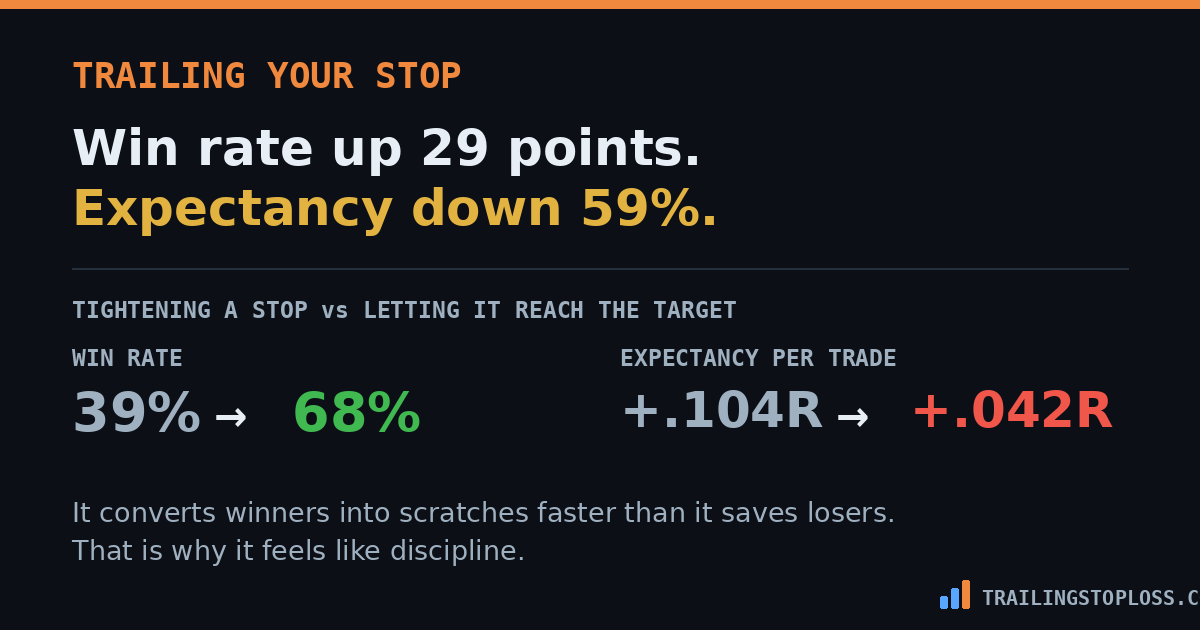
Tight trailing takes a 39% win rate to 68% and cuts expectancy by 59%.
How this was tested
Same entries, same price paths, only the exit rule changed. Forty thousand simulated trades, with price modeled as a path rather than a coin flip, so the simulation actually knows the difference between a trade that went to +1.8R and came back versus one that went straight to the stop. One R is your stop distance, and the drift is calibrated so the plain rule — fixed stop, 2R target — produces a realistic 39% win rate.
| Exit rule | Expectancy | Win rate | Scratched | vs fixed |
|---|---|---|---|---|
| Fixed stop + 2R target | +0.104R | 39% | 0% | — |
| Breakeven stop at +1R | +0.088R | 29% | 23% | −15% |
| Trail 1.5R (loose) | +0.074R | 36% | 2% | −29% |
| Trail 1.0R | +0.056R | 40% | 4% | −46% |
| Trail 0.5R (tight) | +0.045R | 59% | 8% | −57% |
| Trail 0.25R (very tight) | +0.042R | 68% | 0% | −59% |
Read the last two columns together. The rule with the best win rate on the board is the worst earner on the board, and it isn’t close. Tightening your stop as price moves your way converts winners into scratches faster than it saves losers, and the second effect is smaller than everyone assumes because a trade that’s going to hit your stop usually does so without first paying you 1R.
Why it feels so right
Because the feedback is immediate, visible and emotionally load-bearing.
When you trail a stop out and price then collapses, you get a vivid memory of money saved. When you trail a stop out and price then runs to your original target without you, you get a vague sense of having been unlucky. Those two outcomes are not weighted equally in memory, and only one of them gets retold.
The win rate does the rest. Going from 39% to 68% winners changes the entire texture of your trading day — fewer losses, more frequent small wins, a P&L that spends more time green. Given that losses register roughly twice as strongly as equivalent gains, a rule that nearly halves how often you experience one is enormously appealing. It’s also costing you most of your edge.
Moving to breakeven at +1R looks like free insurance: worst case you’re flat. In the simulation it costs 15% of expectancy and ends 23% of all trades at exactly zero — nearly a quarter of your year spent on trades that went your way, came back to your entry, and then frequently went on to do what you expected without you. You didn’t remove risk. You moved it from your account to your results.
The one version that works
There is a trailing rule that beats leaving the trade alone, and it’s the opposite of what people mean by trailing. Remove the target entirely and widen the trail.
| Trail distance, no target | Expectancy | Win rate | Average winner |
|---|---|---|---|
| 0.5R | +0.046R | 59% | +0.63R |
| 1.0R | +0.069R | 40% | +1.15R |
| 1.5R | +0.108R | 36% | +1.69R |
| 2.0R | +0.134R | 35% | +1.98R |
| 2.5R | +0.144R | 36% | +2.07R |
| 3.0R | +0.147R | 36% | +2.08R |
It improves steadily as the trail widens and plateaus around 2.5R, which is the signature of a structural effect rather than a curve fit. At 2.5R it returns +0.144R against the fixed rule’s +0.104R, a 38% improvement.
And the source of that gain is narrow. The median trade under this rule is −0.88R — most of them lose. The entire edge sits in the right tail:
- Top 10% of trades: +2.68R and up
- Top 1%: +5.12R and up
- Best single trade: +9.34R
- The top 5% of trades produce 32% of all gross profit
A 2R target caps every one of those at 2R. That’s the whole finding: the target isn’t protecting you from anything, it’s amputating the third of your profit that arrives in a handful of trades a year.
So what should you actually do
The answer depends on one thing: whether your approach can hold a trade long enough for the tail to arrive.
If you swing or hold for hours, consider dropping the target and using a wide trail. Around 2 to 3R of give, armed only after the trade is meaningfully in profit. You’ll feel worse — your win rate falls and you’ll routinely watch open profit halve before an exit. You’ll also stop capping the trades that pay for the year.
If you scalp, keep the fixed target and leave the stop alone. A 2.5R trail is a swing rule. On a continuation scalp with a twenty-to-ninety-minute hold, sitting through a 2.5R retracement to chase a tail that shows up once a quarter isn’t compatible with the way you trade, and the cure is worse than the disease. For you the finding is narrower and simpler: don’t move to breakeven, don’t tighten as you go, and let the trade reach the target or the stop you set when you had no money on the line.
Either way, stop trailing to protect profit. That’s the version that never wins in any configuration tested. Protecting an open profit is a feeling, not a strategy — the money isn’t yours until the trade closes, and treating it as yours is what makes you manage it badly.
None of this matters much next to position size. A trader with a mediocre exit rule and 25 losing trades of room in their drawdown outlasts a trader with the optimal exit rule and ten. Exits are worth a few percent of expectancy; sizing decides whether you’re around to collect it.
The honest limits
This models price as having no memory. Real markets mean-revert at levels and trend in runs. If your setup genuinely identifies a level price struggles at, a target there beats what this simulation says, because the model can’t know about your level. The results argue against trailing in general; they don’t argue against a target you placed for a specific structural reason.
The drift is calibrated, not measured. It was tuned to produce a 39% win rate at 2:1 on the plain rule, which is realistic for a working method but isn’t your method. Your own fill data beats any of this — most platforms will show you the maximum favorable excursion on every trade, and comparing that against where you actually exited answers this question for your trading specifically.
And the wide-trail result demands patience most people don’t have. A median trade of −0.88R means you’ll lose on most of them while waiting for the tail. That is psychologically much harder than a 68% win rate, which is precisely why the worse rule is the popular one.
The short version
Across 40,000 simulated trades on identical price paths with only the exit rule changing, every trailing variant that kept a target lost money against simply letting the trade reach the target or the original stop. Tightening as you go is worst: a 0.25R trail raises the win rate from 39% to 68% while cutting expectancy 59%, because it converts winners into scratches faster than it saves losers. A breakeven stop at +1R costs 15% and ends 23% of trades at exactly zero. The single rule that beats leaving the trade alone is the opposite of normal trailing — remove the target and widen the trail to 2.5R, returning +0.144R against the fixed rule’s +0.104R, with the entire gain coming from a right tail where the top 5% of trades produce 32% of gross profit. That’s a swing rule, not a scalping one. If you hold for hours, drop the target and widen; if you scalp, keep the target and leave the stop where you set it. Either way, stop trailing to protect an open profit that isn’t yours until the trade closes.
Frequently asked questions
Should you trail your stop loss when in profit?
Not to protect profit. Across 40,000 simulated trades on identical price paths, every trailing rule that kept a profit target earned less than simply letting the trade reach the target or the original stop — and tighter trails performed worse. The one exception is a wide trail used instead of a target rather than alongside it, at around 2.5R, which beat the fixed rule by 38%. Tightening a stop as price moves your way is the version that never wins.
Why does trailing a stop increase my win rate but lose money?
Because it converts winners into scratches faster than it saves losers. A trade heading for your stop usually gets there without first paying you 1R, so the protection triggers less often than it feels like it does — while normal retracement inside a winning move trips a tight trail constantly. In simulation a 0.25R trail raised the win rate from 39% to 68% and cut expectancy by 59%. More frequent small wins, substantially less money.
Is moving your stop to breakeven a good idea?
It costs about 15% of expectancy and ends roughly 23% of all trades at exactly zero — trades that went your way, returned to your entry, and often continued without you. It feels like free insurance because the worst case appears to be flat, but you haven’t removed risk, you’ve moved it out of your account and into your results. The trades it rescues are outnumbered by the ones it interrupts.
What is the best trailing stop distance?
If you use one at all, wide — around 2 to 3R, with no fixed target, armed only once the trade is meaningfully in profit. Expectancy improved steadily from 0.5R out to about 2.5R and then plateaued, which suggests a structural effect rather than a fitted result. Tight trails of 0.5R or less performed worst of every rule tested despite producing the highest win rates.
Should scalpers use trailing stops?
Generally no. The only trailing rule that outperformed requires dropping the target and sitting through retracements of 2 to 3R to capture rare large moves — the top 5% of trades carried 32% of gross profit. On a hold of twenty to ninety minutes that isn’t practical, and tight trailing performs worse than doing nothing. For a scalper the useful finding is narrower: don’t move to breakeven, don’t tighten as the trade progresses, and let it reach the target or the stop set before there was money on the line.
Related on this site: why you’ll never get comfortable with losing · watching your P&L costs you money · the day after your best day · picking an account size from your stop
Figures come from 40,000 simulated trades using modeled price paths with drift calibrated to a 39% win rate at 2:1 on a fixed stop-and-target rule; one R equals the initial stop distance. The model assumes price has no memory, so it cannot account for mean reversion at a level or momentum in a trend — a target placed for a specific structural reason is not what these results argue against. Your own maximum-favorable-excursion data is a better guide than any simulation. Nothing here is financial advice. Futures trading carries substantial risk of loss.