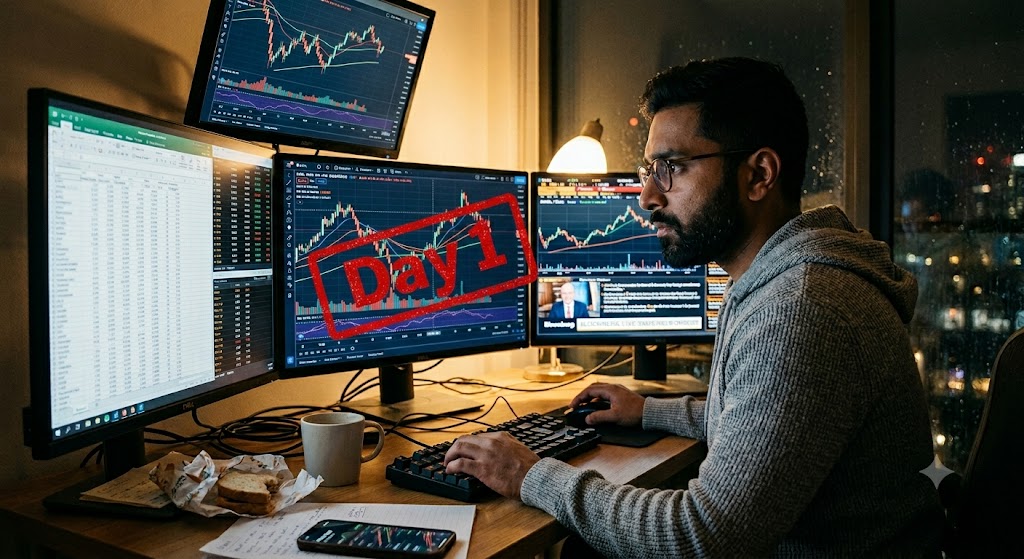
One Trade a Day, Day 1: An NQ Long, a Whipsaw, and a Clean Stop-Out
Day one of the One Trade a Day challenge did not go as planned. It went, instead, exactly the way trading goes about 40% of the time: a setup that looked fine, a long that was green, then red, then green, then stopped. No revenge trade. No moved stop. One trade, one loss, rules intact. That last part is the only score that matters on Day 1.
If you missed the setup for this whole experiment, the rules are laid out in Part 1 of the One Trade a Day NQ challenge: one NQ trade per day maximum, nothing before 9:00 AM ET, a fixed $500 risk targeting a 1:3 ($1,500) reward, stop to breakeven only once price travels 60% of the way to target, and a continuation entry that requires a pullback into a level plus a rejection before I touch the button. The whole point is to grade discipline, not P&L. Good thing, too.
Why I Switched to an Alpha Futures 50K Before I Placed a Single Trade
The plan in Part 1 was a Blue Guardian 100K. The plan changed. Blue Guardian has been showing some cracks on the payout side lately, and after personally living through the FundingTicks wind-down — the firm I had roughly five funded accounts sitting with when it decided rules were retroactive and then quietly vanished — I have a low tolerance for handing an evaluation fee to a firm I’m not confident will still be standing when it’s time to get paid. So I took my own advice from the True Cost hub and chose differently.
I went with a 50K Premium account from Alpha Futures instead. The Premium plan replaced the old Standard plan on May 1, 2026, and the 50K runs $79/month with a $3,000 profit target, a 4% ($2,000) max loss, and a 50.5% consistency rule on the evaluation. (That Alpha Futures link is an affiliate link — if you sign up through it I may earn a commission at no extra cost to you. It does not change which firms I trust or flag.) Alpha Futures Help Center
The reason a 50K works here when Part 1 argued for a 100K is the drawdown mechanic. Alpha uses an end-of-day trailing max loss limit, not an intraday one — the floor only moves on the daily close, so an ugly open doesn’t end your account the way it would at an intraday-trailing firm. My floor opened at $48,000, a $2,000 cushion below the $50,000 start, and it only ratchets up after a green daily close. For a continuation scalper who occasionally has to sit through a noisy session, that EOD structure is the entire reason I was comfortable sizing down. Alpha Futures Help Center
Sign up for an Alpha Futures account here if you want to follow along on the same firm. And if you want the apples-to-apples fee math against every other futures firm before you buy anything, the futures prop firm True Cost breakdown exists for exactly that.
The Setup: Long After the Bearish 8 AM Candle
Shortly after 9:00 AM CST, price was pressing up near the 30,937 high. The 8:00 candle had closed bearish, and my read was a continuation push back into the high after the pullback — pullback into level, rejection wick, the things the rules ask for. So I went long, risking my fixed $500. On NQ at $20 per point, that $500 is a 25-point stop, with the 1:3 target sitting 75 points away just under the prior high. CME Group

What happened next is the trade in one sentence: up, then down, then up again, then gone. Price ticked into profit, but never the 45 points it needed to arm the breakeven stop, so the rule never fired. It pulled back toward my stop without quite tagging it, bounced one more time to get my hopes up, and then the whole high rolled over and took the stop out cleanly on the way down to 30,560 and beyond. Textbook chop into a failed continuation.
To be clear about what “stuck to my rules” actually means here, because it is easy to say and easy to fake: I did not move the stop. I did not add size when it dipped. I did not flip short out of spite when it rolled over and proved my long wrong. The 60%-to-breakeven rule never triggered because price never earned it, so the original stop did the one job a stop has. That is a boring sentence. Boring is the goal.
Day 1 trade ticket
The Damage: Where the Account Stands After Day 1
The full stop plus round-trip commissions came to $505.76. That drops equity to $49,494.24 and leaves $1,494.24 of room before the drawdown floor at $48,000. In other words: I used about a quarter of my total cushion on day one, which is exactly the kind of sentence that makes the breakeven rule and the one-trade cap feel less like restrictions and more like the only thing standing between me and a $228 lesson in account math.


Open P&L is $0.00 because the trade is closed and I am done for the day. That is the part most people scrolling past a red day will skip: the discipline isn’t the entry, it’s the eight hours afterward where the screen is still open, NQ is still moving, and the rules say I’m finished. One trade a day means the second-best trade of the day is no trade at all.
What Actually Went Right on a Red Day
Process and outcome are different scoreboards, and on Day 1 they disagreed. The outcome scoreboard says −$505.76. The process scoreboard — the only one this challenge grades — says: valid setup per the rules, fixed risk respected, stop honored, no second trade, no revenge, no moved stop, position flattened, day closed. That is a passing day on the metric that compounds over twenty of them. Losing trades with clean process are the cost of doing business; winning trades with broken process are the thing that eventually ends accounts.
If you’re newer to this and the sizing math is the part that’s fuzzy, that’s the genuinely important thing to nail before the psychology even matters. The free position-size and risk-of-ruin calculators are there so a “fixed $500 risk” is an actual number of contracts and points, not a vibe. A stop you can’t size correctly isn’t a stop.
Running scoreboard
| Day | Setup | Direction | Result | P&L | Rules followed? |
|---|---|---|---|---|---|
| 1 | Continuation long into 30,937 | Long | Stopped out | −$505.76 | Yes |
Nineteen days to go. The account is down half a percent and still has 75% of its buffer. Day 2 starts with the same single bullet and the same rules. See you there.