▸ Trading Psychology · Risk Management
Should You Move Your Stop to Break-Even?
You know the sequence. The trade goes your way, you slide the stop up to your entry, you exhale — “risk-free now” — and then price drifts back, taps your break-even by a tick or two, and takes you out flat. Then it turns around and walks straight to the target you originally picked, without you. You didn’t lose money. You just watched three R evaporate while feeling responsible. Here’s the uncomfortable part: that isn’t bad luck. It’s structurally predictable, and once you see why, you’ll never move a stop to break-even for the same reason again.
The one level on the chart that means nothing
Start with the thing nobody says out loud. Every level worth putting a stop behind — a swing low, a prior day’s high, a value area edge — is a level that thousands of other participants can see. That’s precisely why it works: enough traders act at the same place to make it meaningful. Your entry price has none of that. You are the only person on earth who knows where you got filled. (Daily Price Action: the market doesn’t know where you entered)
So when you move your stop to break-even, you are relocating your invalidation point from a level the market respects to a level that exists only in your account statement. A break-even stop getting hit tells you nothing about whether your setup is still valid, because the market didn’t reject anything — it just wandered back through a number that’s meaningful to you and to nobody else. (Daily Price Action: arbitrary vs strategic levels)
And there’s a tell that gives away what’s really going on. You could move your stop ten ticks above your entry, or ten below. Both would be equally arbitrary. But traders overwhelmingly move it to the exact entry price — because the goal isn’t protecting capital, it’s protecting the ego from the word “loss.” A trade that scratches doesn’t sting. That’s the whole appeal, and it’s worth being honest that it’s a feeling, not a strategy. (Daily Price Action: protecting the ego, not the capital)
Why it keeps happening to you
Now the mechanical reason your stop keeps getting tapped right before the run. When you placed your original stop, you put it beyond the level where your idea would be wrong — below the swing low, outside a 2×ATR buffer, wherever your invalidation lives. The entire space between your entry and that stop is the room you deliberately gave the trade to breathe. It is, by construction, the zone of normal noise your stop was designed to survive. (MyFundedCapital: the stop belongs at invalidation, ATR buffers)
Move your stop to break-even and you have just planted it in the middle of that zone. You didn’t reduce your risk — you moved your exit inside the noise band you’d already decided you needed to tolerate. Then you act surprised when noise takes you out. A stop sitting exactly at entry gets triggered by ordinary fluctuation, which is why professionals who do use break-even stops almost always add a buffer rather than parking on the number itself. (Breakeven definition: exact-entry stops get triggered by normal fluctuation)
The trade you’re actually making
Strip away the vibes and a break-even rule is a bet on the relative frequency of two outcomes. It only matters in two scenarios — and in the other two it does precisely nothing. Here’s every path a trade can take, for a trader running a 1:3 risk-reward. (Unger Academy: BE guarantees a scratch and forfeits the run)
| What price does | No BE stop | With BE at +1R | What the BE rule did |
|---|---|---|---|
| Goes straight against you to your stop | −1R | −1R | Nothing. The stop never armed. BE cannot save you from a straight loser. |
| Runs +1R, then reverses all the way through entry to your stop | −1R | 0R | Saves you 1R. This is the case the rule exists for. |
| Runs +1R, wicks back through entry, never hits your stop, then runs to target | +3R | 0R | Costs you 3R. The one you keep living. |
| Runs +1R and continues cleanly to target | +3R | +3R | Nothing. The stop was never threatened. |
Look at rows two and three, because they are the entire argument. The break-even stop saves you 1R when it works and costs you 3R when it doesn’t. At a 1:3 reward-to-risk, the reversal scenario has to occur roughly three times as often as the shakeout-then-run scenario just for the rule to break even on itself. That’s not a philosophical question. It’s an empirical one, and it’s specific to your strategy, your instrument, and your timeframe.
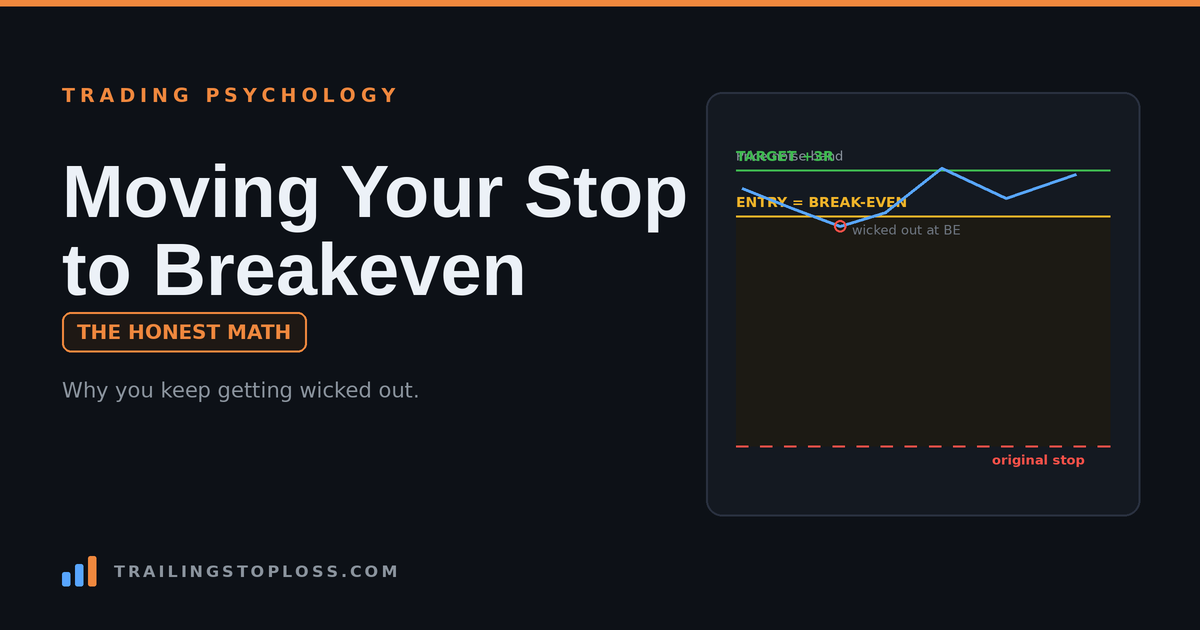
The trouble is that row three is the more common one for intraday traders, for exactly the reason the diagram shows: the pullback zone your break-even sits in is the zone your original stop was explicitly built to absorb. Move the stop mechanically to an arbitrary distance without checking whether structure actually shifted, and you leave the order exposed. A premature adjustment doesn’t lower your losses so much as it converts a pile of would-be winners into a pile of flat $0 results. (ATAS: premature adjustment spikes flat results, distorts expectancy)
What it does to your expectancy
Run the arithmetic and the damage is subtle, which is why it survives. An aggressive break-even rule does two things at once: it cuts your realised loss count (looks great), and it converts winners into scratches while shrinking your average win, because you’re repeatedly shaken out of trades that were about to work. Take a strategy with a positive expectancy of about $60 per trade, apply an aggressive BE rule, and you can watch expectancy fall to roughly $40 — while your equity curve looks smoother and your loss rate looks better. You optimised the metrics you can see and quietly taxed the one that pays you. (ATAS: expectancy falls from $60 to $40 under an aggressive BE rule)
Triggering break-evens too frequently degrades the mathematical expectation of your winning trades — that’s the mechanism, stated plainly. And it echoes what traders find when they actually test it: one trader who spent years moving his stop to break-even as early as he “reasonably could” reported that when he finally stopped, his win rate ticked down slightly, exactly as you’d predict, while his overall profitability went up. Fewer wins, bigger wins, more money. (TradingView: frequent BE triggers hurt mathematical expectation) (BabyPips: win rate down slightly, profit up)
If that sounds familiar, it should. It’s the disposition effect wearing a hard hat and a safety vest. You’re taking the certain, comfortable outcome on a winning position — and anchoring the decision to your entry price, a number the market has never heard of.
The honest case for it
Now the other side, because “never move to break-even” is lazy advice too. There are real, defensible reasons to do it — they’re just narrower than most traders assume.
✅ When break-even earns its keepThe strongest argument isn’t mathematical, it’s behavioural. If knowing the trade can’t lose is what lets you actually hold the runner to target instead of bailing at +0.8R, then a rule that costs you a little expectancy may buy you a lot of execution. Not every decision in trading has to be profit-maximising — giving up a slice of edge for genuine mental clarity is a legitimate trade, as long as you know you’re making it. (Trading Heroes: trading a little profit for mental clarity)
Beyond the psychology, four situations hold up under scrutiny. Higher timeframes — on a 4-hour chart or above, your break-even level sits far enough from price that ordinary intraday chop is unlikely to reach it, which is the whole problem neutralised. Pre-news — flattening directional risk into an FOMC print or an inventory number is a decision about event risk, not about your entry price. After a partial scale-out — once you’ve booked profit on part of the position, moving the remainder to break-even genuinely does create a free-roll rather than an illusion of one. And with a trailing stop attached — strategies that keep trailing can recoup on their big winners what the break-even rule costs them on the shakeouts. (Trading Heroes: which strategies benefit) (TIOmarkets: the legitimate BE triggers)
And one more that matters enormously to this audience and gets almost no airtime: if you’re on a prop firm’s trailing drawdown, a scratch is worth more than it looks. A −1R loss doesn’t just cost you money — on an intraday trailing max-loss, it drags your breach threshold down with it. Converting some of those into flat results protects the buffer that keeps your account alive. That is a real, rational reason to accept lower expectancy in exchange for survival. Just be clear-eyed that you’re buying survival with edge, not getting both for free. (MyFundedCapital: the stop as a prop-firm risk parameter)
The honest case against it
That last point is worth sitting with. Moving a stop for non-technical reasons is an emotional decision no matter how responsible it feels, and emotional decisions are the ones that get you in trouble — whether they’re moving a stop away from price or dragging it toward you. (Daily Price Action: non-technical stop moves are emotional decisions)
What to do instead
Here’s the reframe that fixes it: don’t move your stop to break-even. Move it to the next structural level — or leave it alone. Break-even is a level about you. Structure is a level about the market, and the market is the only counterparty in this trade. (Daily Price Action: move to strategic, not arbitrary, levels)
- Trail behind structure, not behind your fill. If price has printed a new higher low, your invalidation genuinely moved — put the stop below that. If no new structure has formed, nothing has changed and neither should your stop. This is a trailing stop with a reason, and it’s the only kind worth using.
- If you must use break-even, add a buffer. Sitting exactly on your entry is the ego talking. Place it a few ticks beyond, enough to clear commissions and spread — that’s true break-even, and it also nudges the level slightly out of the tightest noise.
- Trigger it later than feels comfortable. A 1R trigger is popular because it’s tidy, not because it’s optimal. On intraday charts, 1R is often still deep inside the noise band. Test 2R, or trigger only when price closes beyond a structural level.
- Scale out instead. Take partial profit at 1R and let the remainder run against the original stop. You bank the psychological relief you were chasing without surrendering the entire tail of the distribution.
- Apply it identically to every trade. Moving to break-even on some trades and not others produces results you cannot interpret, because you’ve mixed two strategies and can’t tell which one is paying. Consistency is what makes the data mean anything.
- Then backtest it both ways. Run your strategy over 100+ trades with the break-even rule and without it. Compare expectancy and profit factor, not win rate. The answer is in your own data, and nobody else’s opinion — including this article’s — can override it.
🔍 The two-column log that settles itFor the next month, every time a break-even stop takes you out, write down one thing: did price subsequently reach your original target without ever touching your original stop? Tally the yes column. If yes is winning, your break-even rule is not protecting you — it’s billing you. That’s not a feeling. That’s your own trade log telling you the frequency of row three.
The bottom line
Moving your stop to break-even is not risk management. It’s a bet that reversals-through-your-entry happen at least three times as often as shakeouts-then-runs — and for most intraday traders, on most instruments, that bet is a loser, because you’re placing your exit in the exact noise your original stop existed to survive. The move survives anyway because it feels like discipline and pays out immediately in relief.
There are legitimate exceptions: higher timeframes, pre-news, after a partial, and the very real case of protecting a prop firm’s trailing drawdown. But if the reason you’re reaching for that stop is that green P&L is making you nervous, you don’t have a stop-loss problem — you have an entry-price anchor, and the fix is to trail behind structure or do nothing at all. Your stop belongs where your idea is wrong. Your idea isn’t wrong just because price came back to say hello. (Daily Price Action: let the market tell you when to move it)
Do it with rules instead of nerves: pre-commit your stop and target with the Hard-Stop Plan Builder, map the R:R before you enter with the Stop-Loss & R:R Visualizer, and log every break-even stop-out (and what price did next) on the P&L Calendar. If you’re managing a trailing drawdown, our prop firm drawdown breakdown explains which structures punish this most.
FAQ
Should you move your stop loss to break-even?
Usually not, and not reflexively. A break-even stop sits inside the noise band your original stop was designed to tolerate, so it gets triggered by ordinary fluctuation that never invalidated your setup. It saves 1R when price reverses to your stop, but forfeits your entire target when price wicks your entry and then runs. Move to structure instead, or leave the stop alone.
Why does price always hit my break-even stop and then go to my target?
Because break-even sits between your entry and your original stop — which is precisely the zone of normal noise you gave the trade when you placed that original stop. Your original stop was set beyond invalidation; break-even is set inside it. Getting tapped there and then watching the move happen isn’t bad luck, it’s the predictable consequence of moving your exit into the chop.
Does moving to break-even hurt your expectancy?
Frequently, yes. It reduces your realised loss count while converting would-be winners into flat results and shrinking your average win. Worked examples show an aggressive break-even rule dropping expectancy from roughly $60 to $40 per trade. Traders who stop doing it typically see their win rate fall slightly and their overall profitability rise.
When is moving your stop to break-even actually a good idea?
On higher timeframes where break-even sits well outside intraday noise; ahead of high-impact news; after scaling out a partial position, which makes the remainder a genuine free-roll; alongside a trailing stop that recoups the cost on big winners; and when protecting a prop firm’s trailing drawdown, where a scratch preserves your buffer. In that last case you’re deliberately paying expectancy for survival.
Is a break-even trade really risk-free?
No. A stop at your exact entry price still leaves you paying commissions, spread, and any slippage — so “break-even on price” isn’t break-even on money. True break-even sits slightly beyond your entry, far enough to cover costs. You also pay the opportunity cost of the capital and the setup, neither of which shows up on the ticket.
TrailingStopLoss publishes independent, funded-trader analysis of prop firms, strategy, and trading psychology. Educational content only — not financial advice. Backtest any rule change on your own strategy before trading it. Trading futures involves substantial risk of loss.