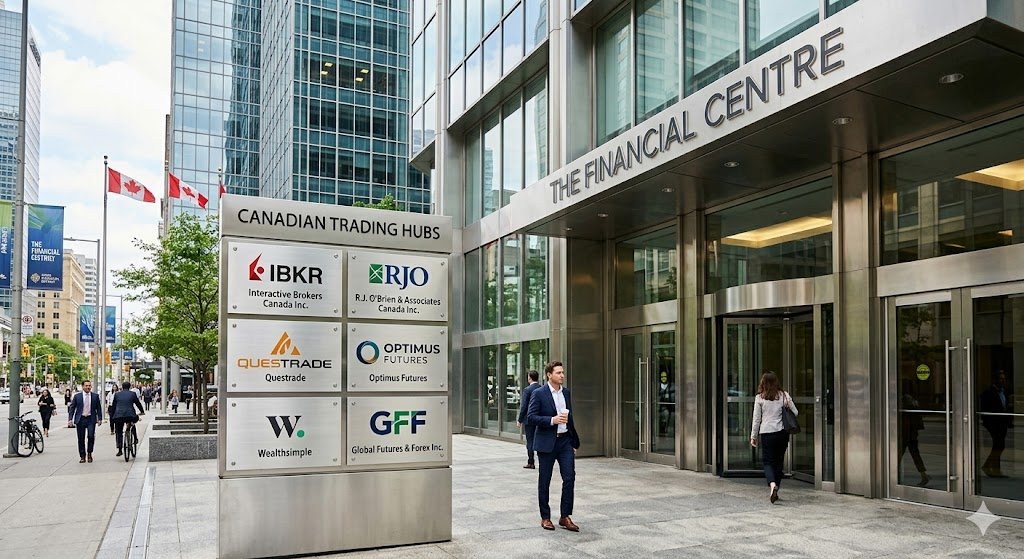
Top Canadian Futures Brokerages 2026: Who's Worth Trading With and What You Can Actually Buy
Picking a futures broker in Canada is a special kind of fun — it's like a U.S. trader's broker shortlist, except half the names on it politely tell you they don't take Canadians, and the regulator made the others quietly change their logos last year. Here's the actual 2026 picture: who you can open an account with, what contracts you can trade, and why "just use NinjaTrader" isn't the answer Canadians get.
The Regulatory Backdrop: CIRO, CIPF, and Why It Matters
Canadian futures trading runs under the watchful eye of the Canadian Investment Regulatory Organization (CIRO), the self-regulatory body created when IIROC and the MFDA merged in 2023. CIRO oversees investment dealers, futures commission merchants, and most retail-facing brokerages, and any broker offering futures to Canadians is expected to be a CIRO member, with client assets protected by the Canadian Investor Protection Fund (CIPF) up to $1 million per account category. [Source: Good Money Guide]
This regulatory wall is the single biggest reason Canadians can't just sign up for AMP Futures, NinjaTrader Brokerage, or Tradovate the way Americans can. To legally solicit Canadian retail clients, a U.S. broker has to either register with CIRO (expensive) or partner with a Canadian-registered firm — and many simply decide the paperwork isn't worth it, especially for residents of Ontario and British Columbia where provincial securities commissions add extra layers. [Source: Elite Trader forum discussion]
The Canadian Futures Ecosystem at a Glance
The Top Canadian Futures Brokerages in 2026
1. Interactive Brokers Canada
CIRO Member CIPF Covered
If there's a default answer for "where should a Canadian trade futures," this is it. Interactive Brokers Canada Inc. is a full CIRO member, CIPF-protected, and gives access to over 30 global futures exchanges — CME, CBOT, NYMEX, COMEX, Eurex, ICE, plus the Montreal Exchange — all from one TWS login. Commissions on futures run roughly $0.25 to $0.85 per contract for the institutional-style tier, which is genuinely cheap for what you're getting. The trade-off is that IBKR has notoriously high day-trading margins compared to U.S. specialist FCMs (think $12,000+ overnight on an ES contract versus $500 at AMP), and the TWS platform has the user interface of a 2008 nuclear submarine — powerful, but you'll spend a weekend learning it. [Source: BrokerChooser]
2. Questrade
CIRO Member CIPF Covered Limited Futures
Toronto-based Questrade is Canada's largest independent online broker with over $50 billion in AUA, full CIRO regulation, CIPF membership, and a focus on registered accounts like TFSA, RRSP, RESP, and FHSA. It's a Canadian household name for stocks and ETFs, but as a pure futures shop it underwhelms — some independent reviews note Questrade does not offer direct futures trading on its retail platform, instead steering active derivatives traders toward CFDs and options. For an all-in-one Canadian-domiciled solution where futures is a side dish rather than the main course, it works; for serious futures-first trading, you'll want something else. [Source: TradersUnion Questrade review]
3. Wealthsimple
CIRO Member CIPF Covered Event Contracts Only
Wealthsimple isn't a traditional futures broker, but it earns a mention because in March 2026 CIRO authorized it to facilitate trading in a limited set of event contracts — yes/no forecast contracts on economic indicators, climate trends, and financial markets, traded and cleared through CFTC-registered U.S. exchanges like ForecastEx. These aren't classic futures, but they're derivative event contracts of a sort, and Wealthsimple is one of only two Canadian dealers approved to offer them alongside Interactive Brokers. Real futures? Not yet. But if you wanted to bet on "will the price of gold exceed US$5,000 by April 30" from a Canadian-regulated app, this is your option. [Source: Investment Executive]
4. RJ O'Brien Canada
CIRO Member CIPF Covered
RJ O'Brien is one of the oldest names in U.S. futures, and its Canadian arm is a registered futures commission merchant under CIRO. It's traditionally been more institutional and commodity-focused (think actual farmers hedging canola and cattle), but it does take retail accounts and supports platforms like CTS T4. It's a solid, no-nonsense choice if you're trading agricultural commodities or want a dedicated FCM rather than a generalist like IBKR. Margins are typically lower than IB's overnight rates because RJO is a specialist clearing firm. [Source: Elite Trader broker discussion]
5. Optimus Futures (via Phillip Capital / Ironbeam)
U.S. Introducing Broker Not CIRO / Not CIPF
Optimus is a Florida-based introducing broker that accepts non-solicited self-directed Canadian futures traders, clearing through Phillip Capital or Ironbeam. The appeal is what made every U.S. day trader love specialist FCMs in the first place: intraday margins as low as $400 to $500 per E-mini, support for serious platforms like Sierra Chart, Bookmap, MotiveWave, and TradingView, and commissions in the $0.25-$1.20 per side range. The catch: there's no Canadian regulatory protection, your funds are covered by U.S. SIPC rules rather than CIPF, and historically Ontario and BC residents have hit availability snags. You're trading a regulatory umbrella for cost and tooling. [Source: Optimus Futures support]
6. GFF Brokers (Ironbeam Clearing)
U.S. Introducing Broker Not CIRO / Not CIPF
GFF Brokers, formerly known as Global Futures, is one of the few U.S. introducing brokers that maintains an active Canadian-friendly pipeline through Ironbeam clearing. NinjaTrader's own forum recommends GFF as one of the two ways Canadians can use NinjaTrader for futures (the other being Interactive Brokers). Day-trade margins are aggressive, withdrawal fees aren't cheap (often $40-50 per wire), and again you're outside the Canadian regulatory perimeter. It's a popular choice for serious Canadian futures day traders who want NinjaTrader connectivity without the IBKR margin penalty. [Source: NinjaTrader support forum]
Side-by-Side Comparison
| Broker | Regulator | Best For | Approx. Commission | Markets |
|---|---|---|---|---|
| Interactive Brokers Canada | CIRO / CIPF | Global multi-asset | $0.25–$0.85/contract | 30+ exchanges |
| Questrade | CIRO / CIPF | Canadian registered accounts | Limited futures offering | Mostly equities, options, CFDs |
| Wealthsimple | CIRO / CIPF | Event/forecast contracts | Variable | ForecastEx contracts only |
| RJ O'Brien Canada | CIRO / CIPF | Commodities, hedgers | Negotiable | CME, ICE, MX, CBOT |
| Optimus Futures | NFA / U.S. | Day traders, low margin | $0.25–$1.20/side | CME, CBOT, NYMEX, COMEX |
| GFF Brokers | NFA / U.S. | NinjaTrader users | $0.50–$1.00/side | CME, CBOT, NYMEX, COMEX |
What Instruments Can You Actually Trade?
Once you're inside a Canadian-accessible brokerage account, the question becomes what you can put trades on. The answer is bigger than most newcomers expect — you're effectively trading two universes simultaneously: a small Canadian-listed one and a sprawling U.S. one. The Canadian one is centered on the Montreal Exchange (MX), a subsidiary of TMX Group, which is the country's only listed derivatives exchange and operates under CIRO and CSA oversight. [Source: Good Money Guide regulatory overview]
Canadian-Listed Futures (Montreal Exchange)
The Montreal Exchange's futures product list is concentrated but covers most of what an institutional Canadian portfolio manager needs. The flagship products are the S&P/TSX 60 Index Standard Futures (SXF), the S&P/TSX 60 Index Mini Futures (SXM), and a suite of interest rate products including the Ten-Year Government of Canada Bond Futures (CGB) and 30-Year Government of Canada Bond Futures (LGB). There are also Three-Month CORRA Futures (which replaced the old BAX Banker's Acceptance contracts after the BAX was officially delisted), share futures on individual Canadian equities, sector index futures, and ESG-themed variants like the S&P/TSX 60 ESG Index Futures (SEG). [Source: TMX Montreal Exchange futures list]
| Symbol | Contract | Multiplier | Use Case |
|---|---|---|---|
| SXF | S&P/TSX 60 Index Standard | C$200 × Index | Canadian large-cap exposure |
| SXM | S&P/TSX 60 Index Mini | C$50 × Index | Smaller-size index hedge |
| CGB | 10-Year Gov't of Canada Bond | C$100,000 face | Canadian rates / duration |
| LGB | 30-Year Gov't of Canada Bond | C$100,000 face | Long-end Canadian rates |
| CGZ / CGF | 2-Yr / 5-Yr Canada Bond | C$200,000 / C$100,000 | Short and belly curve trades |
| CRA | 3-Month CORRA Futures | C$2,500 / bp | Canadian short-term rates |
| SEG / SCG | S&P/TSX 60 / Composite ESG | Index-based | ESG-tilted index exposure |
| Share Futures | Single-stock futures | 100 shares | Synthetic equity, hedging |
The SXF specifically is the most liquid futures contract listed in Canada — it's cash-settled, quarterly expiry (March, June, September, December), and the official benchmark vehicle for hedging Canadian equity exposure. Margins are set by the Canadian Derivatives Clearing Corporation (CDCC), which acts as the central counterparty for every Montreal Exchange contract, so your counterparty risk on an MX trade is CDCC rather than the broker. [Source: Montreal Exchange SXF spec sheet]
U.S.-Listed Futures (CME Group and ICE)
Here's the open secret: most active Canadian futures traders barely touch Montreal Exchange products. They trade U.S. contracts. Through a Canadian-registered broker like Interactive Brokers Canada — or a U.S. introducing broker like Optimus — Canadian traders get full access to the deepest, most liquid futures markets in the world. That means CME Group's equity index suite (ES, NQ, YM, RTY and their micros MES, MNQ, MYM, M2K), NYMEX energy contracts (CL crude oil, NG natural gas, RB gasoline), COMEX metals (GC gold, SI silver, HG copper), CBOT agricultural products (ZC corn, ZS soybeans, ZW wheat) and Treasury futures (ZN, ZB, ZF), plus FX futures like the 6E euro and 6J yen. [Source: Investing in the Web Canadian broker guide]
Trading ES, NQ, YM, and GC from Canada
These four contracts — the E-mini S&P 500 (ES), E-mini Nasdaq-100 (NQ), E-mini Dow (YM), and COMEX Gold (GC) — account for the overwhelming majority of futures volume traded by Canadian retail accounts. They're all CME Group products, they all settle in U.S. dollars, and yes, every one of them is fully accessible from a Canadian-resident account at Interactive Brokers Canada or any of the U.S. introducing brokers that take Canadian clients. There's no special permission needed beyond standard futures trading approval and adequate margin in the account. [Source: BrokerChooser E-mini Dow brokers Canada]
Contract Specs You Need to Know Cold
| Contract | Underlying | Multiplier | Tick Size | Tick Value | Exchange |
|---|---|---|---|---|---|
| ES | S&P 500 | $50 × Index | 0.25 pts | $12.50 | CME |
| NQ | Nasdaq-100 | $20 × Index | 0.25 pts | $5.00 | CME |
| YM | Dow Jones Industrial Average | $5 × Index | 1.00 pt | $5.00 | CBOT |
| GC | Gold (100 troy oz) | 100 oz × Price | $0.10 | $10.00 | COMEX |
| MES | S&P 500 (micro) | $5 × Index | 0.25 pts | $1.25 | CME |
| MNQ | Nasdaq-100 (micro) | $2 × Index | 0.25 pts | $0.50 | CME |
| MYM | Dow (micro) | $0.50 × Index | 1.00 pt | $0.50 | CBOT |
| MGC | Gold (10 troy oz, micro) | 10 oz × Price | $0.10 | $1.00 | COMEX |
The numbers matter because they translate directly into your risk per trade. A 10-point move on NQ at $5 per tick (40 ticks × $5) is $200 per contract; the same 10 points on ES at $12.50 per tick (40 ticks × $12.50) is $500. NQ moves faster in point terms — a typical day might see 200-400 points of range on NQ versus 40-80 on ES — but the lower per-tick cost actually lets you set tighter stops in dollar terms. This is why NQ is the favorite of active intraday scalpers while ES gets more love from swing traders and institutional hedgers. [Source: PropScorer Academy CME contracts guide]
Margin Reality Check for Canadians
This is where Canadian residents get their first big surprise. The CME's exchange-set initial margin for one ES contract is north of $13,000 in 2026 — and Interactive Brokers Canada will hold you to roughly that figure for overnight positions, because CIRO doesn't allow IB to discount day-trade margins as aggressively as a specialist U.S. FCM can. By contrast, U.S. introducing brokers like Optimus or GFF that accept Canadian clients typically offer intraday day-trade margins of around $500 per ES, NQ, or GC contract, and $50 per micro. The catch, again: outside the CIRO/CIPF umbrella. [Source: Prop Trading Vibes 2026 contract specs reference]
| Contract | IBKR Canada (Overnight) | U.S. Specialist FCM (Day Trade) | Prop Firm Eval |
|---|---|---|---|
| ES | ~$13,000+ | ~$500 | ~$500 |
| NQ | ~$17,000+ | ~$500 | ~$500 |
| YM | ~$9,000+ | ~$500 | ~$500 |
| GC | ~$11,000+ | ~$500–$1,000 | ~$500 |
| MES / MNQ / MYM / MGC | ~$1,300–$1,825 | ~$50–$100 | ~$50 |
Trading Sessions for Canadian Time Zones
ES, NQ, YM, and GC all trade nearly 24 hours a day on the CME Globex electronic platform — Sunday 6:00 PM ET through Friday 5:00 PM ET, with a 60-minute maintenance break each afternoon from 5:00 PM to 6:00 PM ET. For Canadian traders, this means the "good stuff" — the New York cash open, where 70%+ of daily volume happens — kicks off at 9:30 AM ET (6:30 AM Pacific, 7:30 AM Mountain, 8:30 AM Central, 9:30 AM Eastern in Canada too, lucky you). The London open at 3:00 AM ET is also tradable but thinly. [Source: Prop Trading Vibes CME contracts guide]
Why Gold (GC) Matters for Canadian Traders
GC deserves its own paragraph because gold has a particular grip on the Canadian psyche — and the Canadian dollar is itself partially a commodity currency, so CAD strength and gold prices often move in correlation. Trading COMEX Gold from Canada gives you direct exposure to the world benchmark gold price in USD without needing to deal with bullion dealers, ETFs, or mining stock idiosyncrasies. At $10 per tick and roughly 100-300 points of daily range in a typical 2026 session (gold has been volatile), GC is a $1,000-$3,000-per-day-of-range contract — meaningful, but not as wild as crude oil. The micro version, MGC (10 troy oz contract, $1 per tick), is the affordable cousin for accounts under $5,000. [Source: Lincoln Park Futures COMEX Gold guide]
The Practical Setup for a Canadian Trading ES/NQ/YM/GC
Most active Canadian traders end up with one of three setups. The first is a single Interactive Brokers Canada account doing it all under CIRO regulation, eating the high overnight margins because they don't carry positions past the close anyway. The second is a U.S. introducing broker account (Optimus, GFF) with NinjaTrader or Sierra Chart on top, accepting the loss of CIPF coverage in exchange for $500 intraday margins and serious tooling. The third — increasingly popular in 2026 — is the prop firm route, where the trader pays $100-$300 for an evaluation account, trades a sim-funded $50K or $150K account on ES/NQ/MES/MNQ, and keeps 80-90% of the profits with no personal capital at risk. For risk management on any of these setups, our guide on trailing stop loss orders walks through how to protect open positions without watching the screen all day. [Source: Apex Trader Funding Canadian platforms 2026]
Quick Sanity Math: What Each Tick Actually Costs You
- ES: 1 tick = 0.25 points = $12.50 per contract. 4 ticks = 1 point = $50.
- NQ: 1 tick = 0.25 points = $5.00 per contract. 4 ticks = 1 point = $20.
- YM: 1 tick = 1 point = $5.00 per contract. 100-point Dow move = $500.
- GC: 1 tick = $0.10 = $10.00 per contract. A $10 move in gold = $1,000.
Memorize these. Every Canadian trader who blows out an evaluation or burns through real capital fast has, at some point, miscalculated their position size because they confused tick value with point value, or forgot that NQ is $5 a tick while ES is $12.50. The contracts look similar on a chart and the symbols are right next to each other on every broker's order ticket, but the dollar math is wildly different. [Source: Funded.Now tick value reference]
Crypto Futures
CIRO has been progressively warmer toward digital asset derivatives, and Canadian-accessible brokers now offer CME-listed Bitcoin futures (BTC, MBT micro), Ether futures (ETH, MET micro), and Solana micro futures where available. These are cash-settled, CFTC-regulated U.S. contracts cleared through CME, not the spot-perpetual offshore products you'd find on Binance or Bybit. For Canadians, this is the cleanest regulated path to leveraged crypto exposure, with all the standard futures benefits (mark-to-market, central clearing, 60/40 tax treatment in the U.S., though that doesn't apply to Canadian residents anyway). [Source: Apex Trader Funding 2026 Canadian platforms review]
Tax Treatment for Canadian Futures Traders
One of the genuinely useful quirks of trading futures from Canada: because of how the CRA classifies derivatives, futures gains are typically reported as either capital gains (50% inclusion rate) or business income (100%, but with full deductibility of trading expenses) depending on how active your trading is. This is different from U.S. traders who get Section 1256 60/40 treatment, and it's something every Canadian who steps up from a small ETF portfolio to leveraged futures should discuss with a tax professional before the trades start adding up. Active intraday futures trading is generally treated as business income by the CRA, not capital gains. [Source: Apex Trader Funding tax overview]
The Prop Firm Loophole
One trend reshaping Canadian futures trading in 2026: the rise of evaluation-based prop trading firms. Apex Trader Funding, TopStep, MyFundedFutures and dozens of others offer Canadian residents access to simulated capital after passing an evaluation, with profit splits typically around 80-90% to the trader. Because these firms operate as proprietary trading companies — not brokers — they fall outside CIRO's regulatory perimeter, and there's no client funds at risk in the traditional sense (you pay an evaluation fee, not a margin deposit). For Canadians frustrated by IBKR's high overnight margins or shut out of U.S. specialist brokers, prop firm evaluations have become the de facto on-ramp into serious futures day trading. Read more in our piece on prop firms and how they fit into a trader's strategy. [Source: Prop Firm Match futures overview]
What to Look for in a Canadian Futures Broker
- CIRO membership and CIPF coverage — non-negotiable if you want Canadian regulatory protection.
- Exchange access — at minimum CME, NYMEX, COMEX, CBOT. Bonus points for the Montreal Exchange and Eurex.
- Margin requirements — IBKR's are high; specialist FCMs offer day-trade margins under $1,000 on E-minis.
- Platform compatibility — TWS, NinjaTrader, Sierra Chart, TradingView, Bookmap, MotiveWave, CQG. Not all brokers connect to all of these.
- Funding in CAD vs. USD — futures clear in USD; whether you eat FX conversion costs depends on your broker.
- Withdrawal fees — U.S. brokers often charge $40-50 per wire. IBKR allows one free withdrawal per month.
Final Word
The honest 2026 verdict for Canadian futures traders looks like this: if you want one account that does everything legally under Canadian regulation, Interactive Brokers Canada is the answer, full stop. If you want lower day-trade margins and the full specialist futures platform ecosystem, you'll route through a U.S. introducing broker like Optimus or GFF and accept that you're outside CIPF coverage. And if you just want to dip a toe in, prop firm evaluations have become the cheapest way for a Canadian to test serious futures strategies without putting personal capital at risk. For more on managing risk once you're trading, see our guide on trailing stop loss orders and our growing library of day trading resources.


