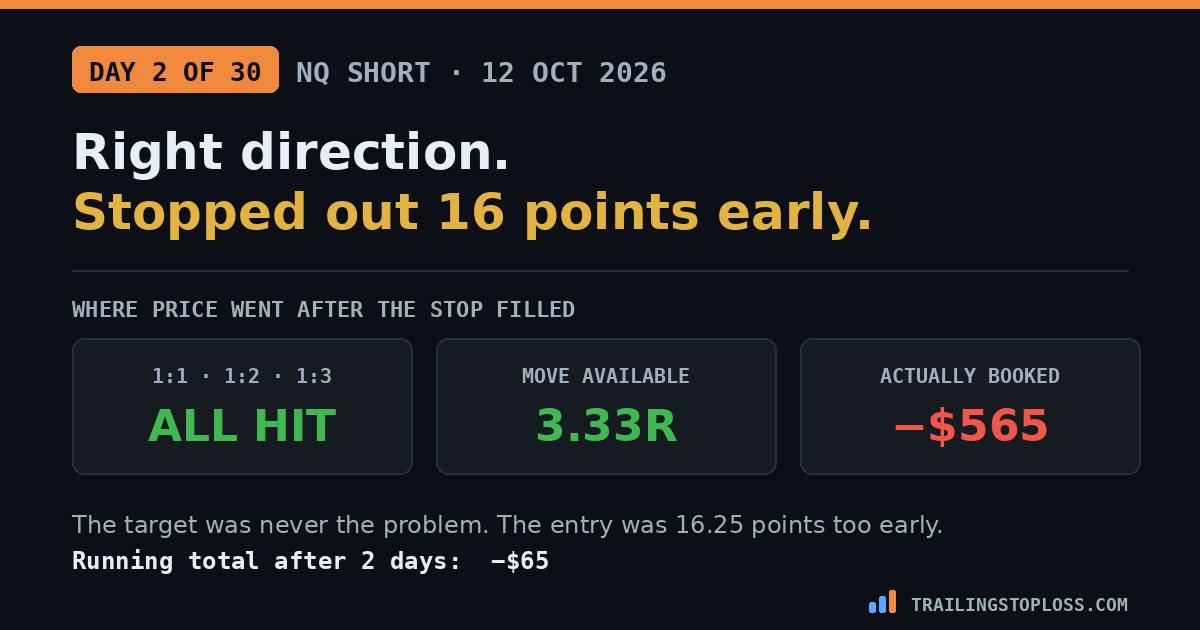
Day 2 of 30: Right Direction, Stopped Out 16 Points Before It Paid
One trade a day, first thirty minutes of the open. A short on NQ with twelve points of entry slippage and 3.25 more on the exit, booked as a $565 loss. Then price kept going — through 1:1, through 1:2, and through 1:3, bottoming 111 points below where the stop filled. The move was worth 3.33R from the actual entry. The stop got hit 16.25 points before it turned.
The target width was never the problem on this trade. The entry was early, and early is indistinguishable from wrong until it isn’t.
The trade

Both fills slipped against the position. A sell stop becomes a market order the instant it triggers, so it fills where price is rather than where you typed it — the same mechanic that makes stop losses expensive, here applied to the entry. For a short, filling twelve points lower is twelve points worse. The exit then filled 3.25 points past the stop, turning a designed $500 loss into $565.

Then the market did exactly what I thought it would
After the stop filled at 30,994.25, price fell to 30,882.75 — 111.5 points below the exit.

All three targets cleared — from the actual entry, not just the intended one. The trade I wanted to be in was worth $1,665 on a single contract. I booked −$565, a $2,230 swing, and the only thing separating the two was 16.25 points of timing.
So why not just get back in?
Because the rule is one trade a day, and I’d taken it.
I watched the rest of that move with no position on. Every point of it was visible in real time, the thesis was intact, and re-entering would have been the easiest decision of the morning — which is exactly why the rule exists. It was written down before the first trade, and a rule that only binds on the days it costs nothing isn’t a rule.
It’s worth being precise about what re-entry would have been. Not a plan — a reaction to having just lost. The setup that triggered the original entry had already played out; what remained was a trader who had been proved right about direction and wanted paying for it. That impulse has a name and a cost, and “I was right, I just need to get back in” is how a one-trade loss becomes a three-trade day.
There’s a second reason specific to this test. Thirty single trades taken the same way is a sample. Thirty days of variable re-entries is a record of how I felt each morning, and it can’t answer the question the experiment was built to ask.
Being right about direction and losing money is not bad luck, and it isn’t a near miss. It’s the normal outcome of entering before the market agrees with you. The stop did precisely what it was placed to do. The alternative — a wider stop that would have survived — is a different trade with worse risk, not a free improvement.
What this means for the test
This cuts against my own prediction, which is the point of writing the rules down first.
I predicted 1:1 would win on this window because the opening is mean-reverting and wide targets need a fat right tail. Day two produced exactly the tail I said wouldn’t be there — a 3.33R move inside the session. Had the entry held, every target would have paid, and the wider ones would have paid more.
But the logged result is a loss at every target, because the stop came first. That distinction matters and it’s a measurement problem I hadn’t planned for:
| Day | Booked | 1:1 | 1:2 | 1:3 | Note |
|---|---|---|---|---|---|
| 1 — 9 Oct | +$500 | Hit | No | No | Clean |
| 2 — 12 Oct | −$565 | Stopped | Stopped | Stopped | All three reached later |
| Running | −$65 | 1 of 2 | 0 of 2 | 0 of 2 |
The test was designed to measure how far price travels from a given entry. It can’t separate “the target was too wide” from “the entry was too early,” and day two is entirely the second. I’m adding a column for it rather than pretending the distinction doesn’t exist: maximum favorable excursion after the stop, logged whenever a stopped trade subsequently reaches its targets.
What I’d change
- Not the target. Nothing here argues for a different target — it argues for a different entry. Widening the target wouldn’t have helped, because the stop was hit first either way.
- Not the stop. Twenty-five points was the planned risk and it did its job. A stop placed wide enough to survive this would have been wide enough to change the trade’s whole arithmetic.
- The entry trigger, possibly. A stop entry participates immediately and pays in price. Twelve points of slippage on a 25-point stop is almost half a R surrendered before the trade starts.
- Nothing, for now. Two trades. The rules stay as written for the full thirty, including on the days they cost money — otherwise the result measures my reactions rather than the method.
The honest limits
The counterfactuals are reconstructions. “Would have reached 1:3” assumes the position survives untouched to the session low, which is true of the price path but still not a filled order.
Two trades is a log, not data. Day one supported my prediction and day two undermined it. Both are noise at this sample size, and reading either as a signal would be exactly the error the thirty-day structure exists to prevent.
And “I was right, just early” is the most seductive sentence in trading. It’s true here and it’s also what every losing trader says. The only thing that makes it worth publishing is that the number in the account is still −$565.
The short version
Day two: short NQ, sell stop placed at 30,978 and filled at 30,966 — twelve points of slippage against the position — with the exit stop filling 3.25 points late at 30,994.25 for a booked loss of 28.25 points, or $565 against a designed $500. Price then fell to 30,882.75, which is 111.5 points below the stop-out and clears 1:1, 1:2 and 1:3 from the actual entry. The move was worth 83.25 points, 3.33R, or $1,665 on one contract — a $2,230 swing from what was booked, decided by 16.25 points of timing. This contradicts my pre-registered prediction that the opening window wouldn’t produce the tail wide targets need, which is why the prediction was published first. It also exposes a gap in the test: it cannot separate “target too wide” from “entry too early,” so maximum favorable excursion after a stop is now logged separately. The rest of that move was watched with no position on — one trade a day, already taken. Running total after two days: −$65.
Frequently asked questions
What happened on day 2 of the test?
A short on NQ was entered by sell stop placed at 30,978 but filled at 30,966, twelve points worse for a short. The stop filled 3.25 points late at 30,994.25 for a loss of 28.25 points, or $565. Price subsequently fell to 30,882.75 — below the 1:1, 1:2 and 1:3 targets from the actual entry — making the move worth 3.33R to anyone still in it. The direction was right; the entry was roughly 16 points too early.
Would a wider target have made money on this trade?
No, because the stop was hit before any target. Price did eventually clear 1:1, 1:2 and 1:3, but only after the position had been closed at a loss. Target width is irrelevant when the stop comes first — this was an entry-timing outcome, not a target-selection one, which is a distinction the test was not originally designed to capture.
Should you widen your stop if you keep being stopped out before the move?
A wider stop is a different trade, not a free improvement. It changes the risk on every trade you take, so the extra room has to be paid for by a smaller position or accepted as a larger loss when it is hit. The cheaper fix is usually entry timing — waiting for confirmation rather than anticipating it — because that improves the outcome without altering the arithmetic of every other trade in the sample.
Why not re-enter after being stopped out?
The test is one trade a day and it had been taken. The rest of the move was watched with no position on. Re-entering would not have been a plan but a reaction to having just lost — the original setup had already resolved, and what remained was the urge to get paid for being right about direction. It would also have broken the experiment: thirty single trades taken identically is a sample, while thirty days of variable re-entries measures how the trader felt each morning.
Why log a trade where you were right about direction?
Because the account doesn’t record direction, it records fills. Being right and losing money is the normal consequence of entering before the market agrees, not bad luck or a near miss. Logging it as a loss — and separately recording how far price travelled afterwards — is the only way to tell later whether the method’s problem was target width or entry timing.
Related on this site: the 30-day test method · day 1 · why slippage only hurts one side · should you trail your stop
All prices and timestamps are from the broker order log for CME_MINI:NQ1! on 12 October 2026; times are US Central. Dollar figures assume one full-size NQ contract at $20 per point. Target outcomes after the stop are reconstructed from the subsequent price path, not from filled orders. Demo account. Two trades is a log, not evidence. Nothing here is financial advice. Futures trading carries substantial risk of loss.