You Will Never Get Comfortable With Losing. Build For That Instead.
The standard advice is to make peace with losses. The evidence says you won’t — professional futures traders tested in a lab showed more loss aversion than students, not less. What separates the people who last isn’t comfort. It’s structure that holds while they’re uncomfortable.
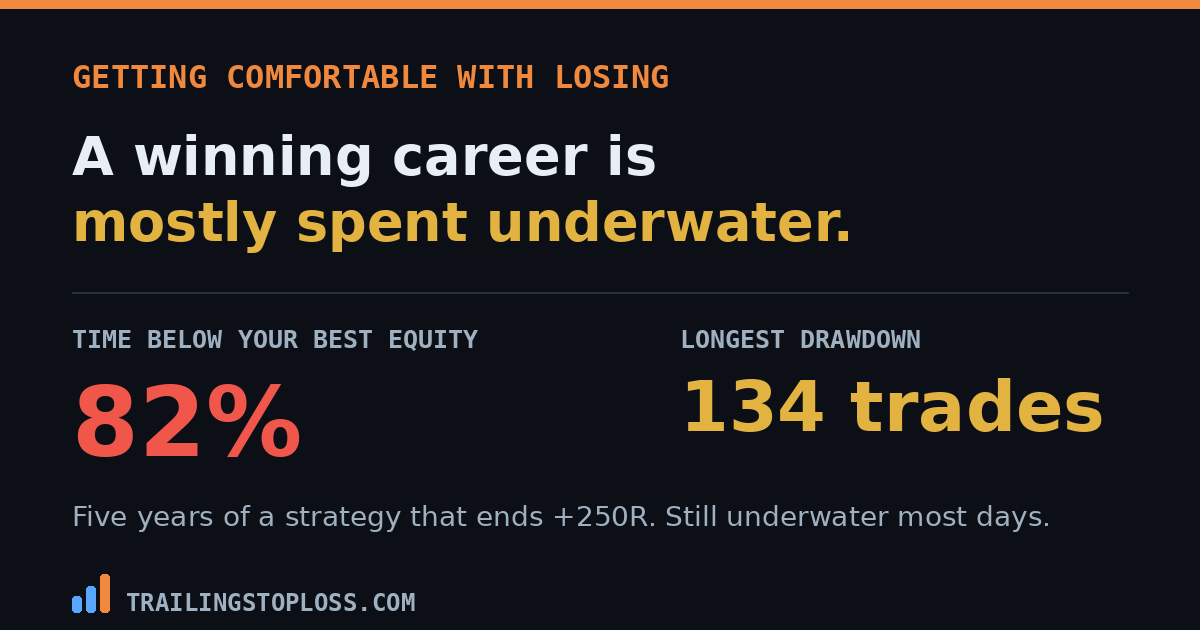
Simulate five years of a strategy that works and you spend 82% of it below your best-ever equity.
What losing actually looks like when you’re winning
Take a genuinely profitable approach — 40% win rate at 2:1, an expectancy of +0.20R per trade — and run it for 1,250 trades, roughly five years at one trade a day. Across 3,000 simulated careers, every single one finished profitable, with a median result of +250R.
Here’s what those winning careers felt like from inside:
| Measure | Result |
|---|---|
| Careers that finished profitable | 100% |
| Individual trades that lost | 60% |
| Time spent below the previous high-water mark | 82% |
| Longest single stretch underwater (median) | 134 trades |
| Longest stretch, worst 10% of careers | 241+ trades |
Read the third row again. Four days out of five, a winning trader is worth less than they were at their peak. Not losing overall — just below the best number they’ve seen. And the median worst drawdown lasts 134 trades, which at one trade a day is more than six months of trading back to where you already were.
Why “get comfortable with it” doesn’t work
Losses register roughly twice as strongly as equivalent gains. That’s the most replicated finding in behavioral economics, and the natural response is to assume it fades with experience.
It doesn’t. Haigh and List ran a loss-aversion experiment on professional futures and options traders from the Chicago Board of Trade and published the results in the Journal of Finance. The professionals didn’t show less myopic loss aversion than student subjects. They showed more. (Haigh & List, via NBER)
The Brazilian study that followed every new index-futures day trader for three years found the same thing from a different direction: among those who persisted beyond 300 days, there was no evidence of learning. Time in the seat didn’t improve results. (Chague, De-Losso & Giovannetti)
So the advice to make peace with losing asks you to train away something that professionals, after years of daily exposure, still have as strongly as anyone. It’s not a character flaw that you can’t. It’s the base case.
Most retail traders lose money — roughly 20% of day traders profit in a given period and fewer than 1% do so reliably. If you’re new, the honest framing isn’t “losses are part of winning.” It’s that the most likely outcome is that you’re one of the people who doesn’t make it, and that everything below is about giving yourself a chance rather than a guarantee.
What the discomfort actually costs you
Being uncomfortable isn’t the problem. Acting on it is, and it shows up in four predictable ways.
You close winners early. Taking 0.8R instead of 3R raises your win rate about 71% and cuts expectancy about 80%. It feels like discipline. It’s the single most expensive habit in retail trading, and it’s a direct response to the discomfort of watching an open profit fluctuate.
You watch the P&L and it makes it worse. In a controlled experiment where the only variable was how often people saw their results, those who looked most took the least risk and earned the least. Every glance is another chance to experience a loss, and losses count double.
You size up to get it back. Modeling a trader $800 down with five sessions left in a payout cycle, doubling size genuinely does lift the odds of reaching the target — and lifts blowup odds almost as much. It stops being worth it once the account is worth more than about 1.3 further payouts.
You conclude things from twenty trades. A real edge still shows a loss over twenty trades about a quarter of the time. Most strategy changes are made on samples that couldn’t possibly support them.
Build the structure instead
Everything that reliably works shares one property: it removes the decision from the moment you’re least able to make it.
- Size so a normal losing streak cannot end you. Twenty to twenty-five losing trades of room inside your drawdown. At ten, the median year ends your account. This is the highest-value change available and it’s arithmetic, not willpower.
- Hide unrealized P&L. Your stop and target are already placed. The number between them provides nothing you can act on, only evaluations you’ll react to.
- Use a platform lockout, not a promise. A daily loss limit that flattens and locks is a rule that binds without your cooperation — the same mechanism that makes a prop firm’s limits work when your own don’t.
- Set your sample size in advance. Decide the number of trades before you start, and refuse to judge the method or yourself before you reach it.
- Track adherence separately from P&L. Breaking your rules usually pays in the median outcome, so judging by results will teach you to break them. Score whether you followed the plan as its own number.
- Expect the underwater period. If you know in advance that four days in five will feel like giving something back, an ordinary drawdown stops reading as evidence that something is broken.
The goal isn’t to stop feeling the loss. It’s to make the feeling irrelevant to what happens next. A trader with a hard platform lockout and a fixed position size feels exactly as bad as one without them — and does considerably less damage while feeling it.
The honest limits
The 82% figure is a model, not your account. It assumes independent trades at a fixed win rate and payoff. Real results cluster, and real edges drift. The direction is robust — a profitable curve spends most of its life below its own peak — but treat the number as illustration.
Loss aversion research is mostly lab-based. The Haigh and List study is unusually good because it used real CBOT professionals, but it’s still an experiment rather than a measurement of their trading.
And “build structure” is not a promise of profitability. Structure keeps you in the game long enough for an edge to show. It cannot create one. If the edge isn’t there, better rules just slow the loss down — which is worth knowing before you spend years finding out.
The short version
Simulating five years of a profitable strategy — 40% wins at 2:1, ending +250R in every one of 3,000 careers — the trader spends 82% of that time below their previous high-water mark, loses 60% of individual trades, and endures a median worst drawdown of 134 trades. That is what winning feels like from the inside. The advice to get comfortable with it doesn’t survive contact with the evidence: professional CBOT traders tested for loss aversion showed more of it than students, and Brazilian day traders who persisted beyond 300 days showed no measurable learning. The discomfort isn’t trainable, so the answer isn’t comfort, it’s structure — size that survives a normal streak, hidden unrealized P&L, a platform lockout rather than a promise, a sample size fixed in advance, and adherence tracked separately from results. You’ll feel it exactly as much. You’ll just do less damage while feeling it. (Haigh & List)
Frequently asked questions
Can you learn to be comfortable with losing trades?
The evidence suggests not, at least not through exposure. Professional futures and options traders from the Chicago Board of Trade, tested for myopic loss aversion, showed more of it than student subjects rather than less. A study following Brazilian day traders who persisted beyond 300 sessions found no evidence of learning at all. Losses register roughly twice as strongly as equivalent gains, and that doesn’t appear to fade with experience.
How much of the time is a profitable trader losing?
More than most people expect. Modeling a strategy with a genuine edge — 40% win rate at 2:1 — over 1,250 trades, 60% of individual trades lose and the trader spends about 82% of the period below their previous best equity. The median longest single drawdown runs 134 trades, and in the worst 10% of cases over 241. Every one of those simulated careers still finished profitable.
Why do losses hurt more than wins feel good?
Loss aversion: losses register roughly twice as strongly as equivalent gains. Combined with frequent evaluation, it produces myopic loss aversion, where checking results more often leads to taking less risk and earning less. In a controlled experiment where feedback frequency was the only variable, the group that saw their results most often took the least risk and made the least money.
What should I do instead of trying to control my emotions?
Build rules that hold without your cooperation in the moment. Size so twenty to twenty-five losing trades fit inside your drawdown. Hide unrealized P&L, since your stop and target are already placed. Use a platform-level daily loss lockout rather than a promise to yourself. Fix your sample size before you start, and score rule adherence separately from profit — because breaking the rules usually pays in the median outcome, so judging by results will train you to break them.
Is it normal to lose most of my trades?
Yes, if you’re trading a high reward-to-risk approach. At 40% wins on 2:1, 60% of trades lose and the strategy is still solidly profitable. Win rate on its own says nothing about whether a method works — expectancy does. The practical implication is that losing streaks are routine rather than diagnostic: at that win rate, long runs of consecutive losses are an expected feature of a normal year.
Related on this site: watching your P&L costs you money · why most traders blow their accounts · the odds of becoming profitable · when a losing streak means stopping
Simulation figures come from 3,000 modeled careers of 1,250 trades at a 40% win rate and 2:1 reward-to-risk, assuming independent trades; real results cluster and edges drift, so treat them as illustrating the mechanism. Nothing here is financial advice. Futures trading carries substantial risk of loss.