Why You Trade Worst When You Most Need the Money
There’s a body of research showing that financial pressure doesn’t just make people anxious — it measurably degrades the reasoning they’d need to escape it. Which raises an uncomfortable question about a product built entirely around a deadline, a non-refundable fee and a profit target.
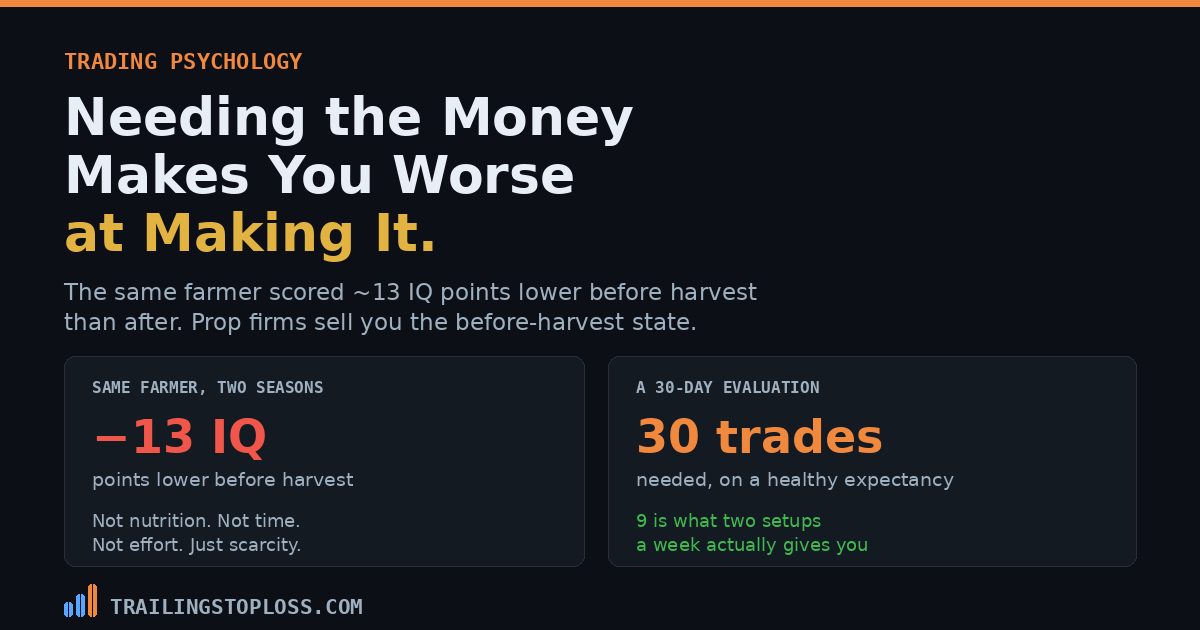
The same farmer, tested twice: sharper after harvest than before. Not better rested, not better fed. Just not broke.
The study
In 2013, Mani, Mullainathan, Shafir and Zhao published results in Science from sugarcane farmers in Tamil Nadu. Sugarcane pays once a year, so the same person is predictably poor before harvest and comfortable after — a natural experiment where the individual is held constant and only the financial pressure changes. (Mani et al., Science, PubMed)
The finding: the same farmer showed diminished cognitive performance before harvest, when poor, compared with after harvest, when rich. And critically, the authors ruled out the obvious alternatives — the gap could not be explained by differences in time available, nutrition, or work effort. (Mani et al., Science)
The tests weren’t about money. Raven’s Progressive Matrices measures fluid intelligence — logical problem-solving in novel situations, independent of acquired knowledge. The spatial incompatibility task and numerical Stroop measure cognitive control: the ability to guide thought and action in line with your intentions, often against your initial impulse. That second one should sound familiar to anyone who has ever held a stop. (Behavioral Scientist)
The commonly cited magnitude is a loss equivalent to roughly 13 IQ points. The companion lab study makes the mechanism clearer still: simply asking people to consider how they’d pay for an expensive car repair impaired performance among lower-income participants but not wealthier ones — and a cheap repair impaired neither. It wasn’t the thinking about money. It was the thinking about money you don’t have. (Science)
Most findings in this field describe a bias you can learn to notice. This one describes a reduction in the capacity you’d use to notice it. Scarcity taxes attention and cognitive control — the exact faculties that let you follow a plan instead of your impulse. It isn’t that pressure makes you emotional. It’s that pressure makes you dumber at precisely the task you’re under pressure to perform.
The trap this creates
Put the finding next to what a trader in drawdown is actually doing, and the loop is obvious.
Now look at what an evaluation actually is
A prop firm evaluation is, structurally, a scarcity generator. A non-refundable fee you’ve already paid. A profit target. A drawdown limit. And on many products, a hard deadline — Apex’s current evaluations expire 30 days from purchase, and new accounts cannot be reset, so failing means buying a fresh one at full price.
None of that is dishonest. It’s a legitimate product and the terms are published. But it is worth being clear-eyed that the conditions the research identifies as cognitively expensive are the same conditions the product is built from. You are being asked to perform your most disciplined trading inside the exact state that measurably degrades discipline.
And the arithmetic of the deadline is worse than it looks. Take a $50K evaluation with a $3,000 target, $2,000 drawdown and a 30-day window, traded by someone with a genuinely healthy expectancy of +0.40R per trade:
| Risk per trade | R needed | Trades required at +0.40R | Setups per week | Losses of room |
|---|---|---|---|---|
| $125 | 24.0R | 60 | 14 | 16 |
| $250 | 12.0R | 30 | 7 | 8 |
| $500 | 6.0R | 15 | 3.5 | 4 |
| $750 | 4.0R | 10 | 2.3 | 2.7 |
Read the top row and the bottom row together. At a sane $125 risk you’d need fourteen setups a week for thirty days — a frequency most discretionary traders simply don’t have. Size up to make the deadline achievable at two or three setups a week, and you’re left with fewer than three losing trades of drawdown room.
Trade your normal size and the window mathematically cannot be met at your setup frequency. Trade the size that meets it and ordinary variance ends the account — because at a 35% win rate, three losses in a row happens roughly one month in four. There is no size that solves both. The deadline, not your psychology, is what creates that.
Tunneling: what scarcity does to attention
Scarcity doesn’t just reduce capacity — it redirects what’s left. The consistent finding is that pressing needs capture attention, which is useful for the urgent thing and costly for everything else. In trading, the urgent thing is the target. The everything else is your process.
That’s why traders under deadline pressure describe the same symptoms: they see setups that aren’t there, hold losers because closing one makes the target harder, and take trades late in the session that they’d never take on day one of a fresh account. None of that is a discipline failure in the usual sense. It’s attention doing what attention does when something is scarce. (Behavioral Scientist)
The compounding cruelty is that the fee is already spent. A non-refundable evaluation puts you in the red before your first trade, which is the break-even state where risk-seeking reliably increases. Deadline plus sunk cost plus a target is three separate pressures pointing the same way.
The honest counterweight
This research has been contested, and an article that cited it without saying so would be doing the thing this site exists not to do.
Wicherts and Scholten published a critique in Science on statistical and psychometric grounds. The original authors responded, showing that the income interaction remained reliable using a continuous income variable, that the cognitive-control results were not driven by ceiling effects, and that the post-harvest improvement was robust to learning effects. Both the critique and the response are in the published record. (Response to comment, Science)
Two further limits worth stating plainly. The study is about acute financial scarcity, not a permanent trait — the same farmer recovered after harvest, which is the entire point and also the hopeful part. And it doesn’t say pressure ruins everyone: plenty of people perform well under deadlines, and the effect is a population average rather than a prophecy about you.
What it does support is a narrower and more useful claim. If you are trading money you need, on a deadline you didn’t set, the environment is working against the specific faculties the task requires — and treating that as a character flaw in yourself is both wrong and expensive. (Mani et al., Science)
What to actually do about it
Most advice here would be “manage your emotions”, which is close to useless if the finding is that your capacity to manage anything is what’s reduced. The interventions that work are structural — they change the conditions rather than asking more of a taxed system.
- Never trade money you need this month. This is the whole article in one line. Not a moral point about discipline — a practical one about the measured cost of needing it.
- Buy an evaluation you could lose twice without caring. If a failed $550 eval would hurt, the $55 coupon-priced version isn’t just cheaper, it’s cognitively cheaper. The fee you can shrug off doesn’t generate the scarcity in the first place.
- Prefer evaluations without a deadline. Several firms have no time limit on the evaluation stage. That single term removes the pressure the table above quantifies, and it costs you nothing to prioritize it when choosing.
- Size for the drawdown, not the target. Pick the risk that gives you eight to sixteen losing trades of room, then accept whatever timeline that implies. If the timeline doesn’t fit the window, the window was never realistic — that’s information, not failure.
- Separate the accounts completely. Trading capital and living expenses in the same mental bucket is what turns an ordinary drawdown into a scarcity event.
- Write the plan when you’re not under pressure. Decisions made in a low-scarcity state and followed mechanically later are the direct workaround for reduced in-the-moment control. That’s the same logic behind writing the trade before the open.
If you’ve traded well on a demo and badly on a funded account with a deadline, the usual explanation is that you “can’t handle real money”. The research suggests something less damning and more actionable: the two situations weren’t testing the same person. One had cognitive resources the other didn’t. Change the conditions and you get the first version back.
The short version
Sugarcane farmers tested before and after harvest performed measurably worse when poor — an effect commonly put at around 13 IQ points, and one the authors showed wasn’t explained by time, nutrition or effort. The tests measured fluid reasoning and cognitive control: the capacity to act on your intentions rather than your impulse, which is exactly what following a trading plan requires. That makes financial pressure different from other trading-psychology problems, because it degrades the faculty you’d use to notice it. Prop evaluations concentrate the effect: a sunk fee, a target, a drawdown limit and often a 30-day window, where the arithmetic forces you to choose between a setup frequency you don’t have and a position size that leaves under three losses of room. The fixes are structural rather than motivational — don’t trade money you need, buy an evaluation you could lose twice without flinching, prefer products with no deadline, and size for the drawdown instead of the target. (Mani et al., Science)
Frequently asked questions
Does needing money really make you a worse trader?
The research supports it. Sugarcane farmers in Tamil Nadu, tested before harvest when poor and after harvest when comfortable, performed worse on fluid reasoning and cognitive-control tasks when under financial pressure — the same individuals, with the gap not explained by time available, nutrition or work effort. Cognitive control is precisely what following a trading plan demands, so the pressure hits the exact faculty the task needs.
Why do I trade fine on demo but badly on a funded account?
Partly because they aren’t testing the same cognitive state. A funded account with a sunk fee, a profit target and a deadline creates acute financial pressure; a demo doesn’t. The scarcity research suggests that pressure measurably reduces attention and cognitive control rather than simply making you emotional. That’s a more useful diagnosis than “can’t handle real money”, because it points at conditions you can change.
Are prop firm evaluation deadlines unfair?
Not unfair — the terms are published and the product is legitimate. But they are cognitively expensive, and the maths is unforgiving. On a $50K evaluation with a $3,000 target and 30-day window, a trader with a healthy +0.40R expectancy needs about 30 trades at $250 risk, which is seven setups a week. Sizing up to make it achievable leaves under three losing trades of drawdown room. Choosing an evaluation without a time limit removes that pressure entirely.
How do I stop financial pressure affecting my trading?
Change the conditions rather than trying harder. Don’t trade money you need within the month. Buy an evaluation cheap enough that failing it twice wouldn’t bother you. Prefer products with no deadline. Size for the drawdown rather than the target, and accept whatever timeline that implies. Write your plan when you’re not under pressure and follow it mechanically — pre-made decisions are the direct workaround for reduced in-the-moment control.
Has the scarcity research been challenged?
Yes. Wicherts and Scholten published a critique in Science on statistical and psychometric grounds, and the original authors responded — showing the income interaction held using a continuous income variable, that the cognitive-control findings weren’t driven by ceiling effects, and that the post-harvest improvement survived controlling for learning. Both are in the published record. The effect is also about acute scarcity rather than a permanent trait, and it’s a population average, not a prediction about any individual.
What is tunneling in the context of trading?
Scarcity doesn’t only reduce mental capacity, it redirects the remainder toward the pressing need. For a trader on a deadline the pressing need is the profit target, so attention goes there at the expense of process. That’s why deadline pressure produces the same symptoms across traders: setups appear where there are none, losers get held because closing one makes the target harder, and late-session trades get taken that would never be taken on day one of a fresh account.
Related on this site: the anxiety before the open · daily loss limits and trailing drawdown · start with micros · why consistency reveals an edge · true cost rankings
Worked figures use a $3,000 target, $2,000 drawdown, 30-day window and +0.40R expectancy to illustrate the mechanism; evaluation terms vary by firm and plan, so confirm against your own account. Nothing here is financial or medical advice. Futures trading carries substantial risk of loss.