▸ Trading Psychology
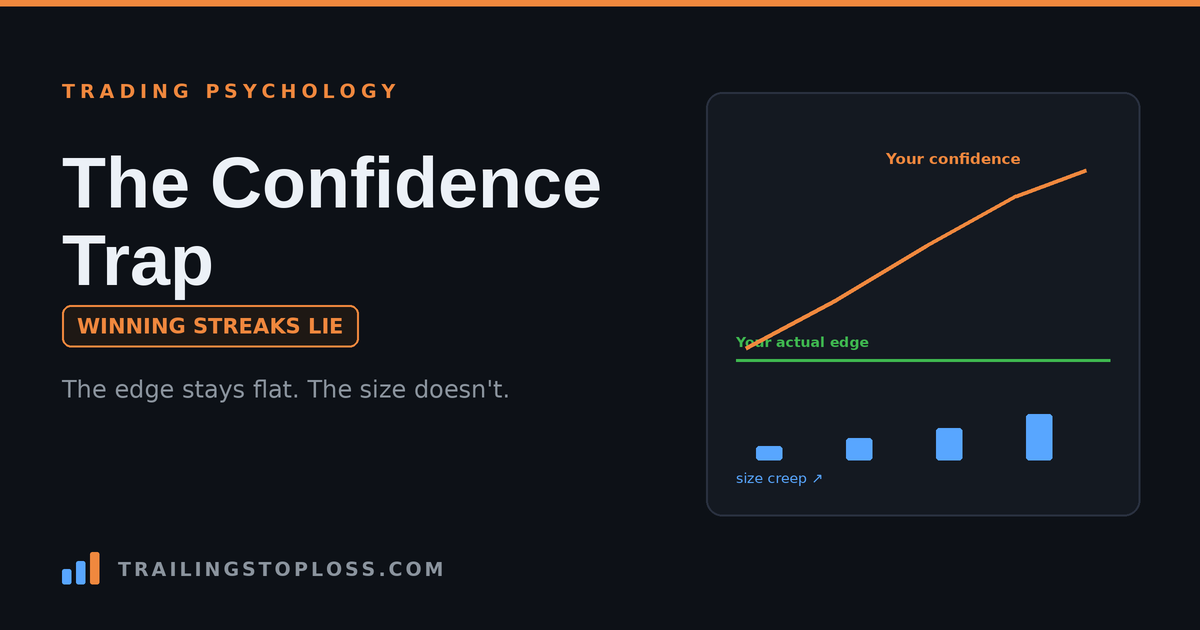
The Confidence Trap
Four wins in a row. The read feels effortless, the entries feel obvious, and somewhere around trade five your size creeps up — just a little, because you’re seeing it clearly right now. That’s the trap closing. The account-killer isn’t the losing streak you white-knuckle through; it’s the winning streak that convinces you the rules were slowing you down. Losing streaks get scrutinized. Winning streaks get celebrated. Which is exactly why the winners are more dangerous.
Why your brain reads noise as skill
The mechanism has a name: the hot-hand fallacy — the belief that a run of success predicts more success. It’s a pattern-seeking bug. Streaks occur constantly in genuinely random processes, but a human brain looking at four green trades doesn’t see variance; it sees evidence. Three repeated outcomes is the threshold where people commonly perceive a “streak,” and from there confidence detaches from the data entirely. (QuantifiedStrategies: the hot-hand fallacy)
Here’s the part that should unsettle you: confidence outpaces evidence. Three wins provide almost no statistical signal about your edge — yet your subjective certainty about the next trade rises sharply. Your long-term stats might show a 52% win rate across 500 trades, but a five-trade hot streak feels like proof of something the 500-trade sample flatly denies. Recent results get weighted absurdly heavily simply because they’re fresh. (TradesViz: confidence outpaces evidence)
Compounding it is self-serving attribution bias: when trades work, we credit skill; when they don’t, we blame bad luck, the algos, or a manipulated tape. Run that asymmetry for a few weeks and you’ve built a systematically inflated picture of your own ability — one that no losing trade can correct, because losses have already been filed under “not my fault.” (TradesViz: self-serving attribution)
The five tells of size creep
Overconfidence rarely announces itself. It arrives as a series of small, reasonable-feeling adjustments, each one defensible in isolation. Watch for these five — if two or more are true this week, you’re in it. (TradesViz: how overconfidence shows up)
Notice that every one of these degrades your expectancy in a specific, measurable way. Bigger size on lower-quality setups, entered more often, with the stop-discipline loosening. You haven’t found a higher gear — you’ve quietly rebuilt your system into a worse one, using the profits from the good version to fund it.
The cost, in real numbers
This isn’t a soft, feelings-based problem — it’s the single best-documented destroyer of retail returns. Barber and Odean’s landmark work found that the most active 20% of retail traders underperformed the market by 6.5% annually net of costs, and that overtrading driven by overconfidence — not strategy selection — was the dominant predictor of underperformance. The people who traded the most, because they were most sure of themselves, did the worst. (JournalPlus: Barber & Odean, 6.5% annual underperformance)
Now put that in a funded account. Four wins at 1R apiece and you’re up 4R, feeling untouchable. Size up 4× on the fifth setup because it’s “the cleanest one yet,” and a single 1R loss on the chart costs you 4R in the account — the entire streak, gone in one trade you were more confident about than any of the four that worked. On a trailing drawdown, that same trade can drag your breach threshold with it. The streak didn’t just get erased; it financed the trade that erased it.
⚠ The prop-account trapConsistency rules exist precisely because firms know this happens. A 40–50% max-single-day rule doesn’t just cap your upside — it’s specifically designed to catch the trader who, riding a streak, swings once for the fences. The rule that feels like a handbrake is the firm’s actuarial read on human nature, and they built it because they watched thousands of people do exactly this.
The mirror image: the gambler’s fallacy
The same broken instinct runs in reverse, and it’s worth naming because you’ll recognize it from your losing weeks. The gambler’s fallacy is the belief that after a string of losses, a win is “due” — so you size up to catch the reversion that the market never promised. Hot-hand says the streak continues; gambler’s says the streak must break. Both are the same error: reading a pattern into a sequence that doesn’t have one. (Enlightened Stock Trading: the gambler’s fallacy)
Which is why the fix for both is identical, and why it can’t be “try to feel less confident.” Feelings aren’t the control surface. Size is. If your position size is fixed by rule rather than by mood, then hot-hand and gambler’s fallacy both become harmless internal weather — you can feel invincible or feel owed, and the account doesn’t care either way. (Enlightened Stock Trading: never size up because a win is “due”)
How to survive your own hot streak
The goal isn’t to kill your confidence — you need it to pull the trigger at all (that’s the opposite failure mode). The goal is to make confidence structurally irrelevant to how much you risk. (QuantifiedStrategies: structure over instinct)
- Fix your size before the week starts. Position size is a function of account and stop distance — never of how you feel about the setup. Write the number down. A streak is not new information about your edge, so it is not a reason to change it.
- Journal wins as hard as losses. This is the single highest-leverage habit here, because winning streaks get celebrated instead of examined. For every win, log why it worked — and be honest about whether you were right or just in a favorable regime.
- Trust the sample, not the streak. Print your real stats — win rate and expectancy over 100+ trades — and keep them visible. When five trades scream “you’re on fire,” 500 trades whisper the truth. Believe the 500.
- Cap the day after a big win. Set a hard rule: after a green day above X R, you’re done, or you trade the next session at half size. The most dangerous trade of your month is the one right after your best one.
- Name the streak out loud. Literally say it: “I’m on a four-trade run and my confidence is above my evidence.” Labeling the bias is what breaks its grip — it converts a feeling you’re acting on into a fact you’re observing.
- Ask what a stranger would do. If someone showed you this setup cold, with no streak behind it, would you still take it at this size? If no, you’re not trading the setup. You’re trading the streak.
The bottom line
A winning streak feels like the market confirming you’ve figured it out. It’s usually just variance wearing your face. The danger isn’t that you get confident — it’s that confidence quietly rewrites your risk: bigger size, looser rules, more trades, less scrutiny. Then one ordinary loss arrives at four times its normal weight and takes the whole run with it. Your edge doesn’t get better because you’re hot, and it doesn’t get worse because you’re cold. Fix the size, journal the wins, believe the 500-trade sample over the 5-trade feeling — and let the streak be a nice week rather than the reason you needed a new account. (MindTradr: winning streaks lie)
Keep size honest: pre-commit risk with the Hard-Stop Plan Builder, check your real expectancy on the win-rate & expectancy calculator, and log wins and losses on the P&L Calendar. Part of our trading psychology guide — see also revenge trading, its post-loss twin.
FAQ
What is the hot-hand fallacy in trading?
It’s the belief that a run of winning trades makes the next trade more likely to win. Streaks occur naturally even in random processes, but our pattern-seeking brains read them as evidence of skill. Three consecutive outcomes is typically enough for people to perceive a “streak,” and confidence rises far faster than the actual statistical evidence supports.
Why is a winning streak more dangerous than a losing streak?
Because losing streaks get scrutinized and winning streaks get celebrated. After losses you journal, review, and ask what went wrong. After wins you assume you’ve figured it out — so the behavior that’s quietly degrading your system (bigger size, looser rules, more trades) goes unexamined until a single oversized loss erases the entire run.
How do I know if I’m overconfident?
Look for five tells: size creep (positions drifting up), rule relaxation (criteria loosening), expanded scope (trading untested instruments or setups), risk blindness (dismissing the downside), and overtrading (more setups because everything looks good). If two or more are true during a good run, you’re in the confidence trap.
Does overconfidence actually cost money?
Yes, measurably. Barber and Odean found the most active 20% of retail traders underperformed the market by about 6.5% annually net of costs, and that overtrading driven by overconfidence — not strategy selection — was the dominant predictor of underperformance. The traders most sure of themselves traded the most and did the worst.
How do I stop overtrading after a winning streak?
Make confidence irrelevant to risk. Fix position size by rule before the week starts, journal wins as rigorously as losses, keep your 100+ trade stats visible so five trades can’t outshout them, cap or halve size the session after a big win, and name the streak out loud when you notice it. If you wouldn’t take the setup at that size without the streak behind you, you’re trading the streak, not the setup.
TrailingStopLoss publishes independent, funded-trader analysis of prop firms, strategy, and trading psychology. Educational content only — not financial advice. Trading futures involves substantial risk of loss.


