Which Tradeify Select Account Should You Buy? The 50K, and It Isn’t Close
Four sizes on one checkout page. One is a value trap, one is beaten outright by a cheaper account, and the advertised contract limits would breach three of the four in a single trade. Measured on drawdown bought per dollar and what failing actually costs, the ladder is far less linear than the price suggests.
The 100K is worse than the 50K on value and harder to pass. There is no trader for whom it is the correct answer.
These figures come from Tradeify’s Select evaluation checkout read on 17 October 2026 with the public code GEMS applied. We have no affiliate arrangement with Tradeify, there are no partner links anywhere on this page, and the firm sits on our tracked list at a 4.4 Trustpilot average across roughly 4,700 reviews. This is a straight look at four prices and four drawdowns.
What you’re actually buying
| Select | Price | List | Max loss (EOD) | Target | Target : DD | Reset |
|---|---|---|---|---|---|---|
| 25K | $76 | $109 | $1,000 | $1,500 | 1.50× | $75 |
| 50K | $116 | $165 | $2,000 | $3,000 | 1.50× | $109 |
| 100K | $186 | $265 | $3,000 | $6,000 | 2.00× | $169 |
| 150K | $258 | $369 | $4,500 | $9,000 | 2.00× | $239 |
No activation fee on any of them, and no daily loss limit on any of them — both genuinely good, and both easy to overvalue. The absence of a daily loss limit means nothing if the overall drawdown is tight enough that one bad session ends you anyway, which on these numbers it very nearly is.
Drawdown per dollar, which is the only number that matters
The useful question is not what an account costs. It is how much room to be wrong each dollar buys you, because room to be wrong is the entire product. Divide the max loss by the price:
| Select | Max loss | Price | Drawdown per $1 | Two attempts |
|---|---|---|---|---|
| 25K | $1,000 | $76 | $13.16 | $151 |
| 50K | $2,000 | $116 | $17.24 | $225 |
| 100K | $3,000 | $186 | $16.13 | $355 |
| 150K | $4,500 | $258 | $17.44 | $497 |
The 150K technically wins, at $17.44 against the 50K’s $17.24. That is a margin of one percent. For that one percent you accept a profit target worth 2.00× your drawdown instead of 1.50×, and a two-attempt bill of $497 instead of $225. Paying 120% more to make the test harder is not a value proposition, it is a dare.
The 100K is strictly dominated
This is the part worth staring at. The 100K is worse than the 50K on drawdown per dollar — $16.13 against $17.24 — and it carries the harder 2.00× target ratio. There is no axis on which it wins. A trader who wants more room than the 50K offers is better served by the 150K; a trader who wants value is better served by the 50K.
Because of what it does to the item beside it. Confronted with $116, $186 and $258, the middle option makes the $258 look like a reasonable step up rather than a 120% premium over the sensible choice. A decoy that nobody should buy still earns its place by changing what you think of the one next to it. The 100K is not there to be bought. It is there to be compared against.
The 25K is the value trap
Cheapest sticker price, worst value on the page: $13.16 of drawdown per dollar, 24% behind the 50K. And the reset is the real sting — $75 against a $76 account, so a second attempt costs 99% of the first. Buy a 25K and reset it once and you have spent $151 for $1,000 of room. The 50K costs $116 for $2,000.
It is also the only size restricted to a single mini contract, which sounds like a safety feature and is partly a consequence of there being nothing smaller to offer.
The contract limits are decoration
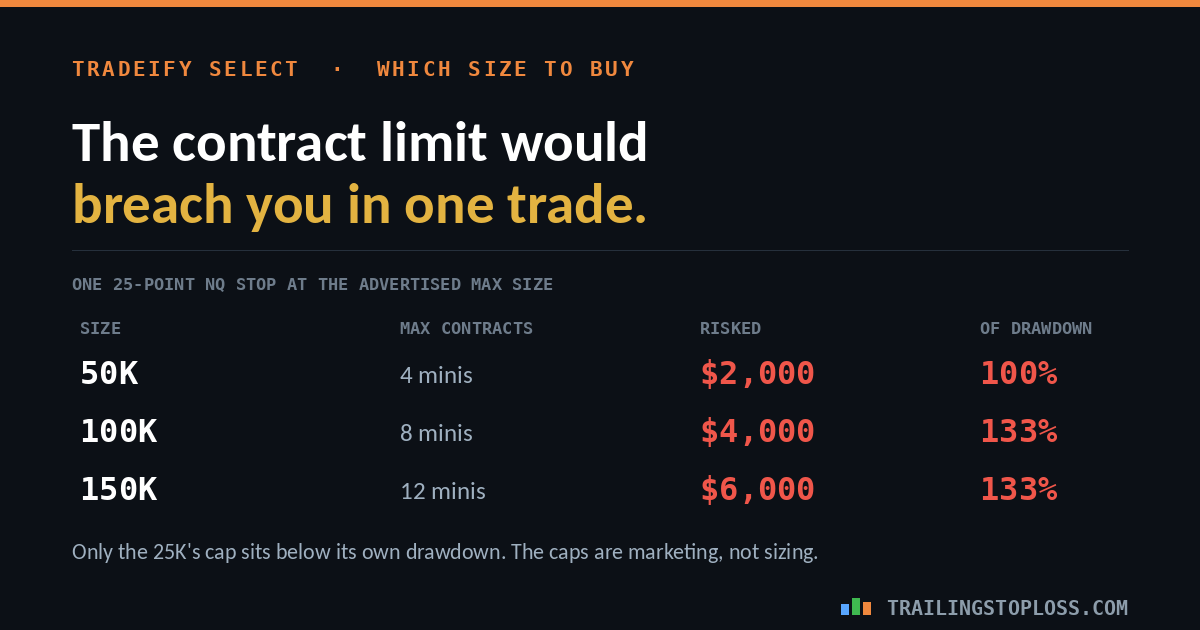
Here is the finding that changed how I read the whole page. Tradeify publishes a maximum position size for each account — 1 mini on the 25K, 4 on the 50K, 8 on the 100K, 12 on the 150K, with ten micros counting as one mini in their own rules documentation.
Now price a single ordinary stop at that maximum. Take a 25-point stop on NQ, which is a perfectly normal intraday stop and the one I use in my own 30-day test. At $20 per point per mini at CME’s contract values:
| Select | Max contracts | One 25-pt stop at max size | Max loss | Share of drawdown |
|---|---|---|---|---|
| 25K | 1 mini | $500 | $1,000 | 50% |
| 50K | 4 minis | $2,000 | $2,000 | 100% |
| 100K | 8 minis | $4,000 | $3,000 | 133% |
| 150K | 12 minis | $6,000 | $4,500 | 133% |
On the 50K, one trade at the advertised maximum, stopped once, is exactly the entire drawdown. On the 100K and 150K a single stop at max size overshoots the drawdown by a third — the account breaches before the stop is even filled. Only the 25K’s limit sits below its own drawdown, and that is because one mini is the smallest number they could print.
I do not think this is a trap so much as an artifact of how these caps get set: they are scaled off notional account size, which has nothing to do with the drawdown, which is the thing that actually kills you. But the effect on a new trader reading “4 minis” as guidance rather than as a ceiling is the same either way. The number tells you what the platform will let you do. It tells you nothing whatsoever about what you can afford.
What these accounts actually support
My own sizing rule is twenty-five losing trades of room inside the drawdown — enough that a normal losing streak is an inconvenience rather than an obituary. At a 25-point stop, one MNQ micro risks $50 at CME’s published micro values, so each account supports:
| Select | Room at $50/trade | Micros at 25R | Verdict |
|---|---|---|---|
| 25K | 20 trades | 0.8 | Can’t support one micro at my rule |
| 50K | 40 trades | 1.6 | One micro, comfortably |
| 100K | 60 trades | 2.4 | Two micros |
| 150K | 90 trades | 3.6 | Three micros |
Note the distance between this table and the previous one. Tradeify will let you trade forty micros on the 50K. The drawdown supports one. That is a factor of forty between what is permitted and what is survivable, and nothing on the checkout page mentions it.
How it compares to FundedNext Flex
Worth placing against the other one-step futures evaluation we looked at recently, FundedNext’s Flex ladder:
| Account | Price | Max loss | Drawdown per $1 | Room at $50/trade |
|---|---|---|---|---|
| FundedNext Flex 50K | $74.99 | $1,500 | $20.00 | 30 trades |
| Tradeify Select 50K | $116 | $2,000 | $17.24 | 40 trades |
| FundedNext Flex 100K | $144.99 | $2,500 | $17.24 | 50 trades |
| Tradeify Select 100K | $186 | $3,000 | $16.13 | 60 trades |
FundedNext is better value per dollar at every rung. Tradeify gives more absolute room at every rung. Which matters depends on what you are short of. If the constraint is cash, FundedNext’s 50K returns $20.00 per dollar and is the best number on either page. If the constraint is room — and for most people failing an evaluation it is — Tradeify’s 50K buys thirty-three percent more drawdown for forty-one dollars, and a drawdown you don’t breach is worth considerably more than a discount you did.
One asymmetry worth knowing: FundedNext’s resets cost more than the discounted account did, at 109–111%. Tradeify’s resets run 91–99% of the purchase price, which is better, though “slightly less than buying the whole thing again” is a low bar that the entire industry seems determined to limbo under.
Two things to check before you buy
The drawdown does not lock during the evaluation. This one caught me out, because our own firm records carried a note that Tradeify’s drawdown “locks at start plus $100” — which is true, but not of the account you are buying here. Tradeify’s rules state plainly that drawdown never locks on evaluation accounts; the locking behavior applies at the funded stage, and their worked example uses a Growth account rather than Select. So for the entire evaluation, every profitable close drags your breach level up behind you. That is the trailing drawdown mechanic that quietly ends more accounts than bad trading does, and it is live for the whole test.
The consistency toggle is you choosing your own constraint. The checkout offers 40% or 50%, with 40% preselected. Tradeify’s rules documentation lists 40% for the Select evaluation phase. The 50% setting is the looser of the two — it permits any single day to be a larger share of your total profit — which matters a great deal if your P&L is lumpy, and not at all if it is even. Find out what the firm charges you for picking it before you assume the toggle is free. Nobody in this industry hands out slack for nothing.
So which one
- Buy the 50K. Effectively ties the 150K on drawdown per dollar at $17.24, keeps the easier 1.50× target ratio, costs $225 for two attempts instead of $497, and gives forty trades of room at a sane micro size. It is the only size that wins on both axes at once.
- Take the 150K only if you need three micros and have already passed something at a smaller size. The 1% value edge is not a reason; needing the room is.
- Skip the 100K. Beaten by the 50K on value and on difficulty simultaneously.
- Skip the 25K unless $116 is genuinely out of reach. It is the worst value on the page and the reset nearly doubles your outlay.
The honest limits
- These are evaluation economics, not funded economics. Everything above measures the cost of getting funded. What happens afterwards — the $1,000 minimum payout on our records, the funded-stage consistency rule, the payout cadence — is a separate analysis and could reasonably change the ranking.
- Promotional pricing rotates. The GEMS code was live on 17 October 2026. List prices are 30–43% higher and the ratios shift materially at list.
- The 25R sizing rule is mine, not a law. A trader using a 10-point stop reaches entirely different conclusions about which account supports what. The method transfers; the numbers don’t.
- I have not pass-rate tested the 1.50× versus 2.00× target ratio here. When I simulated the equivalent gap on FundedNext it was worth roughly four points of pass rate at the margin — real, but smaller than the pricing differences above. I am assuming it behaves similarly and I have not verified that.
- No affiliate relationship, which cuts both ways. Nothing here is bought. It also means I have no account-manager contact to put the contract-limit question to before publishing, so Tradeify has not had a chance to respond to it.
The short version
- Buy the 50K at $116. Best combination of value, target difficulty and failure cost on the page.
- The 100K is beaten by the 50K on both value and difficulty. It appears to exist to make the 150K look reasonable.
- The 25K is the worst value and its reset costs 99% of the account.
- The advertised contract limits risk 100–133% of the drawdown in a single ordinary stop. They are ceilings, not guidance.
- The drawdown trails for the entire evaluation. It does not lock until the funded stage.
- Against FundedNext Flex: FundedNext is better value per dollar, Tradeify gives more absolute room. Pick by which one you’re short of.
Frequently asked questions
Is the 150K really better value than the 50K?
By one percent on drawdown per dollar, yes — $17.44 against $17.24. That margin is smaller than the error in any assumption underneath it, and it comes attached to a target ratio of 2.00× instead of 1.50× and a two-attempt cost of $497 instead of $225. Treat them as tied on value and decide on the other two columns.
Why does the 100K exist if nobody should buy it?
Possibly nothing more sinister than a price ladder built on notional size rather than on what each rung delivers. But a middle option that nobody should take still does useful work on a pricing page: it reframes the most expensive item as a modest step rather than a large premium. Whether that is deliberate here I can’t say. The numbers are what they are.
Should I actually trade four minis on the 50K?
No. One ordinary 25-point stop at that size is your entire drawdown. The contract cap describes what the platform permits, not what the account can absorb — and on the 100K and 150K the cap exceeds the drawdown outright, so a single stop at max size breaches you before it fills. At a sane risk level the 50K supports about one micro.
Is end-of-day trailing drawdown better than intraday?
Considerably, yes. Your breach level only moves at the close, so an intraday spike in your favor doesn’t permanently raise the floor behind you. But it is still trailing: every profitable close ratchets it up, and on a Select evaluation it never stops doing so. Better than the alternative is not the same as harmless.
Tradeify or FundedNext?
On evaluation economics alone, FundedNext returns more drawdown per dollar at every size while Tradeify gives more absolute room at every size. FundedNext’s resets cost more than the account; Tradeify’s cost slightly less. If you expect to pass first time, FundedNext is cheaper. If you expect to need room and possibly a second attempt, Tradeify’s 50K is the steadier purchase. Neither answer survives a change in promotional pricing, so check both at checkout.
Related on this site: the FundedNext Flex ladder · true cost rankings · how trailing drawdown ends accounts · the flagged list
Prices, drawdowns, profit targets, reset fees and contract limits are taken from Tradeify’s Select evaluation checkout with public code GEMS applied, read 17 October 2026, and cross-checked against Tradeify’s published rules documentation; promotional rates rotate and list prices are substantially higher. Sizing figures assume a 25-point NQ stop with 25 losing trades of room, at CME standard and micro contract values. We have no affiliate relationship with Tradeify and this page contains no partner links. Verify current terms at checkout before purchasing. Nothing here is financial advice. Futures trading carries substantial risk of loss.


