Which FundedNext Flex Account Should You Buy? The Real Numbers, Including the Reset
FundedNext‘s Flex plan comes in 50K, 100K and 150K, currently at 47% off. Measured on what actually matters — drawdown bought per dollar, contracts supportable at sane risk, and the cost of failing — the three are much further apart than the price ladder suggests. And the reset fee, which almost nobody checks before buying, costs more than the discounted account did.
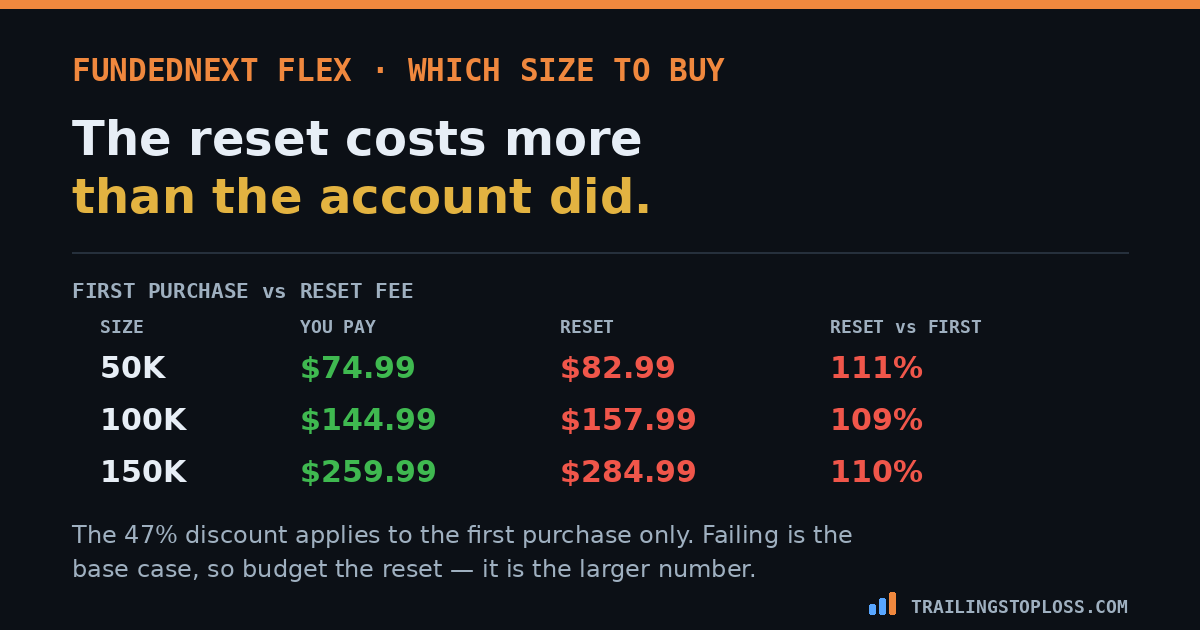
$74.99 to start a 50K. $82.99 to reset it. The discount applies once.
What you’re actually buying
| Flex plan | Price | List | Max loss (EOD) | Profit target | Target : drawdown |
|---|---|---|---|---|---|
| Flex 50K | $74.99 | $141.99 | $1,500 | $2,500 | 1.67× |
| Flex 100K | $144.99 | $273.99 | $2,500 | $5,000 | 2.00× |
| Flex 150K | $259.99 | $490.99 | $4,000 | $8,000 | 2.00× |
All three share the same structure: end-of-day trailing max loss, no daily loss limit, a 40% consistency rule during the challenge that disappears once funded, a 95% reward share, and rewards available in 5 days. Those terms are good — the absence of a daily loss limit in particular removes the rule that ends most evaluations early.
Drawdown per dollar: the 50K wins clearly
The fee is what you pay; the drawdown is what determines whether you survive. The ratio between them is the only efficiency measure that matters.
| Flex plan | Drawdown | Price | Drawdown per $1 of fee | Drawdown as % of account |
|---|---|---|---|---|
| 50K | $1,500 | $74.99 | $20.00 | 3.0% |
| 100K | $2,500 | $144.99 | $17.24 | 2.5% |
| 150K | $4,000 | $259.99 | $15.39 | 2.7% |
The 50K returns $20.00 of drawdown for every dollar spent against the 150K’s $15.39 — about 30% better value for the thing that keeps you alive. The ladder gets worse as you climb it, which is the opposite of how account sizes are usually presented.
The 50K also carries the easiest profit target relative to its own drawdown: 1.67× against 2.00× for both larger plans. You have to make less, proportionally, to pass.
Simulating the pass rate at 25 losing trades of room, the 50K’s easier ratio produces about a 4-point edge at the margin — 37% versus 33% for a break-even trader — and essentially nothing above that. With 25R of room you get enough attempts that the target distance stops being the binding constraint. It’s real, it’s in the 50K’s favor, and it isn’t a reason to choose on its own.
Where the 50K falls down
Contract granularity. At 25 losing trades of room on a 25-point NQ stop, where one MNQ contract risks $50:
| Flex plan | Risk per trade | MNQ contracts at 25R | Platform limit | What you’d actually trade |
|---|---|---|---|---|
| 50K | $60 | 1.2 | 3 minis / 30 micros | 1 micro |
| 100K | $100 | 2.0 | 5 minis / 50 micros | 2 micros |
| 150K | $160 | 3.2 | 8 minis / 80 micros | 3 micros |
The 50K supports 1.2 contracts, which means one. Every trade is all-or-nothing — no scaling out, no partial exits. The 100K is the first Flex plan that supports exactly two micros, and that’s the practical argument for paying the extra $70.
Worth noting the contract limits are never binding for a correctly sized trader. The 50K permits 30 micros and sane risk uses one. If you find the limit relevant, you’re trading roughly twenty-five times the size your drawdown supports.
The reset fee nobody checks
This is the number that should change how you budget, and it isn’t on the pricing cards.
| Flex plan | First purchase | Reset fee | Reset vs first | Two attempts |
|---|---|---|---|---|
| 50K | $74.99 | $82.99 | 111% | $157.98 |
| 100K | $144.99 | $157.99 | 109% | $302.98 |
| 150K | $259.99 | $284.99 | 110% | $544.98 |
Every reset costs more than the discounted account did. That’s not a trick — the 47% discount applies to the first purchase and the reset is priced off something closer to list. But it means the headline price is the cheapest thing you will ever pay here, and the realistic cost of getting funded is roughly double it.
Since failing the first evaluation is the base case rather than the exception, budget the two-attempt number: $158 for the 50K, $303 for the 100K, $545 for the 150K. Measured that way the 150K is no longer a mid-priced account.
So which one
- Buy the 50K if this is your first or second evaluation. Best drawdown per dollar at $20.00, easiest profit target at 1.67×, cheapest to fail on at $158 for two attempts. You’ll be trading one micro, which is restrictive but is also the correct size for a $1,500 drawdown.
- Buy the 100K if you need two contracts. It’s the first size where partial exits become possible, and $17.24 per dollar is still reasonable. The extra $70 buys a position size that divides, not just a bigger number on the badge.
- Skip the 150K. Worst value at $15.39 per dollar, the same 2.00× target as the 100K, and $545 for two attempts. The only reason to take it is the $4,000 withdrawal cap against the 100K’s $2,500 — which matters once you’re consistently hitting the cap, and not before.

FundedNext’s own promotion of the 95% split. The split is the best thing on the page — it is also the number every firm leads with, which is why we measured the drawdown and the reset fee instead. Check current Flex pricing (affiliate link).
All three are end-of-day trailing, which is far better than intraday trailing — your breach level only moves at the close. But it is still trailing, so a strong day raises your high-water mark and pulls the floor up behind it. That mechanic matters more than the choice between these three sizes.
Links to FundedNext on this page are affiliate links and we are paid if you sign up through them. That arrangement has never decided a ranking — the reset-fee finding above is the least flattering thing on this page and it is here because it is true, and we have demoted paying partners to the flagged list for falling below our own rating floor. Current Flex pricing is here — verify at checkout, since promo rates rotate.
The honest limits
These are the discounted prices with code FNFLEX, read 14 October 2026. Promo rates in this sector rotate constantly — the list prices are $141.99, $273.99 and $490.99, and the ratios look considerably worse at those. Verify at checkout before relying on any figure here.
The sizing analysis assumes a 25-point NQ stop and 25 losing trades of room. A different stop distance changes the contract counts proportionally, though not the ranking between sizes.
And we take affiliate commission from FundedNext, disclosed on the page explaining why they’re our top pick, which also covers the five-reward account ceiling that applies to their other plans. The reset-fee finding above is not flattering, and it’s here because it’s true.
The short version
FundedNext Flex at 47% off runs $74.99 for the 50K, $144.99 for the 100K and $259.99 for the 150K, against max loss limits of $1,500, $2,500 and $4,000. Measured as drawdown bought per dollar of fee that’s $20.00, $17.24 and $15.39 — the ladder gets worse as you climb it. The 50K also has the easiest profit target relative to its drawdown at 1.67× against 2.00×, though that’s worth only about four points of pass rate at the margin. Its weakness is granularity: at 25 losing trades of room on a 25-point NQ stop it supports 1.2 micro contracts, meaning one, while the 100K is the first plan supporting exactly two. The finding that should change your budgeting is the reset fee — $82.99, $157.99 and $284.99, which is 109% to 111% of what you paid, because the discount applies to the first purchase only. Two attempts cost $158, $303 and $545. Buy the 50K to start, the 100K if you need two contracts, and skip the 150K.
Frequently asked questions
Which FundedNext Flex account size is best value?
The 50K, measured as drawdown bought per dollar of fee. At $74.99 for a $1,500 max loss limit it returns $20.00 of drawdown per dollar, against $17.24 for the 100K and $15.39 for the 150K. It also carries the easiest profit target relative to its own drawdown at 1.67× versus 2.00× for both larger plans. Its drawback is that it supports only one micro contract at sane risk.
How much is a FundedNext reset?
$82.99 on the Flex 50K, $157.99 on the 100K and $284.99 on the 150K — in every case more than the discounted purchase price, between 109% and 111%. The 47% promotional discount applies to the first purchase rather than resets. Since failing an evaluation is the base case, the realistic cost of getting funded is roughly double the headline: about $158, $303 and $545 for two attempts.
How many contracts can you trade on a FundedNext Flex 50K?
The platform permits 3 minis or 30 micros, but that limit is irrelevant at sane risk. With a $1,500 max loss limit and 25 losing trades of room, risk per trade is $60 — which on a 25-point NQ stop is 1.2 MNQ contracts, meaning one. The 100K supports exactly two and the 150K three. If the contract limit ever feels binding you are trading roughly twenty-five times the size your drawdown supports.
Is the FundedNext 150K worth it?
For most traders, no. It’s the worst value of the three at $15.39 of drawdown per dollar of fee, carries the same 2.00× target-to-drawdown ratio as the 100K, and costs about $545 for two attempts against the 100K’s $303. Its one genuine advantage is the $4,000 maximum withdrawal per cycle against the 100K’s $2,500, which only matters once you are consistently reaching the cap.
Does the FundedNext Flex plan have a daily loss limit?
No. All three Flex sizes show no daily loss limit on both the challenge and funded stages, which removes the rule that ends many evaluations early. There is a 40% consistency rule during the challenge that does not apply once funded, and the max loss limit is end-of-day trailing rather than intraday — meaning the breach level only moves at the close rather than chasing price during the session.
Related on this site: why FundedNext is our top pick · picking a prop firm and account size · true cost rankings · why trailing drawdowns end accounts
Prices, drawdowns, targets, reset fees and contract limits are taken from FundedNext’s Flex checkout pages with discount code FNFLEX applied, read 14 October 2026; promotional rates rotate and list prices are substantially higher. Sizing figures assume a 25-point NQ stop with 25 losing trades of room, at CME standard contract values. Pass-rate figures come from simulation at a range of win rates and are illustrative. This page contains affiliate links to FundedNext and we are paid on sign-ups. Verify current terms at checkout before purchasing. Nothing here is financial advice. Futures trading carries substantial risk of loss.


