Day 5 of 30: 23 Seconds, and the First Day the 1:3 Paid
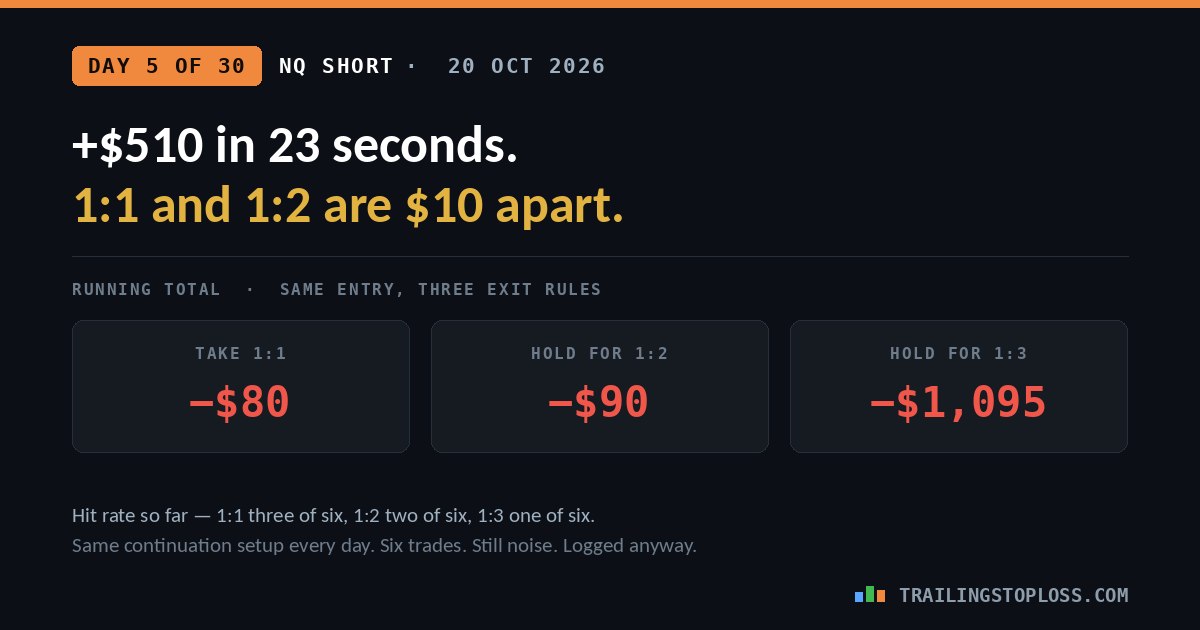
A short at 29,493.00 filled its target at 29,467.50 twenty-three seconds later for $510, and then kept going — clearing the 1:3 level by eighteen points. It is the first winning day for the widest target, and it has pulled the 1:1 and 1:2 running totals to within ten dollars of each other.
Every trade in this test is the same setup — a continuation entry on NQ, one trade a day, 100 ticks of risk. Same strategy, different day. Today is the day it worked.
The trade


The take profit was a resting limit at 29,468.00 and it filled at 29,467.50 — half a point better than the order. That is the first time in this test that slippage has gone in my favor on an exit, and it is worth exactly ten dollars, which tells you roughly how much attention the subject deserves. I report it because I have reported every adverse fill in this series and reporting only those would make the log a complaint rather than a record.
One strategy, five days
Worth stating plainly, because it decides how the table further down should be read: every trade in this test is the same setup. A continuation entry on NQ — waiting for a move to establish and entering on the resumption, rather than trying to be present at the turn — with 100 ticks of risk, one trade a day, in the first part of the session. Days 1 through 5 are one method applied on five different mornings. Nothing has been changed, tuned or swapped mid-test.
The strategy itself is new, in the sense that it is a formalized version of how I have been trading discretionarily for years rather than something with hundreds of logged trades behind it. That is the reason it is being tested in public with a pre-registered method and a published stopping point, instead of being written up as a system that works.
Two things are being measured at once here, and only one of them is the stated subject. The test is designed to compare three exit rules on a fixed entry. But a reader looking at the running total is also, unavoidably, looking at whether the entry itself makes money — and six trades is far too few to say anything about that either.
So the honest position after five days is: no verdict on the targets, and no verdict on the strategy. What the log can honestly offer right now is the raw material, published as it happens, including the days I handled badly.
Consistency of method does not mean consistency of execution. Day 4 was the same setup and went badly for reasons that had nothing to do with the rules: the market was rotating across a fifty-point band, my entries landed inside it, and a twenty-five point stop inside a fifty-point range turns a correct directional read into a coin flip on sequencing. Today the entry sat outside the rotation and the trade never came back to test it. Same strategy. Different quality of entry within it — which is exactly the variable the MAE column below is meant to start capturing.
The widest target finally paid
Price went to roughly 29,400. The levels for this entry sat at 29,468.00, 29,443.00 and 29,418.00, so all three were cleared, the 1:3 by about eighteen points.
| Target | Level | Reached? | Result |
|---|---|---|---|
| 1:1 | 29,468.00 | Yes — filled at 29,467.50 | +$510 |
| 1:2 | 29,443.00 | Yes | +$1,000 |
| 1:3 | 29,418.00 | Yes | +$1,500 |
This is the first of six trades where holding for 1:3 would have been the right call. It is also the single largest day any column has produced in either direction, which is the mechanical reason the table below moved as much as it did.
Where the three strategies stand
| Day | Take 1:1 | Hold 1:2 | Hold 1:3 | What happened |
|---|---|---|---|---|
| 1 — 9 Oct | +$500 | −$500 | −$500 | Reached 1:1, reversed hard |
| 2 — 12 Oct | −$565 | −$565 | −$565 | Stopped first; all levels reached later |
| 3 — 13 Oct | +$500 | +$1,000 | −$505 | Reached 1:2, stopped before 1:3 |
| 4 — 14 Oct | −$1,025 | −$1,025 | −$1,025 | Two trades, both stopped before 1:1 |
| 5 — 20 Oct | +$510 | +$1,000 | +$1,500 | Cleared all three targets |
| Running | −$80 | −$90 | −$1,095 | — |
| Hit rate | 3 of 6 | 2 of 6 | 1 of 6 | — |
Before today, taking the 1:1 was $500 ahead of holding for 1:2. After today it is ahead by ten dollars. One trading day moved the comparison between two strategies by half a thousand dollars, and the strategies themselves did not change at all.
Not “1:2 is catching up.” The lesson is that a single observation can swing a five-day comparison by enough to reverse whatever story you were telling about it. If I had published a verdict on Friday it would have read “take the 1:1, it’s $500 clear.” That verdict survived one trade.
This is the entire reason the test was pre-registered for thirty days with a fixed method and a published stopping point. Not because thirty is a magic number — it is a small sample too — but because committing to it in advance removes the option of stopping on whichever day the numbers happen to flatter the conclusion I want.
The column I promised and did not deliver
Day 4 ended with a commitment to log maximum adverse excursion — how far each trade goes against me before it does anything else — because that is the measurement that actually answers whether a twenty-five point stop is too tight, and I had been guessing at it from charts.
Today’s log does not have it. The trade reached its target in twenty-three seconds and the stop at 29,518.00 was never approached, so the honest answer is “probably almost nothing” — and “probably almost nothing” is precisely the kind of entry that makes the whole column worthless by day fifteen. A measurement you reconstruct afterwards from memory is not a measurement.
From day 6 the number gets recorded at the time, from the chart, before the trade is closed. If it is missing from a future entry in this series, assume I forgot and treat that day’s MAE as absent rather than zero.
Still trading this at the wrong size
This remains one full-size NQ contract, $20 a point, $500 of risk per trade. The day 4 piece made the case for moving to MNQ on survivability grounds: at $50 of risk per trade, a $1,500 prop drawdown holds thirty losing trades instead of three, and the test becomes something a reader could actually reproduce on an account they could actually buy.
I have not switched yet. If it is going to happen, trade six is a much cleaner place to do it than trade twenty — and a rescaling would at least be a clean, declared break rather than a quiet one. Contract size is a pure multiplier, so every point figure and ratio in the table above is identical either way; only the dollar column rescales.
The honest limits
- Six trades. Three winners. Any statement about which exit rule is better would be noise with a decimal point attached.
- The strategy itself is unproven. Six trades is not enough to say the exit rules differ, and it is not enough to say the entry works either. Both are on trial here, and only one of them is the stated subject.
- The 1:2 and 1:3 figures are reconstructed from the price path, not from filled orders. Price trading through a level is not the same as a resting limit being filled at it, though today’s half-point of positive slippage suggests conditions were orderly.
- No MAE recorded, as above. The stop was never near, but that is an observation rather than a figure.
- The low of roughly 29,400 is read off the chart, not taken from a fill. The 1:3 at 29,418.00 clears comfortably on that reading, but “comfortably” is doing some work.
- Demo account, at a contract size no prop account in this test’s price range could survive.
The short version
- Short 29,493.00, target filled 29,467.50, +25.50 points, +$510, held twenty-three seconds.
- Half a point of positive slippage on the exit — the first favorable fill of the series, worth ten dollars.
- Price reached about 29,400, clearing the 1:3 at 29,418.00. First winning day for the widest target.
- Running totals: 1:1 at −$80, 1:2 at −$90, 1:3 at −$1,095. The first two are now ten dollars apart, having been five hundred apart on Friday.
- Same continuation setup as every other day in this test — nothing has been changed mid-sample. The strategy is new, so the running total is a progress note on two unproven things at once.
- MAE still not logged. Starting day 6, recorded live or recorded as missing.
Frequently asked questions
What exactly is the strategy being tested?
A continuation entry on NQ: waiting for a move to establish and entering on the resumption rather than at the turn, with 100 ticks of risk, one trade a day, in the first part of the session. Every trade in this series uses it — days 1 through 5 are the same method on five different mornings. What varies between the three columns in the table is only where the trade is closed.
So is the 1:2 better than the 1:1 now?
No. They are ten dollars apart across six trades, which means they are indistinguishable and will stay indistinguishable for a long time yet. The useful thing the convergence shows is how violently a five-day comparison moves on one observation — the 1:1 was $500 clear on Friday. Treat any running total in this series as a progress note, not a finding.
Why take the 1:1 if the trade cleared 1:3?
Because the test is pre-registered to take the 1:1 live and record where the other two levels would have landed. Taking the 1:1 and logging the rest keeps the comparison honest; switching to whichever target looked best on the day would produce a beautiful curve and no information. The whole point is to find out across thirty trades which rule wins, not to pick the winner trade by trade with hindsight.
What is a continuation entry?
Rather than entering at the edge of a range and hoping the break holds, it waits for a move to establish and enters on the resumption of it. The aim is to have the entry sit outside the rotation rather than inside it. Day 4 shows what happens when that fails: the market was rotating across a fifty-point band, the entries landed inside it, and with a twenty-five point stop the first edge touched decided the trade regardless of whether the read was right.
Twenty-three seconds — is that a normal holding time?
For a twenty-five point target on NQ during the first hour, it is not unusual. Day 3’s winner filled in forty-six seconds. It is worth noticing what that implies about the 1:2 and 1:3 reconstructions though: when a move covers seventy-five points this quickly, the difference between the three exit rules is decided in under a minute, and a trader actually holding for 1:3 would have had almost no time to think about it.
Related on this site: the 30-day test method · day 4 · day 3 · day 2 · day 1 · the no-edge baseline
All prices and timestamps are taken from the broker order log for CME_MINI:NQ1! on 20 October 2026; times are US Central. Dollar figures assume one full-size NQ contract at $20 per point. Outcomes for the 1:2 and 1:3 targets, and the session low, are read from the price path rather than from filled orders. No maximum adverse excursion was recorded for this trade. Every trade in this series uses the same continuation entry on NQ with 100 ticks of risk, one trade a day; the entry method has not changed during the test. The strategy is newly formalized and is itself unproven over this sample. Demo account. Six trades is a log, not evidence. Nothing here is financial advice. Futures trading carries substantial risk of loss.


