MimikTrader vs Every Other Futures Trade Copier: An Honest Comparison
Nine copiers, from $29/month cloud services to $236 lifetime desktop tools. What each one actually costs at scale, which ones enforce risk rather than just copying, and the rule problem that makes half of this irrelevant for some traders.
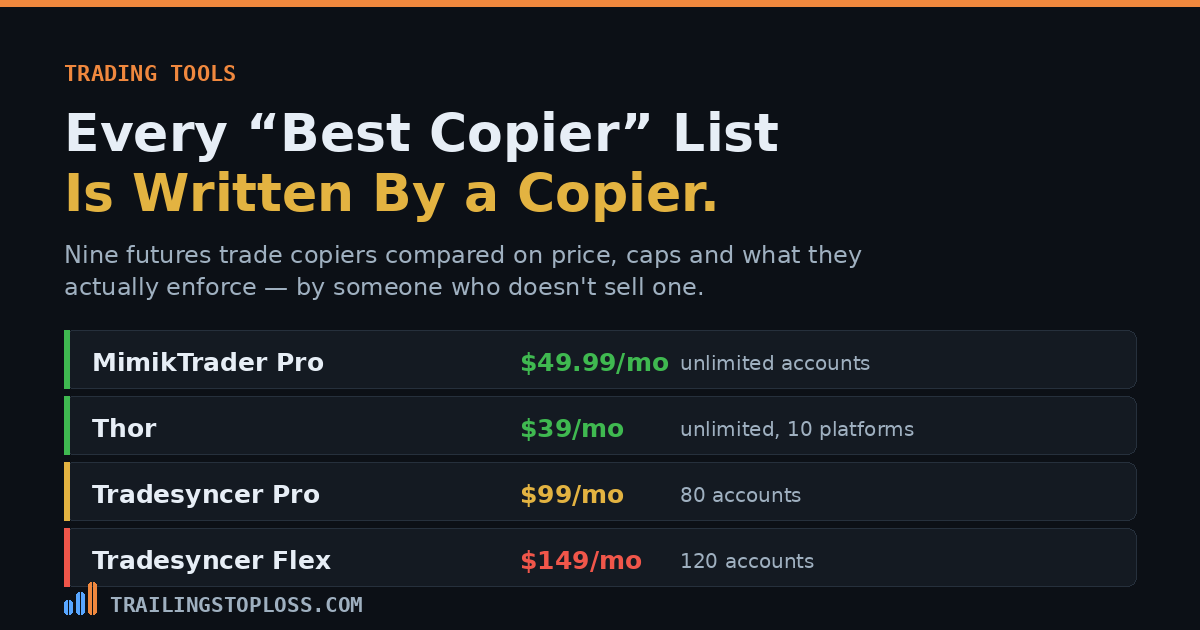
Before anything else: almost every “best trade copier” ranking you’ll find is published by a company that sells one, or by a site earning a commission on the winner. That’s worth knowing before you read theirs — or this one.
Start with who wrote the list
Search for the best futures trade copier and the top results are remarkable for how consistently each one ranks its own publisher first. Thor’s comparison of five copiers concludes that Thor wins on breadth, unlimited accounts and included analytics — and notes it’s the same comparison Thor publishes on its homepage. (Thor)
A Lune-published review of Tradesyncer concludes that Lune’s own copier executes ten times faster than its competitors in production tests. Meanwhile the two most prominent Tradesyncer reviews each carry a discount code — DGT at one site, GUIDE at another — which pay the publisher when you use them. (Lune)
None of that makes the underlying facts wrong. Prices are checkable and features are real. But it does mean the rankings in this category are close to worthless, and the latency claims — 5–10ms here, sub-100ms there — come almost entirely from vendors measuring themselves. Treat every speed number in this article, including the ones below, as a marketing claim until independently tested. (Thor)
TrailingStopLoss doesn’t sell a copier and, at time of writing, has no affiliate relationship with any product below. Prices were verified against multiple independent sources in August 2026 and are listed with their caps, because the headline price in this category is frequently not what you end up paying.
The field, priced honestly
The category splits into three architectures that solve genuinely different problems: cloud services that run without your machine, desktop add-ons that live inside NinjaTrader, and copiers bundled into a platform you’re already paying for. (FinSeeds)
| Product | Type | Price | Account cap | Risk enforcement |
|---|---|---|---|---|
| Tradovate Group Trade | Native (built in) | Free | Accounts under one login only | None |
| MimikTrader Starter | Cloud | $29/mo | Unlimited per connection, 5 connections | None on Starter |
| MimikTrader Pro | Cloud | $49.99/mo | Unlimited accounts & connections | Live, per tick + journal |
| Thor | Cloud | $39/mo | Unlimited, 10 platforms | Analytics + logger |
| Tradesyncer Basic | Cloud | $49/mo | 2 connections, 20 accounts | Risk controls included |
| Tradesyncer Pro | Cloud | $99/mo | 4 connections, 80 accounts | Risk controls included |
| Tradesyncer Flex | Cloud | $149/mo | Unlimited connections, 120 accounts | Risk controls included |
| Lune | Cloud | ~$39/mo | Multi-account | Bundled journal option |
| Replikanto | Desktop (NT8) | $149/yr | 1 machine; addon for remote | None built in |
| ETP TradeCopier | Desktop | $236 lifetime | 1 machine, 1 connection | None built in |
| PickMyTrade | Cloud | Per login | Unlimited under one login; extra sub per login | TradingView automation |
| Tradecopia | Desktop (local) | Sub-Thor tier | Single-tenant, local | P&L limits, per-account trade counts |
| Tickblaze Ignite | In-platform | With Tickblaze | Native routing | Position caps, inversion |
| OmniProp | In-platform | With WealthCharts | Platform-dependent | Platform-dependent |
Tradesyncer’s three tiers were confirmed at $49, $99 and $149 across four independent sources, with a 20% annual discount and a 7-day trial on every plan — and, importantly, the tiers differ by capacity, not features. Every tier includes copying, brackets, risk management, journal and economic calendar. (Tradecovex)
First: check whether you need to pay at all
Tradovate has a native copying feature called Group Trade, built into the platform you’re already using and costing nothing. Almost no comparison in this category mentions it, for reasons that become obvious once you notice who publishes them. (PickMyTrade)
It has one hard limitation, and that limitation is the entire economics of this market: Group Trade only copies between accounts under a single Tradovate login. It won’t run TradingView strategy alerts, gives you no per-account risk control, and can’t copy across platforms. (PickMyTrade)
Are all your accounts under one login, or several? Multiple evaluations with the same firm typically sit under one Tradovate login — Group Trade may cover you for free. Accounts spread across Apex, Topstep and TradeDay are separate logins at separate companies, and no native feature bridges them. That’s the gap every paid copier exists to fill, and it’s why traders have been asking Tradovate for cross-firm copying for years without getting it.
Note the same constraint reappears in the paid tier. PickMyTrade copies to unlimited Tradovate accounts under one broker login on a single subscription — but a second login requires a second subscription. Read any “unlimited accounts” claim against how many logins you actually hold, because that’s where per-account pricing quietly returns. (PickMyTrade)
Where MimikTrader actually sits
MimikTrader is a cloud copier supporting Tradovate, NinjaTrader, Rithmic and ProjectX, with a live risk engine and a built-in journal on the Pro plan, plus TradingView webhook automation. Starter at $29 is copying only — no risk management, no journal. (MimikTrader)
The $29 headline is misleading if risk enforcement is why you’re here. Starter is copying only — no risk management, no journal. The cheap plan specifically excludes the feature that differentiates the product. Anyone buying MimikTrader for the risk engine is buying Pro at $49.99, and that’s the number to compare against everything else.
Its own homepage benchmarks Pro against Tradesyncer Pro at $99, and that comparison holds up: $49.99 against $99, with unlimited accounts and connections against 4 connections and 80 accounts. On price-per-account at scale, it’s the strongest offer among the cloud services with a risk engine. (Tradecovex)
It is not, however, the cheapest cloud copier. Thor lists at $39/month flat with unlimited machines, connections and accounts across ten platforms, plus API access and a bundled analytics stack — and Lune sits around $39. If raw price and platform breadth are the only criteria, MimikTrader isn’t the winner. (Thor)
MimikTrader is the newest product here and it says so itself — there’s a launch promotion running that gives four weeks free with the code EARLYACCESS instead of the standard 7-day trial. We could find no independent review presence for it: no Trustpilot volume, no third-party latency testing, no published uptime history. For contrast, Tradesyncer claims over a billion trades copied, and Tradecopia carries roughly 283 Trustpilot reviews — including some reporting occasional copy failures and disconnections, which is exactly the sort of detail that only shows up once a product has enough users to generate it. None of that means MimikTrader is worse software. It means nobody outside the company has stress-tested it yet, and it sits between you and a funded account.
Copying is solved. Enforcement isn’t.
Every product here copies trades competently. The real dividing line is whether the software does anything when a copied trade starts breaking your rules — and that’s where the category splits sharply. (MimikTrader)
This is where the case for MimikTrader is strongest, and it isn’t really about price. Multi-account trading multiplies the one mistake that ends funded accounts: a rule breach propagating simultaneously to every account you own. Software that evaluates each account against its own daily loss, drawdown and consistency settings — and flattens the breaching account without stopping the others — is solving the actual failure mode. (MimikTrader)
It also matches something we’ve argued elsewhere: the firm’s daily loss limit is a liquidation threshold, not a risk plan, and your own number should sit well inside it. A risk engine enforcing a self-set limit is that idea implemented in software rather than willpower. See why your daily loss limit should be lower than the firm’s.
What the engine actually checks
“Risk management included” is doing a lot of work in most feature tables, so it’s worth being specific about what MimikTrader claims. Every follower account passes eight pre-trade risk checks before an order is placed, and the rules are then evaluated continuously on every price tick rather than only at entry. (MimikTrader)
The trailing drawdown implementation is the notable part: a real-time equity high-water mark tracked on every tick, described by the company as the same methodology Apex and Topstep use, with positions flattened and the account locked when the threshold is reached. That matters because a brief spike followed by a pullback can breach an intraday trailing account while the trade is still open — the failure mode a copier that only watches fills would miss entirely. (MimikTrader)
Two other rules are unusual enough to call out. It can cap the maximum number of trades per day per account, and it can auto-lock an account once a profit target is reached, which the company frames as preserving gains and preventing overtrading. (MimikTrader)
A daily trade cap and a profit-target lock are the two discipline rules this site argues for most often, turned into software that rejects the order rather than relying on you to decline it at 11am. We’ve made the case that one good trade should end the day and that your loss limit should sit well inside the firm’s. Enforcement beats intention — that’s the whole argument, and it applies whether you’re running one account or nine.
Where your credentials go
Handing a third party trading control of funded accounts deserves more scrutiny than it usually gets, and no comparison in this category covers it. MimikTrader connects to Tradovate through the official OAuth 2.0 flow, so your Tradovate username and password are never stored — the flow issues access tokens held AES-256 encrypted in a credential vault, with no API keys to paste or rotate manually. Access is trading-only; the company states it cannot move funds. (MimikTrader)
That’s a meaningfully better posture than storing broker credentials directly, and it’s a question worth asking of any product on this list before you connect a funded account to it. (MimikTrader)
Tradesyncer includes risk management on every tier too, so this is not a MimikTrader exclusive — the difference is price at scale and whether you need more than 80 accounts. The desktop tools, by contrast, largely don’t do this at all: Replikanto and ETP have no built-in take-profit or stop-loss handling, no analytics and no API. (Thor)
The rule problem that outranks all of this
Here is the part the vendor comparisons skip entirely, and it can make this whole decision moot. Broker compatibility is not the same as firm permission. A copier listing Apex, Topstep or Take Profit Trader as “supported” is telling you the broker connection works. It is not telling you your firm’s rulebook allows what you’re planning. (Prop Firm App)
| Firm | Copier / hedging position |
|---|---|
| FundedNext Futures | Self-copying between your own accounts permitted; copying other traders is not |
| Earn2Trade | Trade copiers forbidden at every stage |
| TradeDay | Hedging between accounts means off-boarding and forfeited profits |
| Apex | Hedging between accounts prohibited; household limit counts entities and spouses |
| Topstep | No hedging across accounts, no coordinated trading with other users |
Copy-trading policy is the single biggest variable between firms, and it decides whether a copier is a productivity tool or a fast route to off-boarding. Verify it against your own account’s terms — not a comparison table, including this one. Our guide to firms that allow multiple challenges covers the account caps and household rules in detail. (Prop Firm App)
Read your firm’s terms on copiers and hedging. Then read them again for the specific plan you’re on, because they differ within firms. A $29 subscription is irrelevant next to forfeiting a funded account’s profits over a rule you didn’t check.
Which one, for whom
- Everything in NinjaTrader 8, one machine, cost-sensitive: Replikanto at $149/year is hard to beat, and it replicates full ATM bracket structures natively. You’re accepting a VPS requirement and no risk enforcement.
- One connection forever, allergic to subscriptions: ETP at $236 lifetime pays for itself against any monthly plan inside a year. Single machine, single connection, nothing else included.
- Cheapest capable cloud option: Thor at $39/month, on breadth of platforms and unlimited everything — if you’re comfortable that the comparison establishing this is Thor’s own.
- Most accounts per dollar with live risk enforcement: MimikTrader Pro at $49.99 with unlimited accounts, versus Tradesyncer Pro at $99 for 80. The clearest value case here, offset by the least track record.
- Longest operating history and largest user base: Tradesyncer, at roughly twice the price for a capped account count. For traders whose funded capital dwarfs the subscription difference, that’s a defensible premium.
- Several accounts at one firm, one login: Try Tradovate’s free Group Trade first. No risk enforcement and no TradingView automation, but it may do the copying you were about to pay $49/month for.
- Already paying for the platform: Check what you have first. OmniProp ships inside WealthCharts and Ignite inside Tickblaze — a bundled copier you already own beats a better one you’re paying twice for.
What none of them fix
A copier multiplies whatever your process already produces. Three accounts running one setup is not three positions — it’s one position in three wrappers, and the loss arrives on all of them at once. Sizing across accounts as though they were a single portfolio is the discipline that makes multi-account trading survivable, and no subscription enforces it for you. (Prop Firm App)
The honest summary of this entire category: copying is a commodity, risk enforcement is the real feature, price differences at scale are large but secondary to your firm’s rulebook, and the rankings you’ll read elsewhere were mostly written by the products being ranked.
The short version
Before paying anything, check whether Tradovate’s free built-in Group Trade covers you — it copies between accounts under a single login, which is often all a trader running several evaluations at one firm needs. Accounts spread across different firms are separate logins, and that gap is what the paid market exists to fill. From there: MimikTrader Pro at $49.99/month with unlimited accounts, a live per-tick risk engine and a built-in journal is the strongest price-per-account offer among cloud copiers that actually enforce rules — roughly half Tradesyncer Pro’s $99 for a capped 80 accounts. Thor is cheaper at $39 with broader platform support; Replikanto at $149/year and ETP at $236 lifetime are cheaper still if you live entirely in NinjaTrader and don’t need enforcement. Its risk engine is more specific than most: eight pre-trade checks, a tick-level equity high-water mark mirroring the methodology Apex and Topstep use, a daily trade cap, and a profit-target auto-lock. Note that the $29 Starter tier includes none of that. MimikTrader’s real weakness isn’t features, it’s that it’s new and unproven — a launch promo is still running and there’s no independent review presence — next to competitors with years of operating history. And none of it matters until you’ve checked whether your prop firm permits copying at all — because Earn2Trade forbids it outright and TradeDay forfeits your profits for hedging between accounts. (Prop Firm App)
Frequently asked questions
What is the best trade copier for futures prop firms?
It depends on architecture more than brand. For NinjaTrader-only setups on one machine, Replikanto at $149/year. For the cheapest capable cloud service, Thor at $39/month. For the most accounts per dollar with live risk enforcement, MimikTrader Pro at $49.99/month with unlimited accounts. For the longest operating history, Tradesyncer at $49–$149/month with tiered account caps. Be sceptical of rankings — most are published by copier vendors or affiliates.
How much does MimikTrader cost compared to Tradesyncer?
MimikTrader is $29/month for Starter (copying only, no risk management or journal) and $49.99/month for Pro (unlimited accounts and connections, live risk engine, journal, TradingView webhooks). Tradesyncer is $49/month Basic (2 connections, 20 accounts), $99 Pro (4 connections, 80 accounts) and $149 Flex (unlimited connections, 120 accounts), with a 20% annual discount. Tradesyncer’s tiers differ by capacity rather than features.
Do prop firms allow trade copiers?
It varies enormously and it is the most important question here. FundedNext Futures explicitly permits self-copying between your own accounts while prohibiting copying other traders. Earn2Trade forbids trade copiers at every stage. Apex, Topstep and TradeDay all prohibit hedging between accounts, and TradeDay treats it as grounds for off-boarding with profits forfeited. A copier advertising your firm as “supported” is describing broker compatibility, not permission.
Does Tradovate have a built-in trade copier?
Yes — a native feature called Group Trade, included free. The catch is that it only copies between accounts under a single Tradovate login, and it offers no per-account risk control, no TradingView alert automation and no cross-platform copying. If you run several evaluations with one firm under one login, it may be all you need. If your accounts are spread across different firms, they’re separate logins and Group Trade can’t bridge them — which is the gap every paid copier exists to fill.
Do I need a VPS for a trade copier?
Only for desktop copiers. Cloud services including MimikTrader, Tradesyncer, Thor and Lune run on their own servers, so copying continues with your machine off. Local add-ons like Replikanto and ETP run on your computer and generally need a VPS for reliable uptime, which adds roughly $60–$100/month and changes the cost comparison substantially.
What’s the difference between a trade copier and a risk engine?
A copier replicates orders from a leader account to followers. A risk engine evaluates each account against its own limits — daily loss, drawdown, consistency — on every fill or tick, and can flatten and lock a breaching account while the rest of the group continues. Most desktop copiers do the first only. MimikTrader and Tradesyncer both do the second; Replikanto and ETP have no built-in stop or target handling at all.
Is it safe to give a trade copier access to my funded accounts?
It depends how the product handles credentials, and it’s worth asking before you connect anything. MimikTrader uses Tradovate’s official OAuth 2.0 flow, so your broker username and password are never stored — access tokens are held AES-256 encrypted and the access granted is trading-only, not fund movement. Products that ask you to enter broker credentials directly are a different risk profile. Whatever you choose, the access is real: a copier can place orders on a funded account.
Can a trade copier enforce a daily trade limit?
Some can. MimikTrader caps the maximum number of trades per day per account and can auto-lock an account once a profit target is reached, alongside daily loss and trailing drawdown limits. That turns two common discipline rules into software that rejects the order rather than relying on you to decline it mid-session. Desktop copiers like Replikanto and ETP have no built-in risk enforcement at all.
Are trade copier latency claims reliable?
Treat them as marketing. Claims of 5–10ms, sub-100ms and similar come almost entirely from vendors measuring their own products, frequently in articles that rank the vendor first. There is no independent benchmarking body for this category. If latency genuinely matters to your strategy, test in simulation on your own connection before committing.
Related on this site: prop firms that allow multiple challenges · your daily loss limit should be lower than the firm’s · prop firm true cost rankings
Pricing verified against publicly listed rates and multiple independent sources in August 2026. Vendors change prices and plan limits frequently — confirm on the vendor’s own site before purchasing. Firm rules on copying and hedging change too; confirm against your own account’s terms. Nothing here is financial advice. Futures trading carries substantial risk of loss.