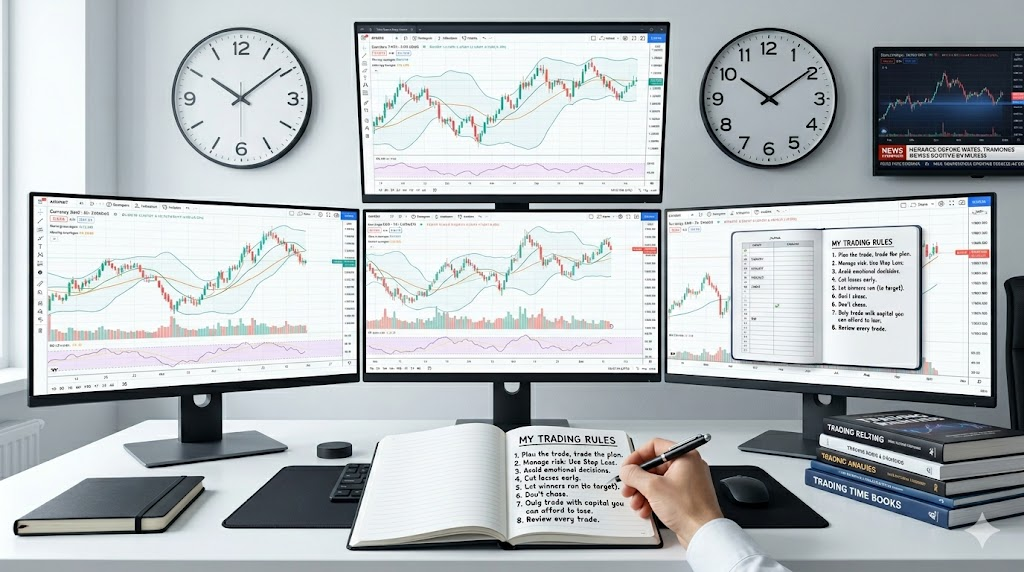
Following rules was something we were all taught at an early age. Don’t run with scissors. Share your toys. Look both ways. And honestly? I ignored most of them. So it should come as absolutely no surprise that when I got into trading, following those rules turned out to be just as hard. Maybe harder — because at least as a kid, there was a teacher watching. In the market, the only person policing you is you. And if you’re anything like me, that’s a terrifying thought.
But here’s the thing: following your trading rules can be the difference between blowing your account and living to trade another day. That’s not a motivational poster — that’s just math. Every time you deviate from your setup, you’re not trading your edge anymore. You’re gambling. And the market is a very bad casino that doesn’t comp your drinks.
Rules don’t limit your trading — they protect it. Structure is not a cage; it’s the foundation everything else is built on.
I have always been a bit of a rule breaker — an outlaw, if you will. The kind of person who reads “suggested serving size” and takes it as a personal challenge. So, learning to follow my trading rules has been a genuinely difficult task, and something I still wrestle with several years into my trading journey. To this day I still find myself wanting to enter trades that don’t align with my setups. I’ll be sitting there, watching a candle form, telling myself all the reasons this one is different. It never is.
Why we break our own rules
Here’s what nobody warns you about: breaking your rules feels great in the moment. There’s a little rush to it. You spot something that’s almost a setup — close enough, right? — and the itch to act is overwhelming. Boredom plays a huge role here. Sitting on your hands during a slow session can feel like defeat, like you’re leaving money on the table. You’re not. You’re protecting your capital. But try telling that to the part of your brain that just watched a ticker move 2% without you.
Overconfidence is the other villain. After a few good trades, a dangerous thought creeps in: maybe I don’t need the rules as much anymore. I’ve had this thought. It has never ended well. The market has a long memory for hubris, and it is absolutely delighted to remind you that last week’s wins have no bearing on today’s trade.
| 01 Define your setups clearly | 02 Write your rules down | 03 Review them before every session | 04 Journal every deviation |
Building a rules-first mindset
The traders who stick around long enough to become consistently profitable share one trait above almost all others: they treat their rules as non-negotiable. Not guidelines. Not suggestions for calm market days. Rules. The kind you actually follow. I know — radical concept.
That doesn’t mean your rules are set in stone forever. As you grow, your edge sharpens and your setups naturally evolve. But here’s the key: changes to your rulebook belong in your journal, during a quiet evening after the close — not in the middle of a live trade when your heart rate is up and you’re trying to talk yourself into something sketchy. Never rewrite the rulebook while the game is in progress.
If full discipline feels impossible right now, start small. Pick one rule — just one — and commit to honoring it for thirty trading days straight. Notice what it feels like to pass on a trade that doesn’t qualify. It’ll be uncomfortable at first. You’ll watch it run without you a few times and question every life choice you’ve ever made. But over time, that restraint stops feeling like sacrifice and starts feeling like control. And control, in this game, is everything.
The market will always offer another setup. Your account, if blown by a string of impulsive decisions, offers nothing. Rules are not the enemy of profit — they are its very stubborn, very unglamorous guardian. Learn to love them. Or at the very least, learn to listen to them — even when the outlaw in you really, really doesn’t want to.


